Have you ever wondered how a large language model actually understands context? It doesn't just read words one by one like a human scanning a page. Instead, it looks at every word in a sentence simultaneously and decides which ones matter most to each other. This magic happens through a process called attention, specifically using three special mathematical tools known as Query, Key, and Value projections. These aren't just abstract math concepts; they are the engine that powers everything from translation apps to creative writing assistants.
When we talk about what these matrices "learn," we are really asking how the model figures out relationships between words during its training phase. The answer lies in how the model transforms raw text into numerical representations that can be compared, searched, and combined. Let's break down exactly how this works without getting lost in overly complex jargon.
The Database Analogy: Understanding Q, K, and V
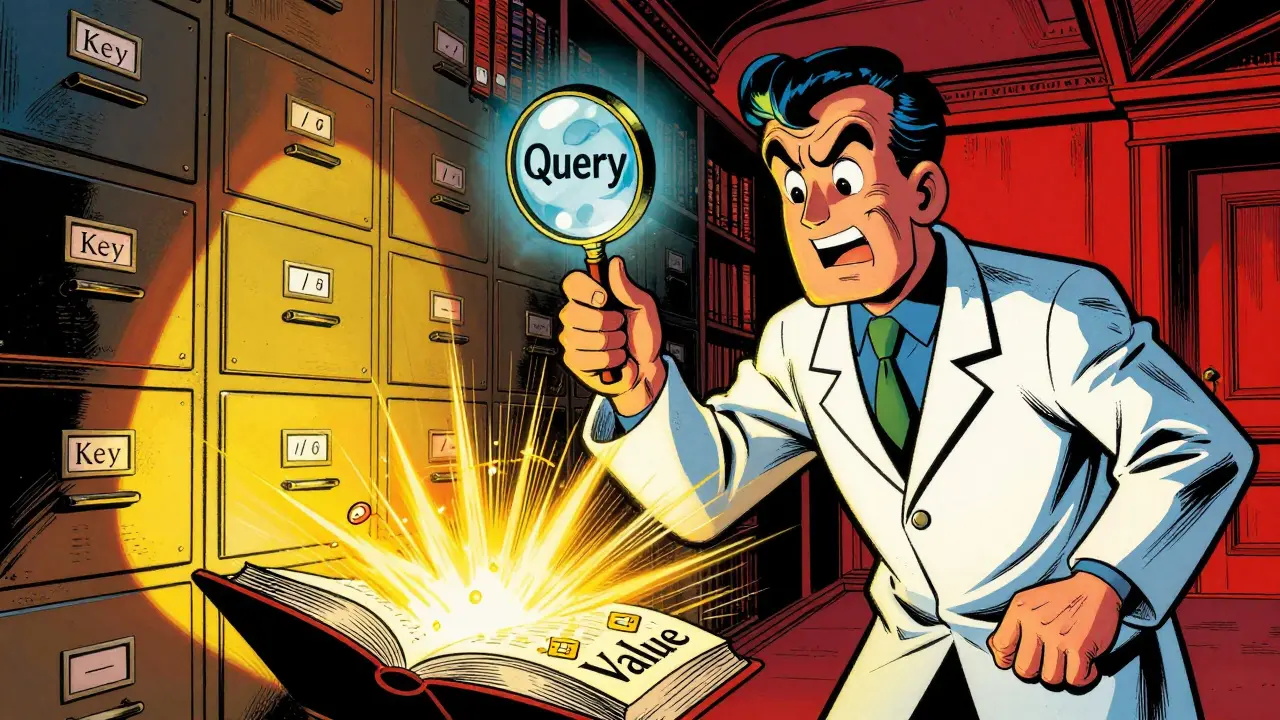
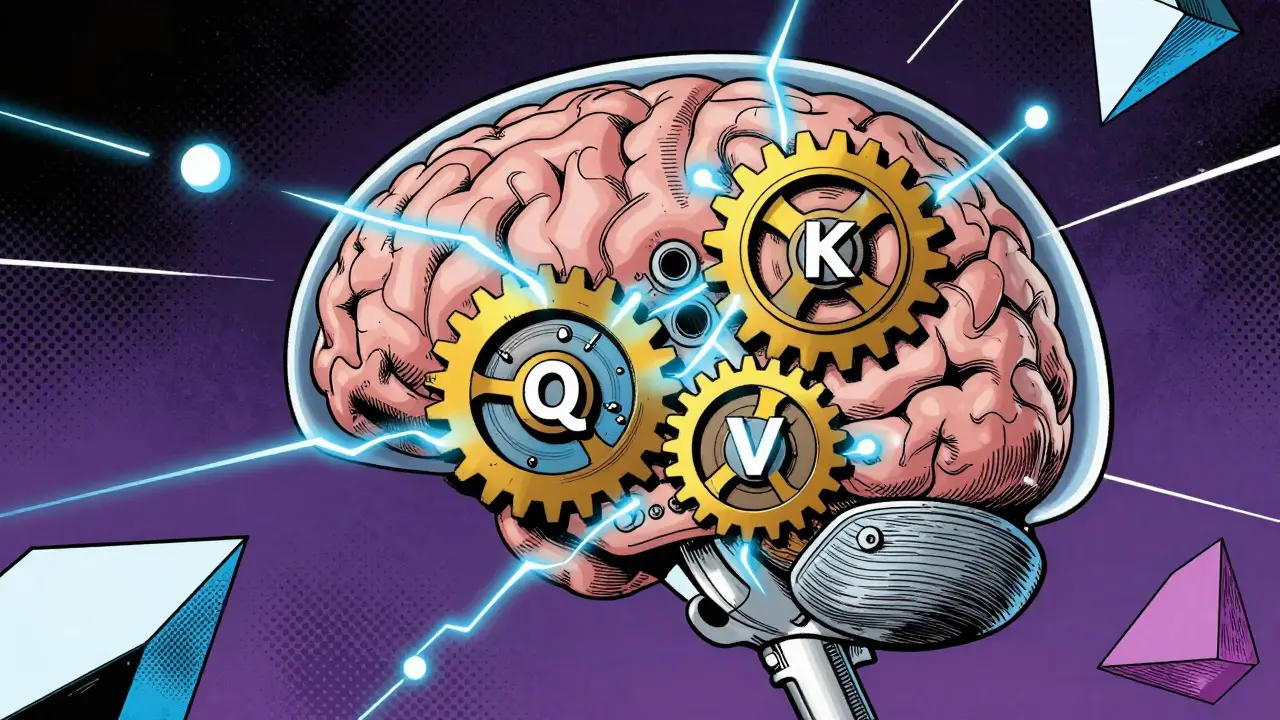
To understand what Query (Q), Key (K), and Value (V) do, imagine you are searching for information in a massive library or database. You don't grab every book on the shelf. You have a specific question in mind, you look for books with matching labels, and then you read the content of those specific books. This is exactly how the attention mechanism works inside a transformer model.
- Query (Q): This represents the "question" a specific token (word or part of a word) is asking. For example, if the current word is "bank," the Query vector asks, "Am I looking for a financial institution or a river edge?" It encodes what the model is currently seeking in the surrounding context.
- Key (K): This acts like the label on the spine of a book. Each token in the sequence has a Key vector that describes its identity and characteristics. If another token is "river," its Key will highlight features related to water and nature, making it easy to match with the "bank" Query if the context suggests geography.
- Value (V): This is the actual content inside the book. Once the model finds a match between a Query and a Key, it retrieves the Value. The Value contains the semantic information that will be used to update the representation of the original token.
This separation of concerns allows the model to efficiently search through long sequences of text. Without this structure, the model would have to compare every piece of data against every other piece blindly, which is computationally expensive and slow. By separating the search criteria (Query) from the searchable index (Key) and the payload (Value), the system becomes highly optimized for parallel processing on modern GPUs.
How the Matrices Are Created: Linear Transformations
Where do these Q, K, and V vectors come from? They start as input embeddings. When you type a sentence, each word is first converted into a dense vector of numbers-a process called embedding. However, these initial embeddings are generic. They don't yet know how to interact with each other in the specific way required for attention.
This is where the learned weight matrices come in. The model uses three separate linear transformations to project the input embeddings into the Query, Key, and Value spaces. Mathematically, this looks like multiplying the input embedding matrix by three different weight matrices:
- $W_q$: The weight matrix for Queries
- $W_k$: The weight matrix for Keys
- $W_v$: The weight matrix for Values
So, $Q = X W_q$, $K = X W_k$, and $V = X W_v$, where $X$ is the input embedding matrix. These weight matrices ($W_q, W_k, W_v$) are not fixed constants. They are parameters that the model learns during training. Each layer in the transformer has its own set of these weights, allowing deeper layers to learn more abstract relationships while earlier layers focus on basic syntax and local context.
The Attention Calculation: Dot Products and Scaling
Once we have our Q, K, and V matrices, the model needs to calculate how much attention each token should pay to every other token. This is done by computing the dot product between the Query vector of one token and the Key vectors of all tokens in the sequence. In matrix form, this is represented as $QK^T$ (Q multiplied by the transpose of K).
The dot product measures similarity. If the Query and Key vectors point in similar directions in high-dimensional space, their dot product will be high, indicating a strong relationship. If they are orthogonal (perpendicular), the dot product will be near zero, indicating no relationship.
However, there's a catch. As the dimension of the vectors increases, the dot products can become very large, pushing the softmax function into regions with extremely small gradients. This makes learning difficult because the updates to the weights become negligible. To solve this, the original Transformer paper by Vaswani et al. introduced a scaling factor. The dot products are divided by the square root of the dimension of the Query vector ($\sqrt{d_k}$). This simple step stabilizes the training process and ensures that the gradients remain healthy throughout the optimization cycle.
After scaling, the results are passed through a softmax function. Softmax converts the raw scores into probabilities that sum to 1. These probabilities are the attention weights. They tell us how much influence each token's Value should have on the final output for the current token.
What Do the Matrices Actually Learn?
This is the core question. During training, the model adjusts $W_q$, $W_k$, and $W_v$ to minimize prediction error. But what does this mean in practical terms?
Query matrices learn to ask relevant questions. For a pronoun like "it," the Query vector learns to emphasize dimensions that correspond to nouns or entities mentioned earlier in the text. It becomes sensitive to grammatical role and semantic category. In later layers, Queries might learn to look for broader thematic connections rather than just syntactic dependencies.
Key matrices learn to encode searchable metadata. A noun like "apple" might have a Key vector that highlights features related to food, technology, or fruit, depending on the context provided by the layer. The Key doesn't contain the full meaning of the word; instead, it contains the "tags" that make the word discoverable by relevant Queries. This is why a single word can participate in multiple types of relationships-its Key can be matched by different Queries in different attention heads.
Value matrices learn to carry contextualized information. The Value vector is the payload. It learns to represent the token's contribution to the overall meaning. When attention weights are applied to Values, the model creates a weighted sum that blends information from multiple tokens. This blended representation is then passed to the next layer. Over many layers, this process allows the model to build up a rich, context-aware understanding of each token.
| Component | Analogy | Primary Function | Learning Objective |
|---|---|---|---|
| Query (Q) | Search Query | Defines what is being sought | Emphasize relevant dimensions for relationship detection |
| Key (K) | Library Label | Encodes identity for matching | Create searchable metadata for semantic/syntactic traits |
| Value (V) | Book Content | Provides the information payload | Carry semantic content optimized for combination |
Multi-Head Attention: Specialization Through Parallelism
In practice, models don't use just one set of Q, K, and V matrices. They use multiple "heads." Each head has its own independent $W_q$, $W_k$, and $W_v$ matrices. This allows the model to attend to information from different representation subspaces at different positions.
For example, one attention head might specialize in tracking syntactic dependencies, ensuring that subjects agree with verbs. Another head might focus on semantic coherence, linking pronouns to their antecedents. A third might track discourse structure, identifying topic shifts. By running these processes in parallel, the model gains a multifaceted understanding of the text.
This specialization is emergent. The model isn't explicitly told to create a "syntax head" or a "semantic head." Instead, through backpropagation, different heads discover that focusing on specific types of relationships helps reduce the overall loss. This is one of the most fascinating aspects of deep learning: complex, specialized behaviors arise from simple, uniform operations repeated across many layers.

Why This Matters for Model Performance
The QKV projection mechanism solves a critical limitation of earlier architectures like Recurrent Neural Networks (RNNs) and Long Short-Term Memory (LSTM) networks. RNNs process sequences step-by-step, maintaining a hidden state that carries information forward. This sequential nature makes them slow to train and prone to forgetting long-range dependencies.
Transformers, by contrast, process all tokens in parallel. The attention mechanism allows any token to directly interact with any other token, regardless of distance. This global connectivity enables the model to capture long-range dependencies effectively. Whether a word appears at the beginning or end of a paragraph, the attention mechanism can link them if their Queries and Keys align.
Furthermore, the differentiable nature of the attention calculation means the entire process can be optimized using gradient descent. The model learns not just the weights of the projections but also the implicit rules for when and how to attend. This flexibility is what allows large language models to generalize so well across diverse tasks, from coding to creative writing.
Practical Implications for Developers and Researchers
Understanding QKV projections is crucial for anyone working with or building large language models. Here are a few practical takeaways:
- Debugging Attention Patterns: Visualization tools can show you which tokens are attending to which others. If a model is failing to resolve a coreference, you might find that the Query for the pronoun isn't aligning with the Key for the antecedent. This could indicate a need for more training data or architectural adjustments.
- Efficiency Optimizations: Since attention complexity scales quadratically with sequence length ($O(n^2)$), optimizing QKV computations is vital for handling long contexts. Techniques like sparse attention or linear attention approximations often involve modifying how Q, K, and V interact.
- Fine-Tuning Strategies: When fine-tuning a model, you're updating these weight matrices. Understanding that $W_q$ controls "what to look for" can help you design better prompts or adapter modules that steer the model's attention toward relevant information.
The elegance of the QKV formulation lies in its simplicity and power. It transforms the abstract problem of contextual understanding into concrete linear algebra operations that are both computationally efficient and highly expressive. As models continue to grow in size and capability, the fundamental principles of Query, Key, and Value projections will remain central to their operation.
What is the difference between Query, Key, and Value in attention?
The Query represents what a token is looking for, the Key represents how a token identifies itself for matching, and the Value contains the actual information content. Think of it like a database search: Query is your search term, Key is the index label, and Value is the document content.
Why do we scale the dot product by the square root of d?
Scaling by the square root of the dimension prevents the dot products from becoming too large. Large values push the softmax function into saturated regions with tiny gradients, which slows down or stops learning. Scaling keeps the values in a range where gradients are meaningful.
Do Q, K, and V matrices change during inference?
No, the weight matrices ($W_q, W_k, W_v$) are fixed during inference. They were learned during training. However, the resulting Q, K, and V vectors change dynamically based on the input text, allowing the model to adapt its attention patterns to each new sequence.
How does multi-head attention improve performance?
Multi-head attention allows the model to focus on different types of relationships simultaneously. One head might track grammar, while another tracks semantics. This parallel specialization provides a richer, more nuanced understanding of the text than a single attention head could achieve.
Can attention mechanisms handle very long sequences?
Standard attention has quadratic complexity, which can be challenging for very long sequences. However, recent innovations like sparse attention, sliding window attention, and linear attention approximations are making it feasible to process much longer contexts efficiently.