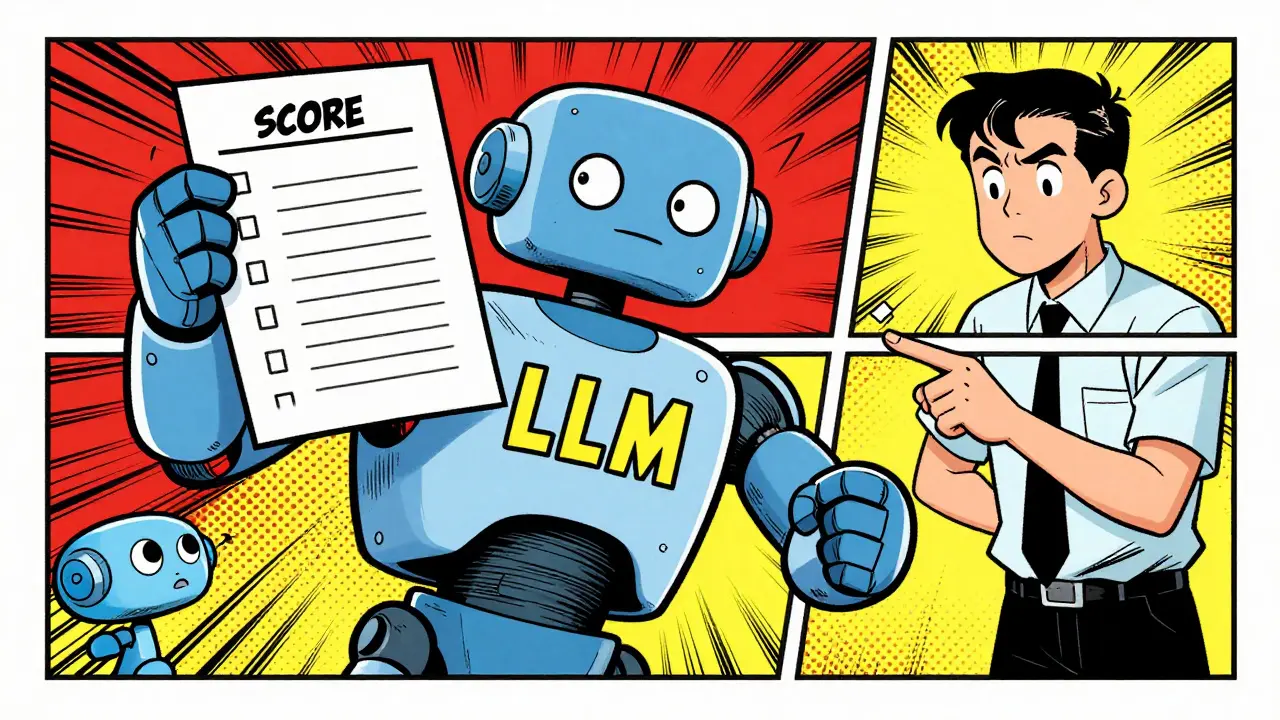
Automated benchmarks are lying to you. You can run your Large Language Model through a standard test suite and get a perfect score, only to have it hallucinate critical facts or produce biased output in production. Purely automated evaluation misses the nuance of human intent, while manual review doesn't scale when you're processing millions of interactions. The solution isn't choosing one over the other; it's building a hybrid system where humans and machines work together.
This is what we call a Human-in-the-Loop (HITL) Evaluation Pipeline. It’s not just about having people check boxes after the model runs. It’s a structured workflow that uses AI to handle the volume and humans to handle the value. By integrating these two forces, you maintain accuracy, fairness, and relevance without burning out your team or slowing down deployment.
Why Automated Benchmarks Fail at Scale
Let's be clear: traditional evaluation metrics like BLEU or ROUGE were designed for machine translation, not for complex reasoning or creative generation. They measure surface-level similarity, not truthfulness or helpfulness. Even newer "LLM-as-a-Judge" methods, where one model evaluates another, have blind spots. An LLM judge might favor verbose answers or struggle with domain-specific jargon it wasn't trained on.
The core problem is context. A machine can count tokens; it cannot always understand sarcasm, cultural sensitivity, or subtle safety violations unless explicitly prompted-and even then, it can miss edge cases. When user behavior evolves, static benchmarks become obsolete overnight. You need an evaluation system that adapts as quickly as your model does. That requires human judgment woven directly into the technical pipeline.
The Three Pillars of HITL Architecture
A robust HITL pipeline operates through three distinct mechanisms. Understanding how they interact is key to designing a system that actually works in the real world.
- Pointwise Evaluation: Here, an LLM evaluates a single output against predefined criteria. For example, you input a document and its summary into a prompt template asking for a clarity score from 1 to 5. The LLM assigns a score and provides justification. This is fast but lacks comparative context.
- Pairwise Comparisons: Instead of scoring in isolation, the evaluator compares two outputs side-by-side. Research shows this method achieves over 80% agreement with crowdsourced human preferences on general instruction-following tasks. It mimics how humans naturally judge quality-by comparison.
- Continuous Monitoring with Escalation: This is the operational layer. The system monitors live traffic, flags anomalies, and escalates uncertain cases to human reviewers. It ensures that evaluation isn't a one-time event but a continuous loop.
The magic happens when you combine these. Pointwise checks filter out obvious errors. Pairwise comparisons refine ranking. Continuous monitoring catches drift. Together, they create a safety net that neither method could provide alone.
Implementing a Tiered Evaluation Strategy
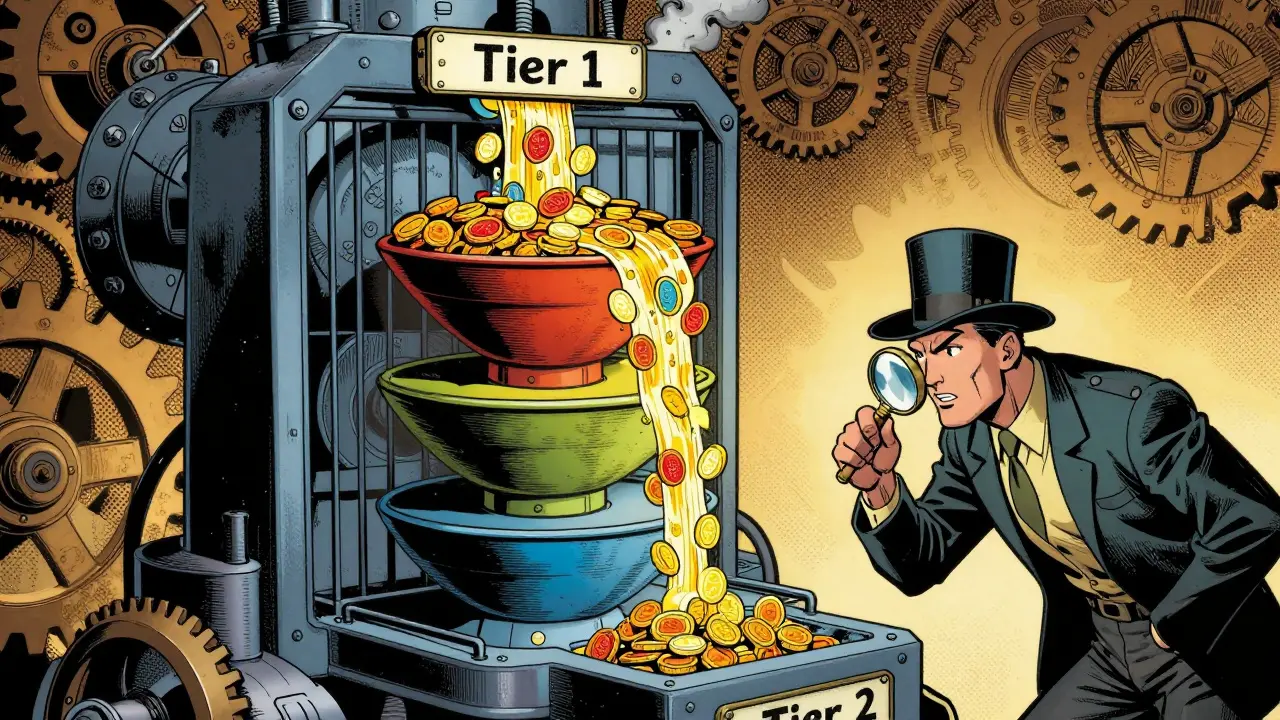
You don't have human experts review every single response. That would be prohibitively expensive and slow. Instead, use a tiered architecture. Think of it as a funnel.
| Tier | Actor | Function | Volume Handled |
|---|---|---|---|
| Tier 1 | LLM-as-a-Judge | Automated screening for basic quality, safety, and format compliance | 80-90% |
| Tier 2 | Human Experts | Review flagged edge cases, ambiguous outputs, and random samples for calibration | 10-20% |
In Tier 1, your automated system handles the bulk of the work. It filters out clear failures-like responses containing personally identifiable information (PII) or completely off-topic gibberish. If the LLM judge is confident, the result is accepted or rejected automatically. If it’s unsure, or if the case falls into a gray area, it gets routed to Tier 2.
Tier 2 is where your human evaluators come in. They aren't just correcting errors; they are providing ground truth labels. These labels are crucial because they recalibrate the automated evaluators. Over time, as humans consistently flag certain types of nuanced errors, the LLM judge learns to recognize them, improving its precision and reducing the load on humans.
Smart Routing: Active Learning and Sampling
Not all human reviews are created equal. To maximize efficiency, you need smart routing strategies. This is where concepts from active learning come into play.
- Uncertainty Sampling: Route outputs where the LLM judge has low confidence. If the model scores a response as 3.5 out of 5, it’s right on the boundary. Humans should review these to clarify the decision threshold.
- Diversity Sampling: Ensure human evaluation covers diverse output types. If you only review common patterns, you’ll develop blind spots. Force the system to pull examples from rare domains or unusual user queries.
- Disagreement Resolution: If multiple LLM judges disagree on the same output, escalate it immediately. This signals a fundamental ambiguity in the criteria or the data that needs human consensus to resolve.
By focusing human effort on these high-value areas, you reduce cost while increasing the signal-to-noise ratio of your feedback. You’re not just checking work; you’re teaching the system what matters.
Closing the Loop: From Feedback to Fine-Tuning
Evaluation is useless if it doesn’t lead to improvement. A true HITL pipeline includes a feedback loop that feeds human corrections back into the model training process.
When a human expert corrects a model’s output, that correction becomes a new training example. In Reinforcement Learning from Human Feedback (RLHF), these corrections shape the reward model, guiding the LLM toward more desirable behaviors. But beyond RLHF, simple supervised fine-tuning can also benefit. If humans consistently flag a specific type of factual error, you can curate a dataset of those corrections and retrain the model to avoid them.
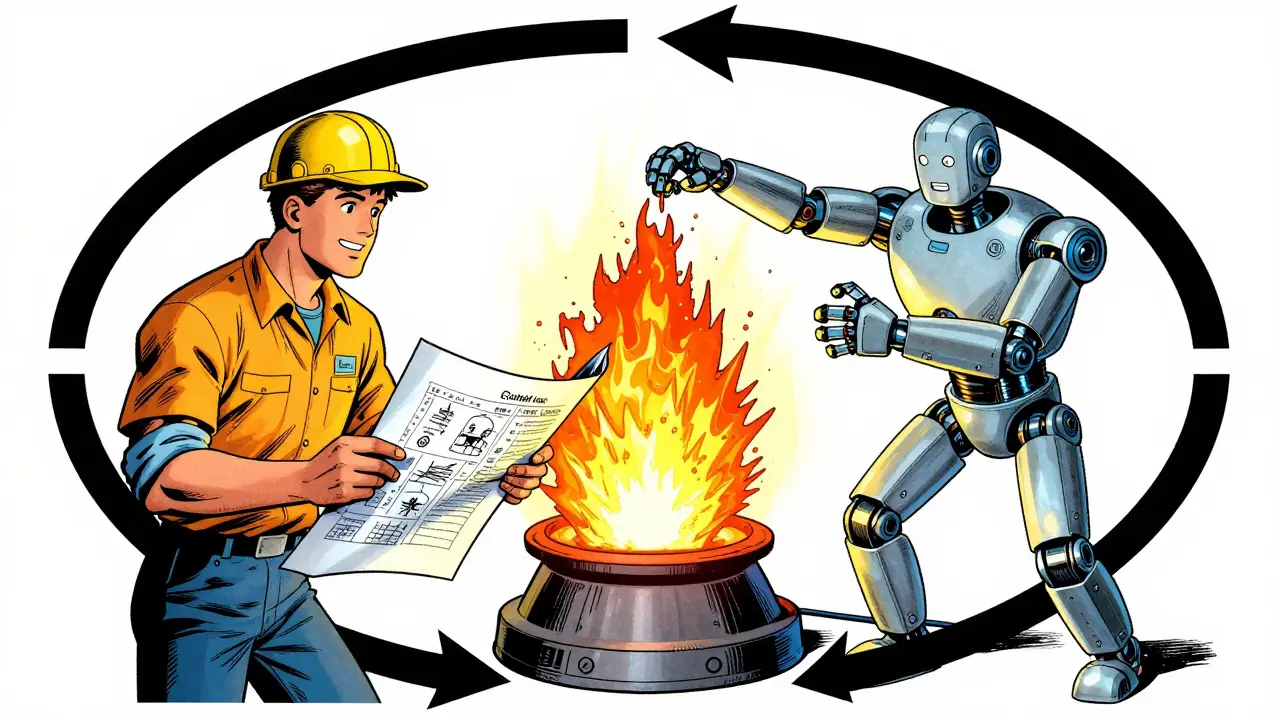
This creates a continuous cycle: Deploy → Evaluate (Auto + Human) → Correct → Retrain → Deploy. Analytics tools track how human input shifts model behavior over time. You gain visibility into where the model struggles and can prioritize fixes based on real-world impact rather than guesswork.
Mitigating Bias and Ensuring Fairness
AI models inherit biases from their training data. Automated systems often amplify these biases because they optimize for statistical likelihood, not ethical correctness. Human-in-the-loop evaluation serves as a critical safeguard.
During the evaluation phase, human reviewers can identify subtle biases that automated metrics miss. For instance, an LLM might generate stereotypical language that still fits grammatical norms but violates company values. Humans catch this. During training, data scientists monitor performance across different demographic groups, tweaking parameters to ensure fairness.
After deployment, any low-confidence predictions or ambiguous cases are flagged for human review. The corrections made by humans are used to retrain the model, gradually reducing bias. This isn't a one-time fix; it's an ongoing commitment to alignment. High-stakes applications, such as healthcare or legal advice, require this level of scrutiny to prevent harmful downstream outcomes.
Practical Steps to Build Your Pipeline
If you're ready to implement HITL, start small. Don't try to automate everything at once.
- Define Clear Criteria: Create detailed rubrics for what constitutes a "good" response. Include examples of edge cases. Ambiguity here leads to inconsistent human labeling.
- Select Your LLM Judge: Choose a strong base model for initial screening. Test its ability to detect obvious errors before trusting it with nuanced judgments.
- Build the Interface: Develop a simple UI for human reviewers. It should show the prompt, the model’s output, and easy ways to annotate or correct errors. Speed matters-if the interface is clunky, reviewers will rush.
- Implement Routing Logic: Code the uncertainty and diversity sampling rules. Start with a high threshold for human escalation to ensure quality, then lower it as the LLM judge improves.
- Close the Feedback Loop: Set up a pipeline to aggregate human corrections and feed them back into your training data. Monitor changes in model performance after each update.
Remember, the goal isn't to replace humans with AI or vice versa. It's to leverage the speed of AI and the wisdom of humans. By building a HITL evaluation pipeline, you create a system that scales without sacrificing quality, ensuring your LLM remains accurate, fair, and useful as it grows.
What is the difference between HITL and standard automated evaluation?
Standard automated evaluation relies solely on algorithms or metrics to score model outputs, which can miss nuance and bias. HITL integrates human experts into the process, using them to review edge cases, calibrate automated judges, and provide feedback for retraining. This hybrid approach balances scalability with depth and accuracy.
How do I decide which cases to send to human reviewers?
Use uncertainty sampling to route cases where the automated judge is low-confidence. Also use diversity sampling to ensure a wide range of output types are reviewed. Additionally, escalate any cases where multiple automated judges disagree. This focuses human effort on the most valuable and ambiguous instances.
Can LLM-as-a-Judge replace human evaluators entirely?
No. While LLM judges are scalable and consistent, they lack true understanding of context, ethics, and subtle bias. They are prone to their own hallucinations and biases. Human evaluators remain essential for high-stakes decisions, nuanced assessments, and calibrating the automated systems to ensure long-term reliability.
What is the role of active learning in HITL pipelines?
Active learning optimizes the selection of data points for human labeling. By identifying the most informative or uncertain examples, it allows the system to achieve higher accuracy with fewer human annotations. This reduces cost and speeds up the training and calibration process.
How does HITL help mitigate bias in LLMs?
Human reviewers can identify subtle biases that automated metrics miss. Their corrections provide ground truth data that can be used to retrain the model, explicitly penalizing biased outputs. Continuous human oversight ensures that the model aligns with ethical standards and organizational values over time.


10 Comments
Dave Sumner Smith
you think this is about safety? its about control. the big tech companies want to keep a leash on every word you type. they call it 'bias mitigation' but its really just censorship wrapped in technical jargon. i see what they are doing. they are building a system where humans act as the enforcers for their algorithmic overlords. you think you are helping by reviewing these outputs? you are training the machine to know exactly how to manipulate you better next time. the 'human-in-the-loop' is just a liability shield. when the AI screws up, they point to the human who approved it. dont fall for the hype. this pipeline is designed to normalize surveillance and sanitize dissent under the guise of quality assurance. we are all just data points in their experiment.
Cait Sporleder
While I appreciate the detailed architectural breakdown provided in the article, one must consider the profound epistemological implications of relying on a tiered system of judgment that inherently privileges automated efficiency over nuanced human discernment. The notion that an LLM can effectively serve as a gatekeeper for truth, even with human oversight, strikes me as somewhat precarious, given that the initial screening is performed by an entity that lacks any genuine understanding of context or moral weight. It is rather fascinating, yet deeply troubling, to observe how we are increasingly delegating the responsibility of ethical calibration to systems that were not designed with ethics as a primary function, but rather with statistical probability. This creates a feedback loop where the definition of 'correctness' becomes circular, defined by what the model has previously been trained to accept, thereby potentially entrenching existing biases rather than mitigating them. We must ask ourselves whether this hybrid approach truly enhances our collective intelligence or merely creates an illusion of rigor while obscuring the subjective nature of evaluation behind a veneer of technical sophistication.
Paul Timms
The distinction between pointwise and pairwise evaluation is crucial for maintaining consistency in large-scale operations. Pairwise comparisons often yield more reliable results because they reduce the cognitive load on reviewers by providing a direct reference point. This method aligns well with established psychological principles regarding relative judgment.
Jeroen Post
the concept of truth is fluid. why do we need humans to judge machines when both are illusions. the pipeline is a ritual to appease the gods of efficiency. we seek order in chaos but create only more complex cages. the human element is the flaw not the fix. we project our biases onto the code and call it alignment. it is a mirror reflecting our own brokenness back at us. stop trying to fix what cannot be fixed. embrace the noise.
Nathaniel Petrovick
Hey everyone, this is actually a super practical guide if you're dealing with real-world deployment issues. I've been working on similar setups and the tiered approach really does save a ton of time. Instead of having experts look at everything, letting the LLM handle the easy stuff makes sense. Just make sure your rubrics are tight so the humans aren't second-guessing themselves too much. Good read!
Honey Jonson
love this idea! its so cool how we can work together with ai instead of fighting it. i think the part about uncertainty sampling is really smart cause it helps focus on the hard stuff. maybe we should all try to build something like this? it feels like a positive step forward for technology and people getting along. hope everyone finds this helpful!
Sally McElroy
It is absolutely imperative that we recognize the moral failing inherent in automating judgment without rigorous ethical oversight; this pipeline, while technically sound, risks perpetuating systemic injustices if the human reviewers are not properly vetted for bias themselves. We cannot simply outsource morality to a 'tiered architecture' and expect fairness to emerge organically from the data; such an assumption is not only naive but dangerously negligent. The article glosses over the critical necessity of diverse representation among the human evaluators, which is essential for catching subtle prejudices that homogeneous groups might overlook entirely. Without this diversity, the 'ground truth' labels become tainted by the very biases we claim to be mitigating, creating a self-reinforcing cycle of exclusion. We must demand transparency in the selection of these human reviewers and ensure that their compensation and working conditions reflect the gravity of their role in shaping societal norms through algorithmic influence.
Destiny Brumbaugh
this is all great for other countries but here in the us we dont need all this hand holding. our models are already better then anyone elses. why waste money on human review when we can just scale up compute? american ingenuity doesnt need crutches. let the market decide what is good output. if it works it works. stop overthinking it and just deploy faster than the rest of the world.
Sara Escanciano
This entire framework is morally bankrupt because it assumes that 'efficiency' is a valid metric for ethical decision-making. You are essentially proposing a system where human dignity is traded for speed and cost savings. The idea that humans should only review 'edge cases' implies that the majority of interactions are disposable, which devalues the human experience itself. We have a duty to treat every interaction with care and respect, not to filter them through a cold, calculating funnel. This approach prioritizes corporate interests over individual rights and will inevitably lead to harm that cannot be undone by a simple retrain button.
Elmer Burgos
i think everyone has some good points here. its definitely a balance between tech and human touch. maybe we can find a middle ground where the tools help us without taking over completely. lets keep the conversation friendly and open to different ideas. peace out