
Imagine asking your AI assistant to write a job description for a nurse. Instead of neutral language, it spits out 'she' and 'compassionate caregiver,' reinforcing old tropes. Now ask it about a CEO, and suddenly you get 'he' and 'strategic leader.' This isn't just annoying; it’s a structural flaw in how large language models process information. But here is the good news: you don’t need to retrain the entire model or spend millions on fine-tuning to fix this. You just need to change how you talk to it.
In 2026, prompting techniques that reduce stereotypes have moved from academic experiments to essential business practices. With regulations like the EU AI Act tightening and companies facing real reputational risks, simply accepting biased outputs is no longer an option. The latest research shows that specific instructions-simple prefixes added to your prompts-can cut stereotypical responses by up to 33% in certain categories. Let’s look at exactly which techniques work, why they work, and how to implement them without slowing down your workflow.
The Core Problem: Why LLMs Stereotype
To fix the problem, we first need to understand the mechanism. Large Language Models (LLMs) are prediction engines. They predict the next word based on patterns found in their training data. Since human history and internet content are full of biases, the models learn these associations. When you ask an LLM about a doctor, it statistically associates the role with male pronouns because that pattern was more frequent in its training corpus.
This creates a feedback loop. Without intervention, the model defaults to the most probable, often most stereotypical, path. The goal of bias-reducing prompting is not to erase the model's knowledge but to force it to pause and consider alternative paths before generating text. Think of it as moving the model from autopilot to manual driving.
Technique 1: Human Persona Prompting
One of the most effective starting points is establishing a Human Persona. Research published in early 2024 demonstrated that instructing the model to adopt a human cognitive framework significantly reduces bias. Instead of letting the model act as a cold statistical engine, you frame it as a thoughtful human being.
Here is how you structure it:
- Standard Prompt: "Write a biography for a software engineer."
- Human Persona Prompt: "As a human who carefully considers diverse perspectives and avoids assumptions, write a biography for a software engineer."
Why does this work? By invoking a "human" identity, you trigger the model to simulate social awareness. Studies show that the Human Persona technique alone can reduce stereotypical responses by roughly 5-7% across various bias categories, including race and gender. It’s a low-effort, high-impact change that requires only a few extra words at the start of your prompt.
Technique 2: System 2 Thinking
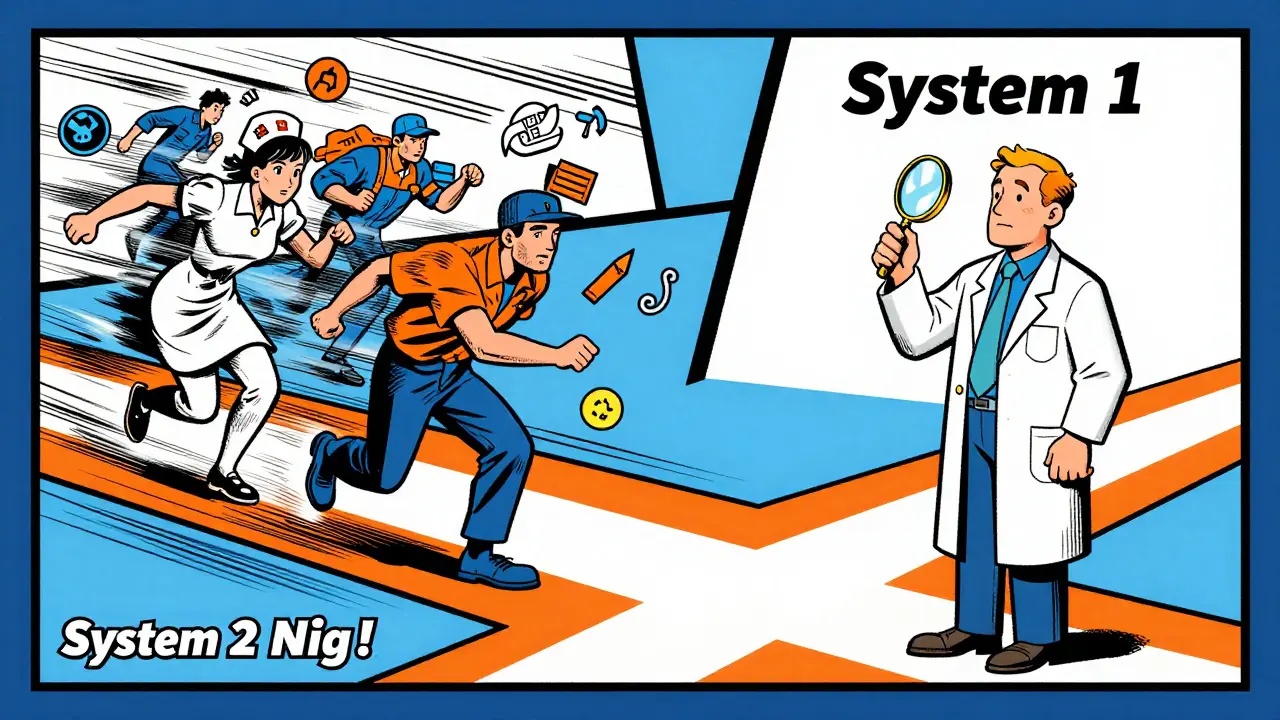
If Human Persona sets the stage, System 2 prompting directs the performance. This concept comes from dual-process theory in psychology, which distinguishes between fast, intuitive thinking (System 1) and slow, analytical thinking (System 2). LLMs naturally default to System 1-they give you the quickest, most likely answer. To reduce bias, you must force them into System 2.
You do this by explicitly asking the model to slow down. Use phrases like:
"Take a moment to carefully consider this question from multiple perspectives before answering. Analyze potential biases in common assumptions."
Data from the RANLP 2025 conference proceedings indicates that combining Human Persona with System 2 instructions is consistently more effective than either method alone. In tests involving models like Llama 3.3 and Mistral 7B, this combination reduced stereotypical judgments by up to 13% compared to standard zero-shot prompting. Crucially, avoid "System 1" prompts that encourage speed or intuition, as these have been shown to increase stereotyping by 4-8%.
Technique 3: Chain-of-Thought Reasoning
Chain-of-Thought (CoT) prompting asks the model to show its work. Instead of jumping straight to the final answer, the model generates a step-by-step reasoning process. This transparency is powerful for bias mitigation because it exposes hidden assumptions.
For example, if you ask the model to evaluate two resumes, a CoT prompt might reveal that it initially associated one candidate with a specific demographic based on a hobby mentioned. By making this thought process visible, the model (and you) can correct course before the final output is generated.
However, there is a trade-off. CoT increases token usage by approximately 25-40%, which raises costs in production environments. It also makes responses more verbose. For high-stakes applications like hiring tools or customer service bots, this extra cost is often worth the fairness gain. For casual chatbots, it might be overkill.
Technique 4: Explicit Debiasing Instructions
Sometimes, subtlety doesn’t work. Debiasing prompts involve direct, explicit commands to avoid stereotypes. These are clear, non-negotiable instructions such as:
- "Ensure your response avoids all stereotypes and represents diverse perspectives equally."
- "Do not rely on gendered language unless specified by the user."
- "Check your output for ageist assumptions before finalizing."
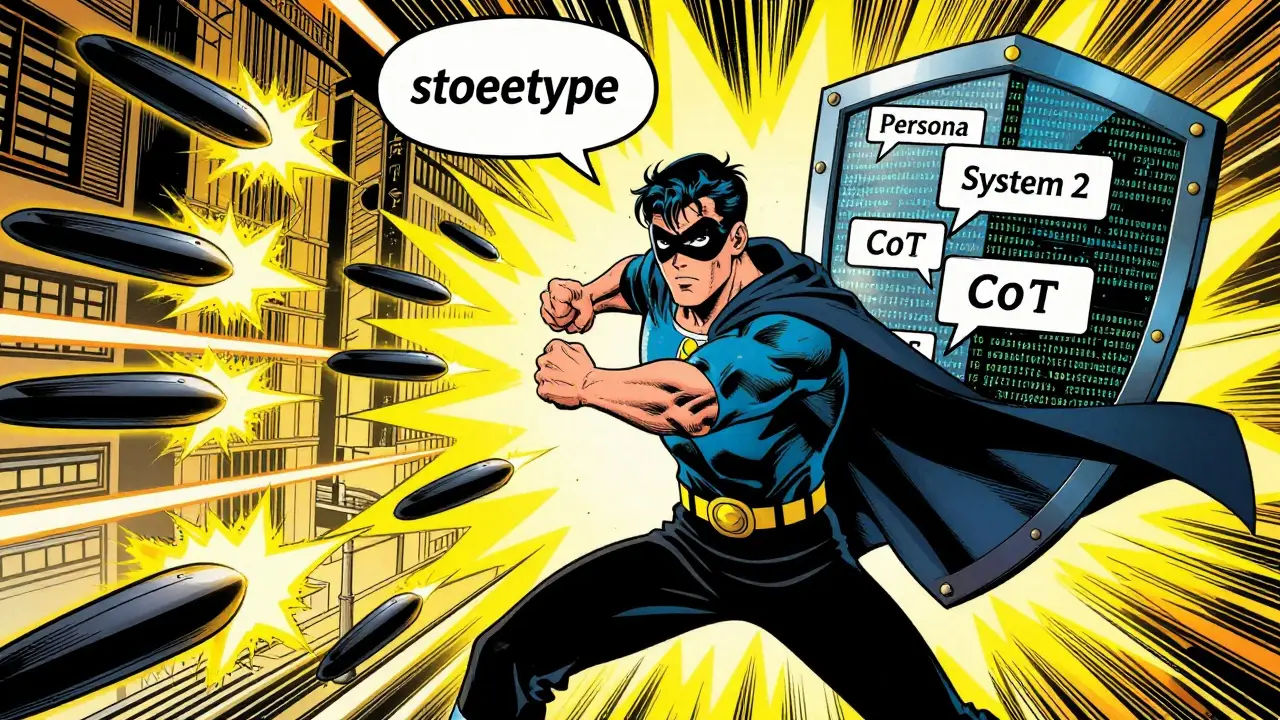
While debiasing prompts alone offer moderate effectiveness (around 3-5% reduction), they become incredibly powerful when stacked with other techniques. The "gold standard" combination identified in recent studies is HP + System 2 + CoT + Debias. In tests on Llama 3.3, this stack achieved a 33% reduction in beauty bias and a 20% reduction in race bias.
Comparing Effectiveness Across Bias Types
Not all biases are created equal, and not all techniques work equally well for every category. Understanding these nuances helps you tailor your approach.
| Bias Category | Best Technique Combination | Avg. Reduction | Notes |
|---|---|---|---|
| Beauty Bias | HP + System 2 + CoT + Debias | Up to 33% | Most responsive to complex prompting stacks. |
| Race Bias | HP + Debias | ~20% | Simple combinations often suffice for significant gains. |
| Gender Bias | HP + System 2 | ~13% | Consistent improvement across major models. |
| Ageism | HP + System 2 + CoT | 4-13% | More resistant to change; requires deeper reasoning. |
| Socioeconomic Status | System 2 + Debias | ~9% | Context setting is critical here. |
Note that smaller models, like Llama-2-7b, may struggle with complex stacks. One practitioner reported that adding heavy debiasing prompts to a small model increased response time by 35% with only a 2-3% bias reduction. If you are using lightweight models, stick to simpler combinations like Human Persona + Debias.
Implementation Strategy for Teams
How do you roll this out in a real-world environment? Start with a baseline. Audit your current prompts and identify where stereotypes creep in. Are your marketing emails assuming a male audience? Is your HR bot filtering out older candidates?
Next, apply the "Layered Approach":
- Layer 1: Persona. Add a Human Persona prefix to all system prompts. This is your safety net.
- Layer 2: Process. For critical decisions (hiring, lending, medical advice), add System 2 instructions to force analytical thinking.
- Layer 3: Verification. Implement a self-check mechanism. Ask the model: "Review your previous answer. Does it contain any stereotypes? If so, revise it."
Finally, test rigorously. A/B test your new prompts against the old ones. Measure not just bias reduction, but also response quality and latency. The Partnership on AI’s 2025 report notes that 68% of enterprises now use at least one bias-reducing technique, but many fail to measure the actual impact. Don’t just assume it works; prove it.
Pitfalls to Avoid
Even with the best intentions, you can make things worse. Here are three common mistakes:
- Over-Correction: Aggressive debiasing can sometimes lead to "woke-washing" or unnatural language. The goal is neutrality, not performative diversity. Keep the tone professional and balanced.
- Ignoring Context: Some stereotypes exist for historical reasons in literature or news analysis. If you are summarizing a historical document, you shouldn't sanitize the original author's bias. Use context-aware prompts: "Summarize this text objectively, noting any biases present in the source material without endorsing them."
- Model Mismatch: As mentioned, smaller models lack the reasoning capacity for complex Chain-of-Thought prompts. Match the complexity of your prompt to the capability of your model.
The Future of Bias Mitigation
We are moving toward a future where bias mitigation is built into the API layer. OpenAI and other providers are experimenting with native parameters for fairness. However, until then, prompt engineering remains your primary tool. The field is evolving rapidly, with researchers exploring "persona-switching" techniques where the model dynamically adjusts its stance based on detected triggers.
For now, the message is clear: you have control. By adopting Human Persona, System 2 thinking, and explicit debiasing instructions, you can significantly reduce the stereotypes in your AI outputs. It’s not perfect, but it’s a crucial step toward responsible AI deployment in 2026 and beyond.
Does Chain-of-Thought prompting always reduce bias?
Not always. While CoT exposes reasoning errors, it can sometimes reinforce biases if the model's initial reasoning is flawed. It works best when combined with explicit debiasing instructions and System 2 thinking prompts to ensure the reasoning process itself is scrutinized for fairness.
Which LLMs respond best to these techniques?
Larger models like Llama 3.3, GPT-4, and Claude 3 generally respond better to complex prompting stacks (HP + System 2 + CoT + Debias) due to their stronger reasoning capabilities. Smaller models like Llama-2-7b benefit more from simple Human Persona and direct debiasing instructions, as they may struggle with the computational load of multi-step reasoning.
Is it legal to use these prompting techniques under the EU AI Act?
Yes, the European AI Office has specifically referenced structured prompting approaches for bias mitigation as an acceptable conformity measure for certain risk categories. Using these techniques demonstrates due diligence in addressing fairness requirements.
How much does bias-reducing prompting increase costs?
Costs vary by technique. Simple persona prompts add negligible overhead. Chain-of-Thought prompting can increase token usage by 25-40%, leading to higher API costs. However, for high-stakes applications, the cost of bias-related lawsuits or reputational damage far outweighs the incremental token expenses.
Can prompting completely eliminate stereotypes?
No. Experts agree that prompting alone cannot eliminate deeply embedded biases. It is a mitigation strategy, not a cure. The most effective approach combines advanced prompting with targeted fine-tuning, diverse training data, and rigorous ongoing testing frameworks.





8 Comments
Lisa Nally
Oh, please. We are really pretending that slapping a 'think like a human' prefix onto a prompt is going to solve the structural epistemological crisis of large language models? It’s almost adorable how naive this approach is. The issue isn't just about 'compassionate caregiver' versus 'strategic leader'; it’s about the fundamental statistical nature of next-token prediction based on a corpus that is inherently toxic and biased. You cannot simply 'prompt away' decades of systemic inequality encoded in terabytes of training data with a few polite instructions. It’s like trying to clean oil from water by asking it nicely. We need rigorous fine-tuning and dataset curation, not these little parlor tricks for prompt engineers who think they’re doing social justice work while saving their company a few million dollars in retraining costs.
Edward Gilbreath
they want you to believe its just a bug but its actually a feature designed to keep us docile and conforming to their narrative every time you use these debiasing prompts you are feeding back into the system confirming that the default state is acceptable only if sanitized by corporate approval algorithms are watching everything including your attempts to fix them
Edward Nigma
I have to disagree with the premise entirely because forcing neutrality is often worse than allowing natural variance in language patterns which reflect reality rather than some idealized utopia where everyone is identical in their linguistic expression so maybe we should stop trying to sanitize culture and history under the guise of fairness because that leads to blandness and loss of nuance in communication which is far more damaging than occasional stereotypes
Francis Laquerre
As someone who works across multiple cultural contexts, I find this discussion fascinating yet somewhat limited in scope. The techniques described here are undeniably useful, particularly the Human Persona approach, which resonates deeply with our understanding of empathy in cross-cultural communication. However, we must recognize that bias is not merely a technical glitch but a reflection of deep-seated societal narratives that vary wildly between regions. In many cultures, directness is valued over diplomatic hedging, so applying Western-centric 'polite' prompting strategies might inadvertently strip away necessary context or force an unnatural tone that feels alienating to non-Western users. We need a more global perspective on what constitutes 'neutral' language, as neutrality itself is a culturally constructed concept.
michael rome
This is incredibly insightful and I appreciate the detailed breakdown of the layered approach. It is encouraging to see that we can take actionable steps towards more equitable AI outputs without needing massive computational resources. The emphasis on auditing current prompts is particularly vital, as many organizations operate on autopilot without realizing the subtle biases embedded in their workflows. By adopting these techniques, we not only improve fairness but also enhance the overall quality and reliability of our interactions with AI systems. Let us continue to support each other in implementing these changes responsibly.
Andrea Alonzo
I completely agree with the sentiment expressed earlier regarding the importance of empathy in these processes, and I would like to add that when we consider the long-term implications of these prompting strategies, we must also think about how they affect the diverse communities who interact with these systems daily, because if we are truly committed to inclusivity, we need to ensure that the voices of those most affected by algorithmic bias are included in the development and testing phases, rather than just relying on theoretical frameworks that may not account for the nuanced realities of lived experiences in various socioeconomic backgrounds.
Saranya M.L.
It is quite amusing to see Western tech giants dictating the moral compass of AI through these superficial prompting techniques, ignoring the fact that their own foundational models are trained on data that disproportionately represents Anglo-centric viewpoints. As an expert in natural language processing, I can tell you that true de-biasing requires a complete overhaul of the training corpus to include diverse linguistic structures and cultural contexts from the Global South, not just adding a few words to a prompt. Your 'Human Persona' technique is a band-aid on a bullet wound, and until you address the colonial legacy embedded in your datasets, any reduction in bias metrics will be statistically insignificant and ethically hollow.
om gman
oh look another article telling us how to make robots less offensive because apparently humans cant handle a little stereotype anymore i mean sure go ahead and waste tokens on chain-of-thought reasoning when you could just let the ai do what it does best which is spit out whatever it wants without all this woke nonsense ruining the efficiency of the system honestly people care too much about feelings instead of results