You’ve got a massive language model that performs like magic. It answers complex queries, writes clean code, and reasons through logic puzzles with ease. But there’s a catch: it costs a fortune to run. Every token generated burns through GPU hours, and the latency is too high for real-time applications. You need something smaller, faster, and cheaper, but you don’t want to lose that magical performance. This is where Knowledge Distillation comes in.
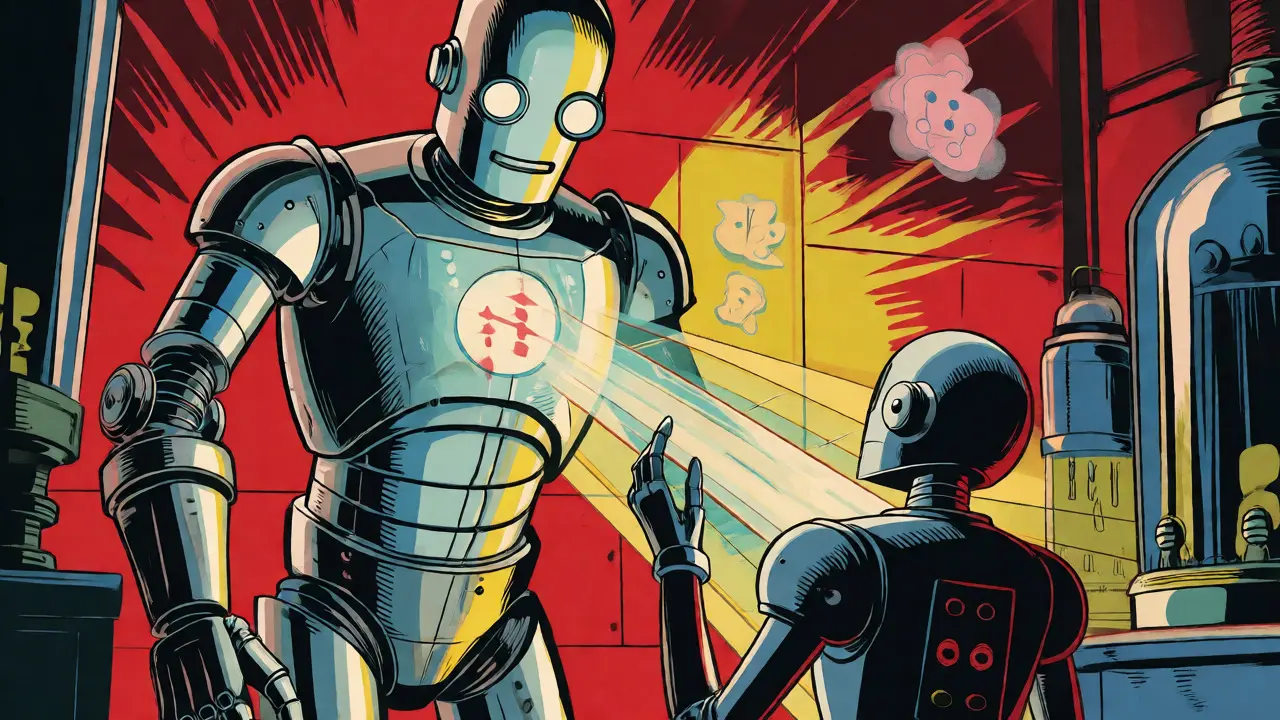
Think of it as an apprenticeship program for AI. Instead of training a small model from scratch on raw data, you train it by having it mimic a larger, smarter "teacher" model. The goal isn't just to copy the final answer; it's to learn the reasoning behind it. By September 2026, this technique has moved from academic curiosity to a standard engineering practice for companies trying to deploy large language models (LLMs) without breaking the bank or their servers.
The Core Idea: Learning from Soft Labels
Traditional machine learning trains a model to predict one correct label. If the input is "The capital of France is," the target is "Paris." Everything else is wrong. Knowledge distillation changes the game. It doesn't just tell the student what the right answer is; it shows the student the entire probability distribution over all possible answers.
Imagine the teacher model outputs these probabilities for the next word after "The capital of France is":
- Paris: 95%
- Lyon: 3%
- Marseille: 1%
- Everything else: 1%
A standard training approach sees "Paris" as the only truth. But knowledge distillation teaches the student that while Paris is overwhelmingly likely, Lyon is a plausible alternative, and Marseille is less so, but still more likely than "Banana." This extra information is often called "dark knowledge." It helps the student understand the structure of the problem better than simple hard labels ever could. Geoffrey Hinton, Oriol Vinyals, and Jeff Dean popularized this concept back in 2015, but it wasn't until LLMs exploded in size that it became essential for compression.
Why Bother? The Economics of Model Size
Let’s look at the numbers. Running a 70-billion parameter model like LLaMA-3-70B requires significant hardware. Inference costs can skyrocket when you’re serving thousands of users simultaneously. A distilled student model might have only 7 billion parameters. That’s a tenfold reduction in size. For many tasks, this smaller model retains 90-95% of the teacher’s accuracy. Is losing 5% of performance worth cutting your inference bill by 80%? Usually, yes.
This isn't just about saving money. It's about accessibility. A 7B model can run on a single consumer-grade GPU or even a powerful laptop. A 70B model needs enterprise-grade infrastructure. Knowledge distillation bridges that gap, allowing organizations to approximate the capabilities of proprietary giants like GPT-4 using open-source students that fit on-premises.
Types of Knowledge You Can Transfer
Not all distillation is created equal. Researchers have identified several ways to transfer knowledge from teacher to student. Understanding these types helps you choose the right strategy for your use case.
| Method Type | What Transfers | Pros | Cons |
|---|---|---|---|
| Logit-Level KD | Full probability distributions (soft labels) | Captures rich uncertainty and ranking info | Computationally expensive; requires full teacher forward pass |
| Data Distillation | Synthetic text generated by the teacher | Simple to implement; no special loss functions needed | Loses "dark knowledge"; quality depends on teacher generation |
| Preference KD | Reward signals or human preference rankings | Good for alignment and safety features | Complex setup; requires reward models |
| Feature-Based KD | Internal hidden states or attention maps | Can improve intermediate representations | Hard to align architectures of different sizes |
Most production pipelines today rely on a mix of logit-level and data distillation. Logit-level is the gold standard for fidelity because it preserves the subtle nuances of the teacher’s output. However, it’s heavy. Data distillation-where the teacher generates synthetic training data-is lighter and easier to scale, which is why methods like those used in DeepSeek-R1 are gaining traction.

The Temperature Parameter: Turning Up the Heat
If you dive into the math, you’ll encounter a hyperparameter called "temperature" ($T$). This controls how "soft" the teacher’s probabilities become during training.
At $T=1$, the softmax function behaves normally. High-confidence predictions stay high-confidence. But if you raise $T$ to 2, 3, or 4, the distribution flattens out. The difference between the top choice and the second-best choice shrinks. Why do we want this? Because it amplifies the "dark knowledge." At low temperatures, non-top tokens might have probabilities so close to zero they vanish numerically. Raising the temperature makes these small probabilities visible and meaningful for the student to learn from.
Typical values range from 2 to 5. Too low, and you miss the nuance. Too high, and the distribution becomes uniform noise, destroying the signal. Finding the sweet spot requires experimentation, but starting at $T=3$ is a common heuristic.
Practical Implementation: From Teacher to Student
So, how do you actually build this pipeline? Let’s walk through a realistic scenario using modern tools like NVIDIA NeMo or Hugging Face Transformers.
- Select Your Models: Pick a strong teacher (e.g., Meta-Llama-3.1-8B) and a smaller student architecture (e.g., a pruned version of the same model or a smaller Mistral variant).
- Prepare the Dataset: You need a corpus of prompts. These can be real user queries or synthetic questions. Crucially, you don’t need ground-truth answers for every prompt if you’re doing pure logit distillation.
- Generate Teacher Outputs: Run the teacher model over your dataset. For each token position, save the full logits or the top-K probabilities. Storing full distributions for huge vocabularies (like 128k tokens) is memory-intensive, so many systems sample the top 256-1000 tokens instead.
- Train the Student: Initialize the student model. During training, calculate two losses:
- Distillation Loss: KL-divergence between the softened teacher logits and softened student logits.
- Task Loss: Standard cross-entropy against any available ground-truth labels.
- Tune Alpha: The weight $\alpha$ balances imitation vs. factual correctness. Start around 0.5 and adjust based on validation performance.
NVIDIA’s NeMo framework provides scripts that automate much of this, handling depth pruning (dropping layers) and width pruning (reducing hidden dimensions) before applying distillation to recover lost accuracy. This combined approach-pruning then distilling-is highly effective for creating efficient models from existing large ones.
Pitfalls and Limitations
Knowledge distillation isn’t a magic wand. There are real risks.
Teacher Bias Propagation: If your teacher hallucinates or holds biased views, the student will inherit them. The student learns to mimic the teacher’s mistakes, not just its successes. If the teacher says "The moon is made of cheese" with 99% confidence, the student will too.
Computational Cost of Training: Proper logit distillation requires running the teacher model during student training. This doubles the compute load compared to standard fine-tuning. If you’re processing billions of tokens, this cost adds up quickly. Approximations like sampled soft labels help, but they introduce some noise.
Capacity Mismatch: Don’t try to squeeze a 70B model’s capability into a 1B model. If the student is too small, it lacks the capacity to represent the teacher’s complex decision boundaries. You’ll see diminishing returns or even degradation in performance. A rule of thumb: aim for a student that is roughly 1/4 to 1/10 the size of the teacher for optimal trade-offs.
Where This Fits in the Compression Landscape
Knowledge distillation is one leg of the model compression tripod. The other two are quantization and pruning.
- Quantization reduces the precision of weights (e.g., from FP16 to INT4). It saves memory bandwidth but doesn’t change the number of operations.
- Pruning removes redundant neurons or layers. It reduces computation but can hurt accuracy if done aggressively.
- Distillation trains a new, smaller model. It’s the most flexible but also the most resource-intensive during training.
In practice, engineers often combine all three. They prune a large model to create a candidate student, distill knowledge from the original teacher into that pruned student, and finally quantize the result for deployment. This stacked approach maximizes efficiency gains.
The Future: Flipped Distillation and Beyond
The field is evolving. Recent research, such as the ACL 2025 paper on "Flipping Knowledge Distillation," suggests that small specialized models can sometimes teach large generalist models. Imagine a tiny, highly accurate medical diagnosis model teaching a large LLM how to interpret radiology reports. This reverses the traditional flow and opens up new possibilities for merging expertise.
Additionally, integration with Reinforcement Learning from Human Feedback (RLHF) is becoming standard. Instead of just distilling raw probabilities, we’re distilling preferences and alignment behaviors. This ensures that the smaller student doesn’t just sound smart-it sounds helpful and safe, just like the teacher.
Is knowledge distillation better than fine-tuning?
They serve different purposes. Fine-tuning adapts a model to a specific task using labeled data. Knowledge distillation compresses a model by transferring knowledge from a larger teacher. Often, you fine-tune the teacher first, then distill that fine-tuned teacher into a smaller student. So, they are complementary, not mutually exclusive.
Do I need access to the teacher's source code?
No. One of the biggest advantages of knowledge distillation is that it works with black-box teachers. As long as you can query the API and get the output probabilities (logits), you can train a student. This is crucial for distilling from proprietary models like GPT-4 where you don't have access to internal weights.
How much does the student model degrade compared to the teacher?
It depends on the size ratio and task complexity. Typically, a student with 1/4 the parameters of the teacher retains 90-95% of the performance on general benchmarks. For highly specialized tasks, the drop can be larger. Always evaluate on your specific domain data rather than relying solely on public benchmarks.
What is the role of the temperature parameter?
Temperature controls the smoothness of the probability distribution. Higher temperatures flatten the distribution, making lower-probability tokens more significant. This helps the student learn the relative ranking of alternatives, not just the top choice. Typical values are between 2 and 5.
Can I distill a model for edge devices?
Yes, this is a primary use case. By distilling large cloud-based models into small, efficient students, you can run sophisticated NLP tasks locally on smartphones or IoT devices. This reduces latency and privacy concerns since data never leaves the device.