You spend hours tweaking a prompt. You add context, specify the format, maybe even give it a persona. But when the AI spits out an answer, how do you actually know if your prompt was good? Was it clear? Did it miss anything? Most people rely on gut feeling, which is messy and inconsistent. That’s where rubrics come in.
Rubrics aren’t just for grading high school essays anymore. In the world of AI prompting, they are structured frameworks that turn subjective vibes into objective data. Think of them as a checklist that tells you exactly what "good" looks like before you even hit enter. If you’re trying to scale AI usage in a business or just want to stop guessing why one prompt works better than another, you need a way to measure quality. Specifically, we’re looking at two big buckets: completeness (did it cover everything?) and clarity (was it easy to understand?).
Why Gut Feeling Fails in Prompt Engineering
Let’s be honest: most prompt engineering advice is anecdotal. Someone on Twitter says, "Add 'think step by step' and magic happens." You try it. It works once. Then it fails three times. Why? Because without a standard, you can’t isolate variables. A rubric fixes this by breaking down a prompt into measurable parts. According to research from Stanford’s SCALE center, effective assessment tools must create meaningful expectations. For prompts, this means defining success criteria upfront.
When you lack a rubric, you’re flying blind. You might think a prompt is clear because *you* wrote it, but the model sees something else entirely. Dr. Sarah Johnson, an assessment specialist, notes that rubrics must discriminate based on central features of performance, not just the easiest things to count. In prompting, the "easy" thing to count is word length. The "central feature" is whether the instruction reduces ambiguity for the model. A rubric forces you to look at the right things.
The Core Criteria: Completeness vs. Clarity
To build a useful rubric, you need to separate two distinct concepts that often get confused: completeness and clarity. They sound similar, but they solve different problems.
Completeness asks: Does the prompt provide all necessary information? This includes context, constraints, examples, and desired output format. If you ask an AI to "write a blog post," that’s incomplete. It lacks audience, tone, length, and topic specifics. A complete prompt leaves no room for the model to guess critical details.
Clarity asks: Is the language precise and unambiguous? You can have a very complete prompt that is still unclear. Imagine listing ten requirements in a jumbled paragraph with conflicting instructions. It’s complete, but the model might prioritize one constraint over another incorrectly. Clarity ensures the instructions are logically ordered and linguistically precise.
Here’s a quick breakdown of how these two interact:
| Prompt Type | Completeness Score | Clarity Score | Expected Outcome |
|---|---|---|---|
| Vague & Short | Low | Medium | Generic, hallucinated, or off-topic results. |
| Detailed but Confusing | High | Low | Inconsistent outputs; model ignores some constraints. |
| Simple & Clear | Medium | High | Accurate but potentially shallow or missing nuance. |
| Optimized | High | High | Precise, nuanced, and consistent outputs. |
Building Your First Prompt Rubric
You don’t need a PhD in education to make a rubric. North Carolina State University suggests keeping it simple-no more than five criteria. If you have too many, you’ll never use it. Here is a practical four-criterion framework you can steal right now.
- Focus: Does the prompt stay on task? Does it clearly define the core request?
- Context: Does it provide background info, persona, or scenario details?
- Specificity: Are there concrete parameters (word count, format, style)?
- Tone: Is the desired voice defined (e.g., professional, witty, academic)?
For each criterion, you need performance levels. Avoid words like "good" or "bad." They mean nothing. Use descriptive language. For example, under Specificity, instead of saying "Good specificity," say "Prompt includes three or more specific parameters including length constraints, formatting requirements, and target audience characteristics." This makes scoring objective. Two different people using this rubric should arrive at nearly the same score.

Analytic vs. Holistic: Which Rubric Do You Need?
Not all prompts require the same level of scrutiny. There are two main types of rubrics you can use, and choosing the wrong one wastes time.
Analytic Rubrics give you a separate score for each criterion. This is great for complex tasks where you need detailed feedback. If you’re building a customer service bot, you need to know if the failure was due to poor tone or missing context. Analytic rubrics tell you exactly where the break happened. However, they take longer to apply. Research shows they increase consistency by about 32% but take 47% more time to grade compared to holistic methods.
Holistic Rubrics give a single overall score. You read the whole prompt and assign a level like "Exemplary" or "Developing." This is perfect for quick checks or simple tasks. If you’re just testing if a prompt generates code correctly, you don’t need to dissect every sentence. Just look at the result. Single-point rubrics are a hybrid-they describe only the proficient level and leave space for comments above or below. These are surprisingly popular among students and novices because they reduce cognitive load.
If you are teaching someone to prompt, start with single-point. If you are debugging a production workflow, go analytic. If you are doing a quick sanity check, go holistic.
Common Pitfalls in Prompt Evaluation
Even with a rubric, people mess up. The biggest error is overlapping criteria. If your "Focus" and "Specificity" criteria both penalize vague language, you’re double-counting the same mistake. Dr. Lisa Chen from Appaca AI warns that 63% of first-draft rubrics suffer from this overlap. Make sure each criterion measures a unique dimension.
Another trap is inconsistent jumps between levels. One user on GitHub noted that moving from "Developing" to "Proficient" required adding two elements, but jumping to "Exemplary" required five. This creates frustration and breaks the logic of improvement. Keep the increments logical. If going from basic to good requires adding context, then going from good to great should require refining that context, not inventing new categories.
Also, beware of bias toward complexity. Sometimes a simple, clear prompt beats a long, detailed one. A rubric that rewards length automatically will misjudge efficient prompts. Always test your rubric against known "gold standard" prompts to ensure it doesn’t favor verbosity over precision.
Automating the Process
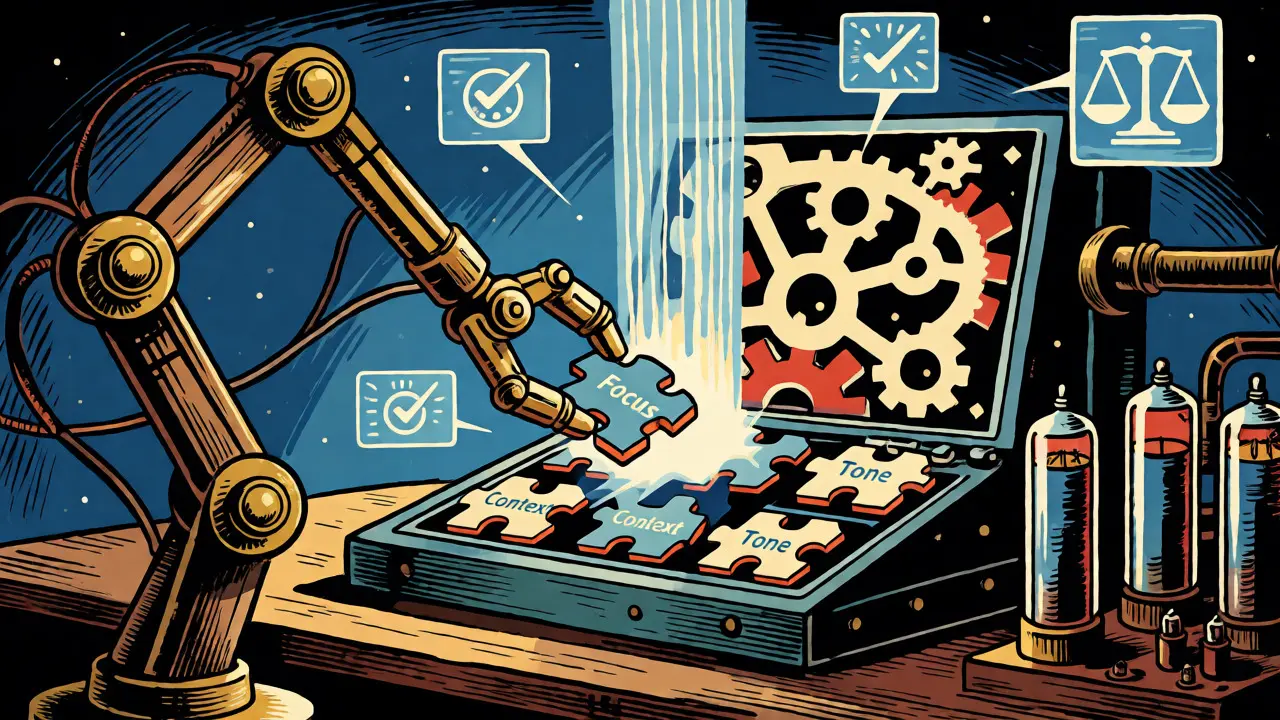
Manually scoring every prompt is fine for learning, but it doesn’t scale. Enter automated refinement. Tools like Appaca AI and RISEPoint have developed engines that analyze prompts against rubric criteria. Recent studies show AI systems can identify scoring inaccuracies with 83% effectiveness compared to human experts. This isn’t about replacing humans; it’s about handling the volume.
Imagine having 500 prompts in your library. An automated system flags the bottom 10% based on your clarity and completeness scores. You then manually review those ten. This targeted approach saves massive amounts of time. Furthermore, adaptive rubrics are emerging. These adjust their weighting based on the task type. A creative writing prompt might weigh "Tone" higher, while a coding prompt weighs "Specificity" higher. This dynamic adjustment leads to more accurate evaluations across diverse use cases.
Putting It Into Practice
So, how do you actually start? Don’t try to build a perfect system overnight. Follow this six-step process adapted from educational best practices:
- Analyze the Goal: What is the primary purpose of your prompts? Informational? Creative? Technical?
- Choose Your Type: Pick holistic for speed, analytic for depth.
- Select Criteria: Stick to 3-5 key areas. Focus, Context, Specificity, Tone.
- Define Levels: Write concrete descriptions for each level. No vague adjectives.
- Pilot It: Test your rubric on 5 sample prompts. See if it catches the obvious flaws.
- Refine: Adjust weights and definitions based on pilot results.
Remember, the goal isn’t to restrict creativity. As Dr. Elena Rodriguez notes, rubrics must balance structure with flexibility. You want to codify what works so you can innovate faster, not slower. Once you have a baseline of quality, you can experiment with wilder ideas, knowing exactly how to measure their impact.
What is the difference between completeness and clarity in a prompt?
Completeness refers to whether the prompt contains all necessary information, such as context, constraints, and examples, leaving no critical gaps for the AI to guess. Clarity refers to the precision and unambiguity of the language used. A prompt can be complete but confusing (high completeness, low clarity) or clear but lacking detail (low completeness, high clarity). Both are needed for optimal results.
How many criteria should a prompt quality rubric have?
Experts recommend limiting a rubric to 3-5 criteria. Including more than 5-6 criteria can make the rubric unwieldy and difficult to apply consistently. Common criteria include Focus, Context Provision, Specificity, and Tone Appropriateness. Keeping the number low ensures users can actually apply the rubric during their workflow.
Are analytic rubrics better than holistic rubrics for prompt engineering?
It depends on the use case. Analytic rubrics provide separate scores for each criterion and offer detailed feedback, making them ideal for complex tasks and formative learning. They increase grading consistency by approximately 32%. However, they take significantly more time to apply. Holistic rubrics provide a single overall score and are better for quick assessments or simple prompts. Choose analytic for debugging and training, and holistic for rapid iteration.
Can AI automatically evaluate prompt quality?
Yes, automated tools can evaluate prompts against rubric criteria with high accuracy. Recent developments show AI systems can identify scoring inaccuracies and generate improved rubrics with about 83% effectiveness compared to human experts. Automated rubric refinement helps scale evaluation processes, allowing teams to focus manual review efforts on the lowest-performing prompts.
What are common mistakes when creating prompt rubrics?
The most common mistakes include overlapping criteria (where multiple criteria measure the same thing), using vague language like "good" or "poor" instead of concrete descriptors, and creating inconsistent jumps between performance levels. Additionally, many early rubrics fail to account for task type, leading to biased scoring that favors verbose prompts over concise, effective ones.