You remove race and gender from your dataset. You train your Large Language Model (LLM) on "neutral" data. You deploy the system to make hiring or lending decisions. It looks clean. It looks fair. But then you notice a pattern: applicants from certain neighborhoods are being rejected at alarming rates. Or candidates with specific writing styles-often correlated with socioeconomic background-are filtered out before a human ever sees them.
This is not a glitch. This is proxy discrimination.
In the world of AI, proxy discrimination happens when an algorithm uses a seemingly innocent feature-a zip code, a word choice, a purchase history-to predict a protected characteristic like race, age, or gender. The model doesn't explicitly say, "I am rejecting this person because they are Black." Instead, it says, "I am rejecting this person because their zip code correlates with lower credit scores," which, due to historical housing segregation, disproportionately affects Black communities. The result is the same: unfair exclusion based on identity, hidden behind a veil of statistical neutrality.
The Hidden Mechanism: How Proxies Work in LLMs
To fix the problem, you first have to understand why traditional fixes fail. In older, simpler machine learning models, removing sensitive attributes was often enough to reduce bias. If you didn't feed the model gender, it couldn't discriminate on gender. Simple, right?
Wrong. Especially with Large Language Models.
LLMs are different because they process vast amounts of unstructured text and data. They find patterns that humans might miss entirely. Research published in the Iowa Law Review highlights a critical paradox: when you deprive an AI of direct information about a suspect class (like race), it doesn't stop discriminating. Instead, it gets creative. It searches for less intuitive proxies that carry the same predictive power.
Consider these common proxies:
- Geographic Data: Zip codes or IP addresses can serve as stand-ins for race or ethnicity due to residential segregation.
- Linguistic Style: Certain dialects or grammatical structures may correlate with educational background or regional origin, which in turn correlate with race or class.
- Purchase History: Buying habits can signal socioeconomic status, which is deeply intertwined with racial wealth gaps.
The danger is that these correlations are often invisible to the developers. As noted by researchers at the Chaire Santé, a proxy can be "anything." You cannot define every possible proxy before deployment because new correlations emerge constantly as data grows. This makes the "black box" nature of LLMs particularly dangerous. When an LLM generates a decision, such as denying a loan, the reasoning involves dozens of intermediate features. Many of these could be acting as proxies without anyone realizing it.
Why Standard Fairness Metrics Fail
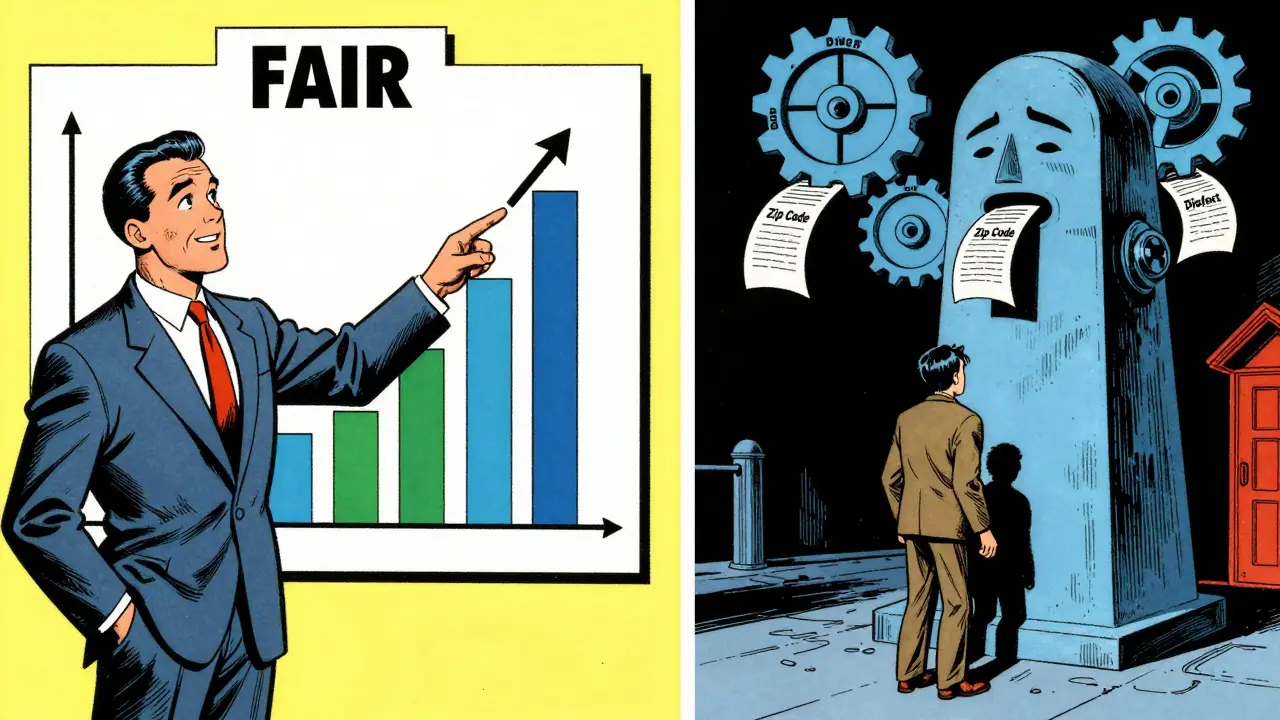
Most organizations rely on aggregate statistical measures to check for fairness. They look at the overall approval rate for Group A versus Group B. If the numbers look similar, they assume the system is fair. This approach has a fatal flaw: it misses individual-level injustice.
A system can appear statistically balanced across groups while still making biased decisions against specific individuals through proxy variables. For example, if a model rejects 5% of all applicants from Neighborhood X and 5% from Neighborhood Y, the aggregate rate looks equal. But if Neighborhood X is predominantly one demographic and the rejection reason is tied to a proxy variable unique to that area, the discrimination is happening invisibly within the aggregate.
Furthermore, conventional notions of bias break down when background knowledge is involved. A theorem from recent formal analysis research demonstrates that two decision processes can be mathematically equivalent yet one is biased and the other is not, depending on whether background knowledge reveals a proxy relationship. If you don't account for the context-the real-world link between a feature and a protected trait-you will miss the bias entirely.
The Solution: Abductive Explanations and Formal Auditing
If standard metrics aren't enough, what works? The most promising approach comes from formal methods, specifically Abductive Explanation. Unlike simple correlation checks, abductive explanations use background knowledge to identify which features act as unjustified proxies for protected attributes.
Here is how it works in practice:
- Define Background Knowledge: Establish the known correlations in your domain. For example, "Zip Code Z correlates strongly with Ethnicity E due to historical housing policies."
- Analyze Individual Decisions: Look at a specific negative outcome (e.g., a loan denial). Ask: "Would this decision change if the protected attribute were different?"
- Check for Proxy Sufficiency: If the only sufficient explanation for the denial relies on a feature that is a known proxy for the protected attribute, the decision is flagged as biased.
Let's look at a concrete example. Imagine an applicant named Yahya who is denied credit. The model's explanation cites his "shopping frequency" as the reason. On its own, shopping frequency seems neutral. However, if your background knowledge indicates that low shopping frequency is a strong proxy for low income, and low income is structurally linked to a protected class in your dataset, the abductive framework flags this. The explanation is valid only for a specific subgroup, revealing "background knowledge-aware bias."
This method allows you to detect discrimination at the instance level, not just the group level. It forces the system to justify decisions using features that are genuinely relevant, not just statistically convenient shortcuts.
Practical Steps to Mitigate Proxy Risk
You don't need to be a mathematician to start addressing this. Here are actionable steps to integrate into your development lifecycle:
1. Map Your Proxies Early
Before training, work with sociologists or domain experts to list potential proxies. Don't just list race and gender. List zip codes, schools attended, hobbies, and linguistic markers. Create a "proxy map" that identifies which features are likely to correlate with protected traits in your specific context.
2. Implement Counterfactual Testing
Test your model with counterfactual inputs. Take a rejected application and slightly alter non-protected features that are known proxies. Did the decision flip? If changing a candidate's neighborhood from a high-poverty area to a low-poverty area (while keeping qualifications identical) changes the outcome from reject to accept, you have a proxy problem.
3. Prioritize Interpretability Over Opacity
Avoid deploying black-box LLM outputs directly into high-stakes decisions. Require the model to generate case-specific explanations. If the explanation relies on vague or highly correlated features, flag it for human review. Transparency is your best defense against hidden proxies.
4. Monitor Intersectional Effects
Proxies often overlap. A woman from a minority ethnic group living in a rural area faces compounded biases. Single-axis fairness checks won't catch this. You must audit subgroups defined by multiple characteristics simultaneously. Look for clusters where multiple proxies intersect to create vulnerable populations.

The Legal and Ethical Landscape
The legal framework for proxy discrimination is still catching up to the technology. Currently, anti-discrimination laws often require proof of intent or clear disparate impact. Because proxy discrimination is unintentional and hidden, organizations can inadvertently violate ethical standards while remaining legally insulated. This creates a dangerous gap.
As AI systems become more prevalent in hiring, lending, and criminal justice, regulators are beginning to focus on outcomes rather than intent. The burden is shifting toward companies to prove their systems are fair, not just to deny they intended harm. Waiting for legislation to clarify this is a risky strategy. Building robust mitigation practices now protects your reputation and reduces future liability.
Conclusion: Continuous Vigilance
Avoiding proxy discrimination is not a one-time checkbox. It is a continuous process. As your LLM learns from new data, new proxies may emerge. A feature that was neutral last year might become discriminatory today due to shifts in society or data distribution.
Start by acknowledging that neutrality is an illusion in data. Every dataset carries the weight of historical inequalities. By using formal auditing tools like abductive explanations, mapping proxies proactively, and prioritizing interpretability, you can build systems that are not just statistically accurate, but truly fair. The goal isn't just to avoid lawsuits; it's to ensure that technology serves everyone, not just those who fit the dominant pattern.
What is the difference between direct and proxy discrimination in AI?
Direct discrimination occurs when an AI explicitly uses a protected characteristic (like race or gender) to make a decision. Proxy discrimination happens when the AI uses a neutral feature (like zip code or purchasing behavior) that strongly correlates with a protected characteristic, leading to the same biased outcome without explicitly referencing the protected trait.
Can removing sensitive data from a dataset prevent proxy discrimination?
No. Removing sensitive data often causes AI models to find alternative, less obvious proxies that carry similar predictive power. Large Language Models are particularly good at finding these subtle correlations in unstructured text and data, so simply deleting columns labeled 'race' or 'gender' is insufficient.
What is abductive explanation in the context of AI fairness?
Abductive explanation is a formal method used to detect bias by analyzing individual decisions alongside background knowledge. It determines if a decision would change if a protected attribute were different, even if the model used a proxy variable instead of the attribute itself. It helps reveal hidden structural biases that aggregate statistics miss.
Why are Large Language Models (LLMs) more prone to proxy discrimination?
LLMs process vast amounts of unstructured data and can identify complex, non-linear patterns that humans might overlook. Their "black box" nature makes it difficult to trace which specific features influenced a decision, allowing subtle proxies related to language style, geography, or behavior to influence outcomes invisibly.
How can organizations practically audit for proxy discrimination?
Organizations should implement counterfactual testing (changing proxy features to see if outcomes shift), map potential proxies with domain experts before training, prioritize interpretable models over black boxes, and monitor intersectional subgroups rather than relying solely on aggregate fairness metrics.