
Running a large language model (LLM) on a single GPU used to be a dream. Now, it’s a daily challenge. Every time you feed in a long document, a complex conversation, or a multi-step reasoning prompt, your GPU memory starts to scream. That’s the Out-of-Memory (OOM) error - the silent killer of LLM deployments. It doesn’t crash the server. It doesn’t show a blue screen. It just stops. And you’re left wondering why a model that worked fine yesterday suddenly can’t handle a 5,000-token input today.
The root of this problem isn’t your hardware. It’s the transformer architecture itself. Since 2017, the self-attention mechanism has been the engine behind every major LLM - from GPT-3 to Llama 3. But it’s also the reason memory usage explodes. For every token you add to your input, the memory cost doesn’t go up by one. It goes up by the square of the number of tokens. That’s O(n²). So if you double the input length from 1,000 to 2,000 tokens, you’re not using twice as much memory. You’re using four times as much. And by the time you hit 8,000 tokens, you’re looking at 64x the memory of a 1,000-token input. No GPU can handle that without help.
Why Quantization Alone Isn’t Enough
Most engineers reach for quantization first. Reduce weights from 16-bit to 8-bit. Then to 4-bit. It’s simple. It works. And it cuts memory use by 2x to 4x. But here’s the catch: you’re only optimizing the model’s weights. You’re ignoring the real memory hog: the activations.
Activations are the temporary values generated during inference - the intermediate outputs between layers. For long sequences, these can be 3x to 5x larger than the model weights themselves. Quantization helps, but it doesn’t touch this. And if you push too hard on quantization, accuracy drops. Studies show 5% to 15% performance loss on tasks like summarization, code generation, and long-context QA. That’s not acceptable for production systems.
What you need isn’t just smaller weights. You need smarter memory use. That’s where modern memory planning comes in.
CAMELoT: Memory That Remembers Like a Human
IBM Research’s CAMELoT - short for Consolidated Associative Memory Enhanced Long Transformer - doesn’t just compress memory. It rethinks it. Inspired by how the human brain consolidates memories, CAMELoT adds a small external module to any pre-trained LLM. This module doesn’t store all tokens. It stores only the most important ones based on three rules: consolidation (repeated patterns), novelty (new information), and recency (recent context).
For example, if you’re summarizing a 10,000-token legal document, CAMELoT doesn’t keep every clause. It remembers the key parties, the deadlines, the penalties, and the exceptions. Everything else gets dropped - but only after making sure the model has already used that info to build context. The result? A 40% to 60% drop in memory use, with accuracy actually improving. In tests on the LongMemEval benchmark, CAMELoT boosted accuracy by over 10%. And when paired with Llama 2-7B, perplexity dropped by 30%, meaning the model made better predictions.
It’s not magic. It’s neuroscience. And it works best when you’re dealing with inputs longer than 4,096 tokens - where standard transformers start to choke.
Dynamic Memory Sparsification: Cut the Fat, Keep the Muscle
University of Edinburgh’s Dynamic Memory Sparsification (DMS) takes a different approach. Instead of deciding which tokens to keep, it decides which to throw away - but with a twist. It doesn’t delete tokens immediately. It waits. It lets the model use those tokens to influence nearby ones. Then, after the influence is passed, it deletes them. This delay is critical. It’s like letting a message be copied before you burn the original.
DMS works without changing the model. Just plug it into your inference pipeline. It’s hardware-agnostic. Works on NVIDIA, AMD, even cloud instances with limited VRAM. In tests across 12 LLMs, DMS cut memory use by 47% on average. Accuracy? Only 0.8% degradation on GLUE benchmarks. That’s negligible for most use cases.
One developer on Reddit reported dropping a 13B-parameter model from 26GB to 15GB on a 24GB A6000. No retraining. No fine-tuning. Just a few lines of code. And the latency increase? Only 12%. For many, that’s a fair trade.
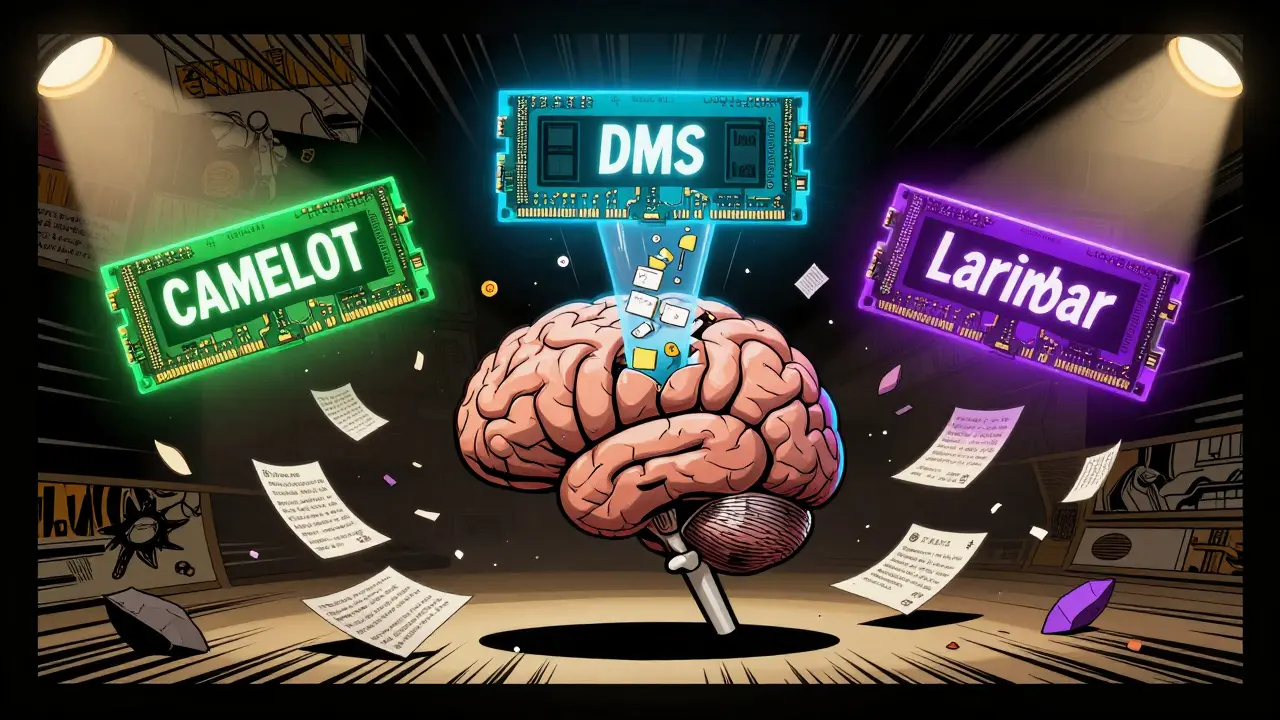
Larimar: Memory You Can Edit On the Fly
What if you could update your model’s memory during inference? Not retrain it. Not reload it. Just add or forget a fact in real time? That’s Larimar.
Developed by IBM Research, Larimar uses an external episodic memory module - think of it like a scratchpad that lives outside the model. During inference, if the model needs to know the CEO of a company, it checks Larimar instead of relying on training data. Need to correct an outdated fact? Update Larimar. Forget a sensitive detail? Wipe it. No retraining. No downtime.
In attack tests, Larimar reduced memory leakage risks by 92%. It also let teams deploy a 20B-parameter model on a single A100 40GB GPU - instead of needing two. For enterprises dealing with private data, compliance, or real-time updates, this is a game-changer.
But there’s a catch. Larimar needs extra infrastructure. You need a fast key-value store - Redis, VectorDB, or similar. That adds complexity. If you’re running a simple chatbot, it’s overkill. If you’re building a legal AI assistant that needs to pull from live case law? Essential.
What Works Best? A Quick Comparison
| Technique | Memory Reduction | Accuracy Impact | Latency Increase | Best For |
|---|---|---|---|---|
| Quantization (4-bit) | 2x-4x | -5% to -15% | -5% | Small models (<7B), low-budget setups |
| Dynamic Memory Sparsification (DMS) | 40%-50% | -0.8% | +10%-15% | Long-context tasks, consumer GPUs |
| CAMELoT | 40%-60% | +3%-10% | +8%-12% | Enterprise LLMs, >4K context, accuracy-critical |
| Larimar | 30%-50% | Neutral | +5%-10% | Dynamic knowledge, compliance, real-time updates |

Real-World Trade-Offs
Here’s what nobody tells you: memory planning isn’t a plug-and-play fix. It’s a system design problem.
One team at a fintech startup tried CAMELoT on their 13B model. They spent three weeks just integrating it into their PyTorch pipeline. Documentation was sparse. Their engineers had to reverse-engineer how the associative memory module interacted with attention masks. They got it working - and cut memory use by 52%. But now their inference latency is 18% higher. Customers noticed. They had to add a caching layer on top.
Another team at a healthcare startup used DMS with Llama 3 8B. They got 45% memory reduction. Accuracy stayed flat. They rolled it out in production. No issues. No complaints. Just lower costs.
There’s no one-size-fits-all. If you’re on a 24GB GPU and need to handle 8K-token inputs? DMS is your best bet. If you’re building a legal AI that needs to cite live court rulings? Larimar. If you’re deploying a 70B model and can’t afford two A100s? CAMELoT.
What’s Next? The Future of Memory in LLMs
By 2026, memory planning isn’t optional. It’s mandatory. Gartner predicts 70% of enterprise LLM deployments will use advanced memory techniques - up from 15% in 2023. IBM just released CAMELoT 2.0, which cuts memory another 15%. The University of Edinburgh plans to open-source DMS in Q2 2026. And Forrester says by 2028, all major foundation models will have memory optimization built in.
But here’s the truth: we’re not just optimizing memory. We’re rethinking how models think. The old model was a giant, static memory bank. The new model is a dynamic, selective processor - remembering only what matters, forgetting what doesn’t, and updating on the fly.
If you’re still running LLMs without memory planning, you’re not just risking OOM errors. You’re wasting hardware. You’re overpaying. You’re limiting what your model can do. And in 2026, that’s not an option.
What causes Out-of-Memory (OOM) errors in LLM inference?
OOM errors happen because the transformer’s self-attention mechanism requires memory that grows quadratically with input length. For a 10,000-token input, memory usage can be 100x higher than for a 1,000-token input. This overwhelms even high-end GPUs. The model weights are only part of the problem - the real culprit is the activation memory from attention layers during inference.
Can I solve OOM just by using smaller models?
You can, but you lose capability. A 7B model won’t handle long documents, complex reasoning, or nuanced dialogue like a 70B model can. Memory planning lets you keep the large model’s intelligence while using less memory. It’s not about shrinking the model - it’s about making it smarter about how it uses memory.
Do I need to retrain my model to use CAMELoT or Larimar?
No. Both CAMELoT and Larimar are plug-in modules. You load your pre-trained model (like Llama 3 or Mistral) and add the memory module during inference. No fine-tuning or retraining is needed. This makes them ideal for production environments where model weights are locked down for compliance or stability.
Which technique is easiest to implement?
Dynamic Memory Sparsification (DMS) is the easiest. It requires minimal code changes - often just wrapping your inference loop with a few lines of memory management logic. CAMELoT and Larimar require more integration work because they involve custom modules and sometimes external services (like Redis for Larimar). But DMS doesn’t require changes to your model architecture, making it ideal for quick wins.
Is memory planning worth the effort for small models under 7B parameters?
For models under 7B, traditional quantization (4-bit) is usually more cost-effective. The memory savings from advanced techniques like CAMELoT or DMS are smaller, while the latency and complexity costs remain. Stanford AI Lab found that for models under 7B, quantization delivers better ROI. Save memory planning for when you’re pushing beyond 4K context or running models larger than 13B.
How long does it take to integrate memory planning into an existing pipeline?
It varies. DMS can be integrated in 1-3 days. CAMELoT and Larimar typically take 2-4 weeks, depending on your stack. You’ll need to understand attention mechanisms, tensor shapes, and how your inference engine handles memory. Teams with strong ML engineering experience report smoother integration. Documentation gaps are common - expect to dig into source code and GitHub issues.
Do memory planning techniques work with all LLM architectures?
Most do. DMS works with any transformer-based model - Llama, Mistral, Gemma, etc. CAMELoT was designed for Llama-style architectures but has been adapted for others. Larimar is architecture-agnostic since it sits outside the model. However, non-transformer models (like Mamba or RWKV) have different memory dynamics and may require custom adaptations. Always test on your specific model and task.