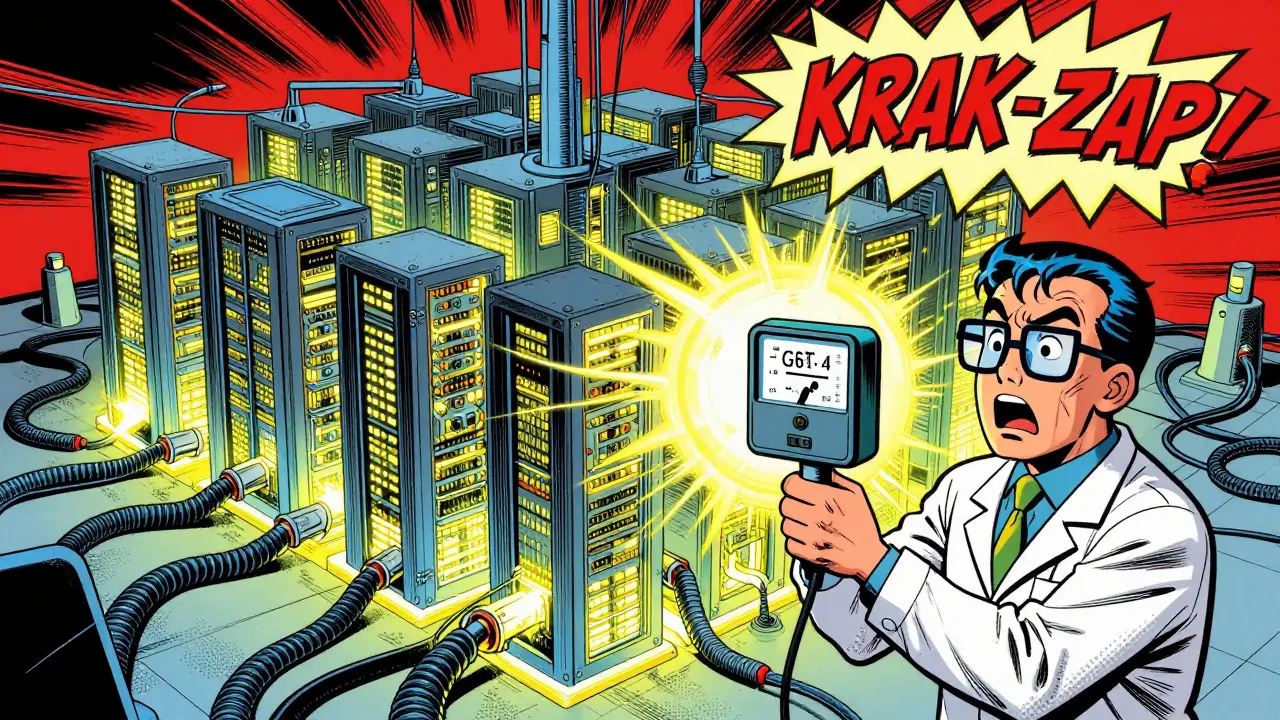
The good news is that we don't actually need every single single parameter in a neural network to be active all the time. In fact, MIT researchers found that about half the electricity used for training is wasted just to squeeze out the last 2 or 3 percentage points of accuracy. This is where energy efficiency techniques like sparsity, pruning, and low-rank methods come in. They allow us to cut energy consumption by 30-80% without noticeably hurting the model's intelligence.
| Method | Core Mechanism | Typical Energy Saving | Accuracy Impact |
|---|---|---|---|
| Sparsity | Introduces zero-valued weights | 30-60% | Low to Moderate |
| Pruning | Removes unnecessary connections | 40-50% | Very Low (if iterative) |
| Low-Rank (LoRA) | Decomposes weight matrices | 30-40% | Negligible |
Cutting the Noise with Sparsity
Think of Sparsity as a way of telling the AI, "You don't need to pay attention to everything." In a standard dense model, every single neuron connects to every other neuron. Sparsity introduces zero-valued weights, meaning certain connections are effectively turned off.
There are two main ways to do this. Unstructured sparsity is the "wild west" approach-you just set individual weights to zero wherever they aren't useful, which can get you 80-90% zero weights. However, hardware doesn't always know how to handle that randomness. Structured sparsity is much cleaner; it removes entire blocks or channels of weights. According to ASE Software, using structured sparsity in MobileBERT slashed the parameter count from 110 million down to 25 million while keeping 97% of its accuracy. The real win here is hardware acceleration; NVIDIA has reported up to 2.8x speedups on A100 GPUs when using 50% sparse models.
Surgical Precision through Pruning
While sparsity is about making weights zero, Pruning is about cutting the connections out entirely. It's like pruning a hedge to make it grow better. There are three big ways developers handle this: magnitude-based pruning (cutting the smallest weights), movement pruning (removing weights dynamically as the model learns), and the "lottery ticket hypothesis," which suggests there's a small sub-network inside the big one that does all the heavy lifting.
Does it actually work in the real world? Yes. Research from the University of Michigan showed that iterative magnitude pruning on GPT-2 reduced training energy by 42% with only a tiny 0.8% drop in accuracy. On GitHub, developers using the TensorFlow Model Optimization Toolkit reported cutting training energy for BERT-base by 41% using these methods. The catch is that you can't just prune everything at once. If you go beyond 70% density, you risk "over-pruning," where the model suddenly forgets how to be smart and accuracy plummets.

Simplifying the Math with Low-Rank Methods
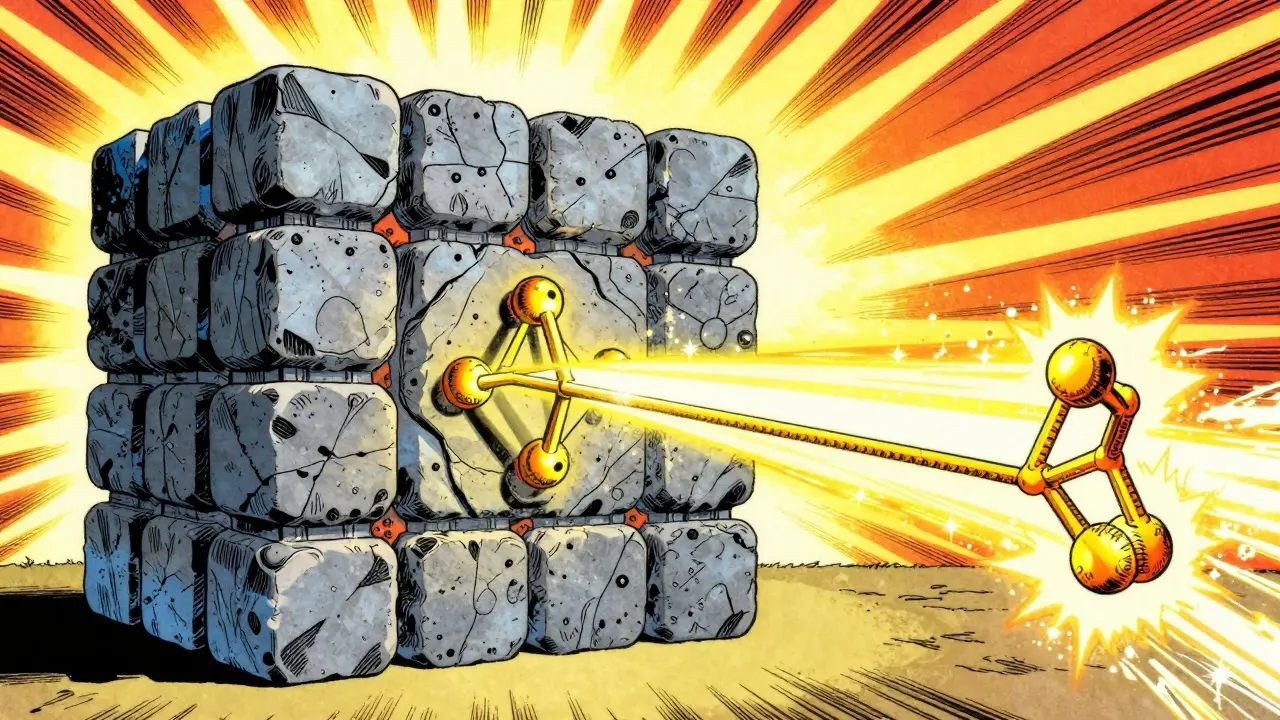
If you've ever taken linear algebra, you know that huge matrices can often be broken down into smaller, simpler ones. Low-Rank Methods apply this to AI. Instead of updating a massive weight matrix, we decompose it using techniques like Singular Value Decomposition (SVD) or Low-Rank Adaptation (LoRA).
LoRA is a game-changer for fine-tuning. Rather than retraining billions of parameters, LoRA tracks only the changes in a much smaller set of matrices. NVIDIA documented that applying LoRA to BERT-base dropped energy use from 187 kWh to 118 kWh-a 37% reduction-while maintaining nearly 100% of the original accuracy on question-answering tasks. It's essentially a shortcut that gets you to the same destination using a fraction of the fuel.
Putting it into Practice: The Developer's Workflow
You can't just flip a switch to make your model energy-efficient. It takes a bit of engineering elbow grease-usually adding about 5-15% to your initial development time. Based on the PyTorch and TensorFlow workflows, a typical implementation looks like this:
- Establish a Baseline: Train your full model first so you know what "perfect" accuracy looks like.
- Configure Sparsity: Decide if you want unstructured (maximum compression) or structured (better hardware speed) sparsity.
- Gradual Application: Don't prune 50% on day one. Increase the sparsity level incrementally during fine-tuning.
- Validation: Run your benchmarks to ensure the accuracy hasn't dipped below your threshold.
- Deployment Optimization: Use tools like NVIDIA NeMo to ensure the hardware is actually leveraging the sparse weights.
The Bigger Picture: Why This Matters Now
We are hitting a wall where the demand for compute is doubling roughly every 100 days. We can't just build more data centers. This has led to a surge in the AI energy optimization market, which is projected to hit $14.7 billion by 2027. It's not just about saving money anymore; it's about regulation. The European Parliament's AI Act will likely require energy logging for large systems by 2026.
Beyond software, we're seeing hardware catch up. The University of Michigan's Perseus tool is a great example-it targets the 30% of power wasted during distributed training by fixing how processors synchronize. When you combine Perseus with structured pruning and LoRA, you're not just saving a few kilowatts; you're fundamentally changing the cost structure of AI development. For enterprises, this means the ability to train larger, more capable models within a fixed energy budget rather than being limited by the size of their electricity bill.
Will pruning my model make it significantly less accurate?
Not necessarily. If you use iterative magnitude pruning, the accuracy drop is often negligible (less than 1%). However, if you prune too aggressively-typically beyond 70% density-you will see a sharp decline in performance. The key is gradual sparsification during the fine-tuning phase.
Which is better: LoRA or standard pruning?
It depends on your goal. LoRA is superior for fine-tuning existing models quickly and with very low energy overhead. Pruning is better if you need to reduce the overall size of the model for deployment on edge devices or to reduce long-term inference costs.
Do I need special hardware to use these techniques?
You can implement these on standard GPUs, but you'll get the most benefit from hardware that supports sparse computation. For instance, NVIDIA A100 and Blackwell GPUs have specific architectural enhancements that make sparse models run significantly faster than dense ones.
How long does it take to implement these energy-saving methods?
For a professional engineering team, it typically adds 2-4 weeks of dedicated effort to the development cycle. This includes the time needed for hyperparameter tuning and validating that the model's performance remains stable.
Can I combine different methods, like sparsity and LoRA?
Yes, and that's often the most effective strategy. Combining structured pruning with low-rank adaptation has been shown to reduce energy consumption by up to 63% for models like Llama-2-7B, far outperforming mixed precision training alone.





5 Comments
Ray Htoo
This is some seriously high-level wizardry right here. The way LoRA basically treats a massive weight matrix like a foldable map is just brilliant. I've been tinkering with a few small projects and the thought of slashing my cloud bill by 30% while keeping the brain-power of the model intact is a total game-changer.
Rocky Wyatt
Cute that people think a few percentage points of energy saving will fix the absolute disaster that is modern AI development. Most of you are just blindly following these 'optimization' trends without realizing that the actual architecture is fundamentally flawed and bloated. It's like putting a fuel-efficient engine in a car made of lead; you're still hauling a ton of useless weight and pretending you're saving the planet.
Veera Mavalwala
The sheer audacity of calling this 'engineering elbow grease' when it's clearly a desperate scramble to stop these digital behemoths from bankrupting the power grid is just poetic. It is an absolute circus of mathematical gymnastics, where we prune and slice these models like some sort of perverse digital bonsai tree, hoping that the remaining fragments aren't too lobotomized to function. One must wonder if we are merely polishing a sinking ship with these low-rank methods, creating a facade of efficiency while the underlying appetite for compute continues to swell like a bloated corpse in the sun, leaving us to pray that the European Parliament's regulations aren't just a drop of ink in a vast ocean of corporate greed.
Natasha Madison
Just a way for the government to track every single watt we use through that AI Act.
Santhosh Santhosh
I can really feel the weight of the environmental concern here, and it is quite moving to see how these technical solutions are emerging to protect our shared home, even if the process seems daunting for those of us who aren't deep into the linear algebra side of things. It is a very humbling experience to realize how much energy we have been wasting, and while I tend to stay in the background, I truly appreciate the effort to make this technology more sustainable for everyone across the globe, ensuring that the digital divide doesn't widen simply because only the wealthiest nations can afford the electricity bills for these massive models, which is a thought that often keeps me up at night when I think about the future of accessible intelligence.