
Imagine waking up to a $1,120 invoice for an AI agent that was supposed to handle customer support. It didn't take months of heavy usage. It took 17 minutes. A single misconfigured loop processed 2.8 million tokens before anyone noticed. This isn't a hypothetical nightmare; it’s a documented reality from early 2026, where 78% of machine learning teams reported a 'budget surprise' within their first three months of deploying large language models.
We used to think API calls were just lines of code. Now, they are line items on a balance sheet. As organizations moved from testing chatbots to building production-grade systems, the old methods of rate limiting-counting requests per minute-stopped working. You can have ten requests per minute, but if each request sends a 50-page document as context, your bill explodes. That is why token budgets and quotas have become the new standard for keeping artificial intelligence expenses under control.
Why Request Counting Failed Us
To understand why we need token budgets, we have to look at how pricing changed. In the early days of cloud computing, you paid for server time or storage space. With modern LLM providers like OpenAI, Anthropic, and Alibaba Cloud, you pay for computation measured in tokens. A token is roughly a word fragment. Input tokens (what you send) and output tokens (what the model generates) have different prices.
Traditional API gateways limited traffic by counting 'requests.' If you set a limit of 100 requests per hour, you felt safe. But here is the trap: one request could contain 100 words, and another could contain 10,000 words. The older system treated them equally. The newer token-based billing treats them very differently. According to Alibaba Cloud's 2025 documentation, their Qwen-Flash model charges $0.05 per million input tokens but $0.40 per million output tokens for shorter contexts. If your application generates long responses, those output costs add up fast. Without tracking the actual token count, you are flying blind.
The Anatomy of a Token Budget System
A token budget system does not just watch your spending; it actively controls it. Think of it as a smart circuit breaker for your AI infrastructure. These systems typically rely on three core components:
- Token Counters: Tools embedded in your API gateway that count every token entering and leaving the model in real-time.
- Quota Engines: Logic that compares current usage against pre-set limits (daily, weekly, or per-user).
- Action Triggers: Automated responses when limits are approached, such as throttling speed, switching to a cheaper model, or blocking requests entirely.
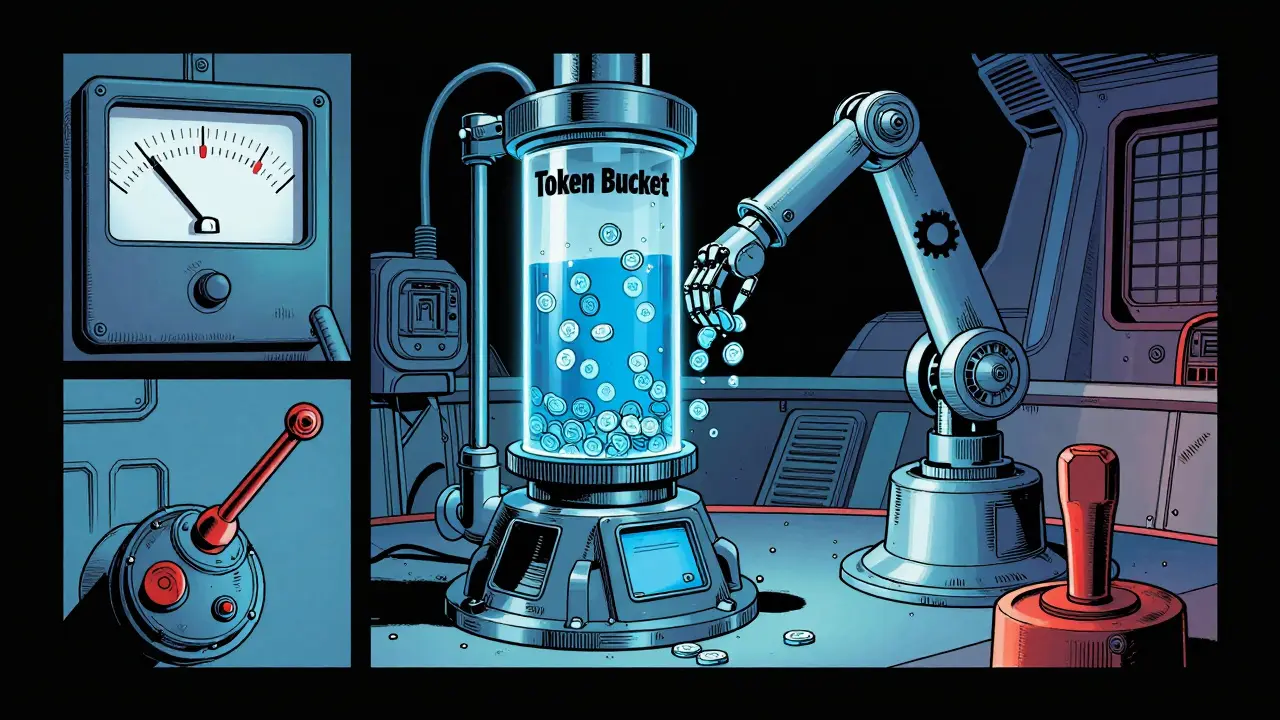
These systems use mathematical models to manage flow. The most common is the token bucket algorithm. Imagine a bucket that fills with tokens at a steady rate-say, 60,000 tokens per minute. Every time your app makes a call, tokens are removed from the bucket. If the bucket empties, the next request waits until more tokens 'fill' the bucket. Another approach, the sliding window, tracks usage over rolling periods without sharp resets, preventing users from spamming requests right after a daily reset.
Setting Up Graduated Thresholds
You don't want your AI to stop working abruptly when you hit 100% of your budget. That creates a bad user experience. Instead, experts recommend a graduated threshold system. OneUptime’s engineering team outlined a clear framework in January 2026 that many enterprises now follow:
- 50% Usage: Send a warning email to the finance or ops team. This is a heads-up, not a panic.
- 80% Usage: Trigger Slack notifications and begin monitoring closely. Consider if any non-essential features can be paused.
- 95% Usage: Initiate request throttling. Slow down response times slightly to reduce load, or downgrade complex queries to simpler, cheaper models.
- 100% Usage: Block all new requests. This is the emergency brake. Better to have a few angry users than a catastrophic bill.
This structure turns unpredictable variable costs into managed line items. It gives you time to react rather than forcing you to react in crisis mode.
Comparing Implementation Approaches
Not all token budgeting tools work the same way. Depending on your technical resources, you might choose a dedicated API gateway, a cloud-native solution, or a custom build. Here is how the major players compare as of mid-2026:
| Feature | KrakenD Enterprise | Alibaba Cloud Budget Mgmt | Custom Build (e.g., Python/Node) |
|---|---|---|---|
| Primary Strength | Dynamic routing to cheaper models | Tiered pricing integration | Full customization |
| Complexity | Medium (requires config) | Low (native dashboard) | High (3+ weeks dev time) |
| Granularity | Per-user, per-endpoint | Per-account, shared RAM users | Any level you code |
| Best For | Multi-model architectures | Single-provider ecosystems | Unique business logic needs |
KrakenD stands out because it doesn't just block traffic; it routes it. If you are approaching your budget limit for an expensive model like GPT-4o, KrakenD can automatically shift subsequent requests to a cheaper model like Haiku or Qwen-Flash. This maintains functionality while controlling costs. Alibaba Cloud offers robust native tools but warns that free quotas are often shared between main accounts and sub-users, which can make tracking individual department spending tricky unless you set up strict resource groups.
The Hidden Cost: Context Window Management
Many teams set up token quotas and think they are done. They aren't. Marcus Chen, a senior analyst at Cloud Geometry, points out a critical blind spot: context window costs. Many organizations implement quotas without considering how much history they are sending with every prompt.
If your chatbot sends the entire conversation history back to the model with every new message, your input token count grows linearly with every turn. A 10-minute conversation might cost ten times more than a 1-minute one, even if the answers are short. This inefficiency can lead to 30-40% higher expenses than necessary.
To fix this, you need aggressive summarization. Instead of sending raw logs, use a lightweight process to summarize previous interactions into a brief context summary. Tonic3’s AI Budget Framework suggests categorizing costs into Build, Run, and People. Optimizing context management falls under 'Run' costs. By reducing the average input size per request, you effectively lower your unit price without changing the model you use.

Step-by-Step Implementation Guide
Getting started with token budgeting takes about two to four weeks for a typical technical team. Here is a practical roadmap:
- Implement Token Counters (Week 1-2): Install a middleware layer or configure your API gateway (like Nginx or Kong) to log token usage for every request. Do not skip this. You cannot manage what you do not measure.
- Establish Baselines (Days 3-5): Look at your prototype data. What is the average token count per user session? Multiply this by your expected user volume to set initial monthly budgets.
- Configure Thresholds (Days 2-3): Set up the graduated alerts mentioned earlier. Start conservative. Set your hard block at 90% of your agreed budget to leave room for unexpected spikes.
- Allocate Costs (Week 4): Decide who pays. Use chargebacks or showbacks to attribute costs to specific business units or product features. Traceloop’s case studies show that granular attribution is the only way to truly control costs, as it highlights which features are burning money.
Common Pitfalls to Avoid
Even with good intentions, teams stumble. Based on feedback from Reddit’s r/MachineLearning community and Capterra reviews, here are the biggest mistakes:
- Ignoring Output Tokens: Focusing only on input limits. Remember, generation is often more expensive than ingestion.
- Static Limits: Setting a flat daily limit that doesn't account for weekend vs. weekday traffic patterns. Use sliding windows to smooth out bursts.
- Free Tier Confusion: Assuming free credits apply uniformly. As noted by Alibaba Cloud, shared quotas can mask true usage until the free tier runs out, leading to sudden billing shocks.
- Lack of Multi-Provider Standardization: Different providers count tokens differently. A 'word' in one tokenizer might be two tokens in another. Build a unified abstraction layer so your budget logic works regardless of the underlying model.
Future Trends in AI Cost Control
The market for LLM cost management is growing fast, estimated at $1.2 billion in 2025. By 2027, Gartner predicts that token budgeting will be a standard feature in 95% of enterprise AI deployments. We are seeing a shift toward tighter integration with financial operations. More companies plan to connect LLM cost data directly to their ERP systems by late 2026.
Another trend is 'weighted costs.' Newer platforms like OneUptime are experimenting with algorithms that charge more internally for requests that strain resources heavily, such as those using long context windows or complex tool calls. This internal pricing signal helps developers write more efficient code, knowing that inefficient prompts carry a higher 'internal tax.'
What is the difference between rate limiting and token budgeting?
Rate limiting controls the number of API requests allowed in a given time period (e.g., 100 requests per minute). Token budgeting controls the total amount of computational units (tokens) consumed. Since one request can vary wildly in token size, rate limiting alone does not protect against high costs if users send large payloads.
How do I calculate my monthly LLM budget?
Start by measuring your average tokens per interaction during testing. Multiply this by your projected number of interactions per month. Then, apply the provider's price per million tokens for both input and output. Add a 20-30% buffer for unexpected spikes. For example, if you expect 1 million input tokens at $0.05/million and 500k output tokens at $0.40/million, your base cost is $5 + $20 = $25. Your budget should be around $32-$35.
Can I switch models automatically when I hit my budget?
Yes, advanced API gateways like KrakenD support dynamic routing. You can configure rules to route traffic from expensive models (like GPT-4 or Claude Opus) to cheaper alternatives (like GPT-3.5 or Haiku) once a certain percentage of the budget is consumed. This preserves functionality while capping costs.
Why are output tokens more expensive than input tokens?
Generating text requires the model to perform probabilistic calculations for each new token, which is computationally intensive. Reading input (prefilling) is generally faster and less resource-heavy. Therefore, providers charge significantly more for output tokens, often 4 to 10 times the rate of input tokens.
Is it worth building a custom token tracking system?
For most teams, no. Custom builds require significant engineering time (often 3+ weeks) and ongoing maintenance. Unless you have unique compliance needs or a multi-provider setup that existing tools don't support, using established solutions like KrakenD, OneUptime, or cloud-native budget managers is more cost-effective and reliable.




8 Comments
Robert Barakat
the true cost is not in the tokens but in the attention we surrender to these probabilistic engines
we measure efficiency while losing the essence of human deliberation
the algorithm does not think it only mimics thought
and in that mimicry we find our own reflection distorted by silicon
it is a quiet erosion of agency masked as convenience
Joe Walters
look i read this whole thing and its just more corporate bs about saving money
who cares if you save a buck on tokens when the system is rigged anyway
im tired of hearing about budgets like its some big secret
just build the damn app and stop worrying about every little penny
its annoying how much people stress over this stuff
Lisa Nally
You are fundamentally misunderstanding the operational risk profile here.
Uncontrolled token consumption leads to catastrophic budget variance which directly impacts the bottom line.
We need rigorous governance frameworks implemented via API gateways to ensure deterministic cost behavior.
It is not about 'saving a buck' it is about enterprise-grade financial accountability and preventing runaway inference costs.
The distinction between input and output token pricing is critical for accurate unit economics modeling.
Without granular tracking you are essentially operating blindfolded in a high-stakes environment.
Michael Richards
listen up amateurs
if you cant manage your context window you dont deserve to use AI
summarize your history or get out of the way
real engineers know that output tokens are where the money burns
stop sending garbage prompts and start optimizing your architecture
this is basic stuff for anyone who has deployed production models
Lisa Puster
typical american obsession with counting pennies while ignoring the bigger picture
you guys are so focused on token limits you forget why you built the thing in the first place
its pathetic really
all this talk about quotas and thresholds just shows how scared you are of your own creations
maybe if you spent less time monitoring bills and more time innovating you wouldnt be so stressed
but no lets just throttle everything until nothing works properly
Edward Gilbreath
they want you to believe its about cost control
but its really about data harvesting
every token you send is another piece of your soul sold to the cloud giants
krakend and alibaba are just fronts for surveillance capitalism
why do you think they make it so hard to track individual usage?
because they want to keep you confused and dependent on their black box systems
wake up sheeple
kimberly de Bruin
is the budget real or is it just a construct of our collective anxiety
perhaps the tokens are merely symbols of our desire for control in an uncontrollable universe
we build walls around our spending while the world changes beneath us
what is a limit but a suggestion from those who wish to govern
Laura Davis
hey everyone let's keep this conversation respectful and helpful
i totally get why people are frustrated with unexpected bills
it's super stressful to wake up to a huge invoice
but instead of fighting each other let's share tips on how to set up those graduated thresholds
starting with a 50% warning email is such a game changer for peace of mind
we can all learn from each other's experiences with different providers
let's support one another in building sustainable AI projects!