You’ve probably heard the hype. Your junior dev just shipped a feature in an afternoon that used to take a week. Your senior lead is muttering about "hallucinated dependencies" while staring at a screen full of code they didn’t write. So, what’s actually happening with vibe coding and developer productivity? Is it a magic bullet, or are we just moving the bottleneck from typing to debugging?
The short answer? It’s complicated. But if you look past the noise, there’s a clear pattern emerging in late 2025 and early 2026. While some studies suggest slowdowns for experts, a massive wave of data shows that when done right, vibe coding delivers real speed. Here is what the numbers actually say, where the traps are, and how you can get on the winning side of the curve.
What Is Vibe Coding, Really?
Let’s cut through the jargon. Vibe coding isn’t just autocomplete on steroids. It’s a development style where you use natural language prompts to generate code via Large Language Models (LLMs), treating the AI as a conversational partner rather than a static tool. The term was popularized by OpenAI co-founder Andrej Karpathy, who described his workflow as "seeing things, saying things, running things, and copy-pasting things."
This shift moves developers away from writing every line manually toward curating and verifying AI-generated output. It’s less about syntax and more about intent. You describe what you want; the model drafts it; you refine it. This approach has exploded since 2023, driven by tools like GitHub Copilot, Amazon CodeWhisperer, and Google Gemini Advanced. But here’s the catch: it works differently depending on who is doing the prompting.
The 74% Claim: Separating Hype From Reality
You asked about the 74% figure. That number aligns closely with recent industry surveys, including Atlassian’s 2025 State of the Developer Survey, which found that 72% of developers believe AI assistants make them more productive. When you combine self-reported gains from major platforms like Stack Overflow and internal metrics from companies adopting these tools, the consensus hovers around a 70-75% perceived productivity uplift.
But perception isn’t always reality. A randomized controlled trial by METR involving experienced open-source developers showed a 19% increase in completion time for complex tasks, despite developers expecting a 24% reduction. This creates a "perception-reality gap." Why the discrepancy? Because most reported gains come from boilerplate generation, CRUD operations, and test scaffolding-tasks where AI shines. Complex logic integration often slows things down due to debugging overhead.
Where Vibe Coding Actually Speeds You Up
If you’re trying to decide where to deploy AI assistance, focus on high-value, low-complexity scenarios. Data from Stanford University’s analysis of over 100,000 engineers highlights specific sweet spots:
- Greenfield Projects: Starting fresh? Success rates hit 87%. Without legacy baggage, AI can scaffold entire modules quickly.
- Boilerplate & Tests: Writing unit tests and standard API endpoints is tedious. AI handles this effortlessly, saving hours per sprint.
- Popular Languages: JavaScript and Python see 35-40% productivity gains because LLMs were trained heavily on these datasets. Legacy languages like COBOL only see 8-12% improvement.
- Prototyping: Y Combinator reported that 25% of its Winter 2025 cohort used vibe coding to generate most of their initial codebase, allowing rapid iteration.
Essentially, if the task is repetitive or well-documented in public repositories, AI will likely save you time. If it involves intricate business logic or obscure legacy systems, tread carefully.
The Hidden Costs: Debugging and Context
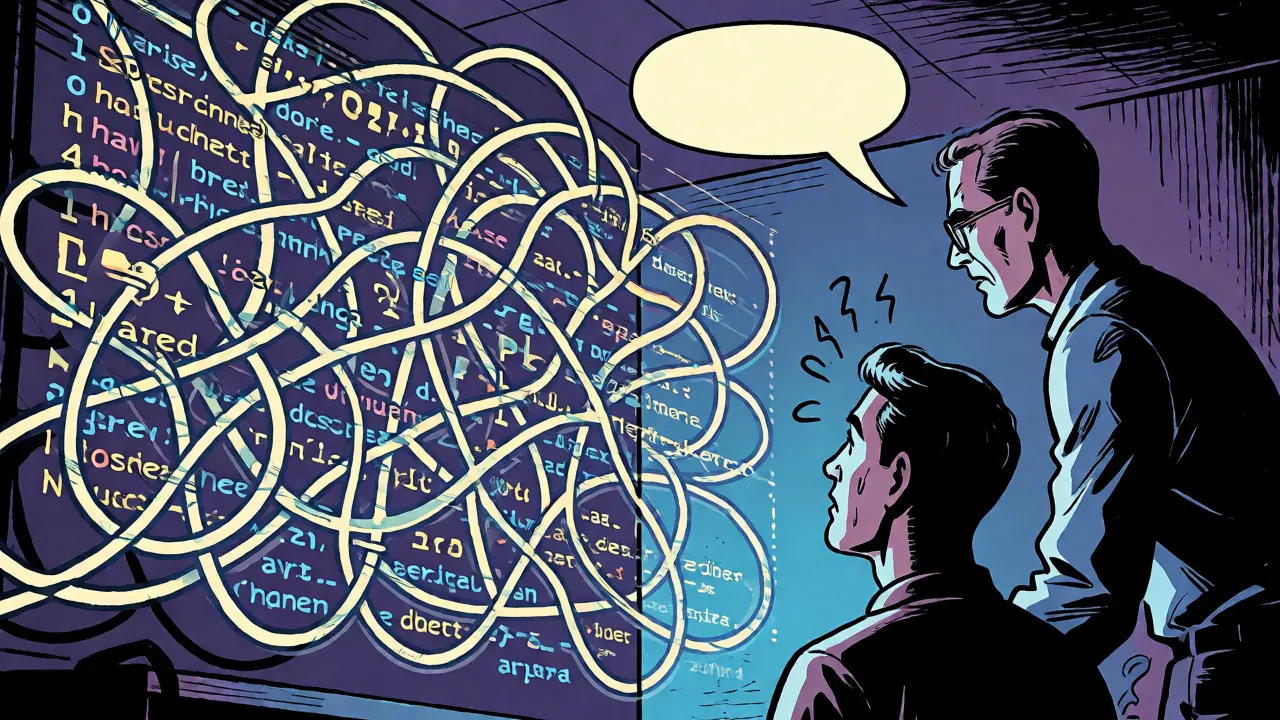
Here’s the part nobody puts in the marketing brochure: debugging AI-generated code is harder than writing it yourself. IBM case studies indicate that fixing errors in machine-written code consumes 2.7x more time than original development. Why? Because understanding someone else’s logic-even if that "someone" is an algorithm-requires significant cognitive load.
A common pitfall is "context dumping." Junior developers often paste entire codebases into the prompt window, hoping for a miracle. But LLMs have limited context windows. Performance degrades sharply after 32,000 tokens, with accuracy dropping from 90% to roughly 50%. Instead, successful teams practice Context Engineering. They selectively inject only relevant files and functions into the prompt. Developers who master this skill achieve 35% productivity gains, compared to just 12% for those who don’t.
Experience Level Matters More Than You Think
Your tenure in tech dictates your experience with vibe coding. Fastly’s July 2025 survey revealed a stark divide:
| Developer Level | AI Code Shipped | Perceived Speed Gain | Common Pitfall |
|---|---|---|---|
| Junior (0-2 years) | 78% of tasks | High initially, drops later | Rework requests up 40% |
| Mid-Level (3-9 years) | 63% of tasks | Steady 20-25% | Over-reliance on suggestions |
| Senior (10+ years) | 32% of tasks | Net positive after 18 months | Debugging hallucinations |
Juniors love the speed but struggle with quality. They report faster shipping but face 40% more rework requests during code reviews. Seniors are skeptical at first but eventually find net gains once they learn to treat AI as a junior pair programmer rather than an oracle. The key takeaway? Don’t expect immediate results. There’s a learning curve of 3-4 weeks to develop effective prompting skills.

How to Get Real Productivity Uplift
To join the 74% who report genuine gains, you need discipline. Random prompting leads to technical debt. Structured workflows lead to speed. Here’s a practical checklist for implementing vibe coding effectively:
- Start Small: Begin with non-critical components like utility functions or test cases. Do not let AI refactor your core payment processing logic on day one.
- Master Context Injection: Learn to isolate the exact files needed for a task. Use IDE features that allow you to reference specific symbols or lines rather than whole directories.
- Implement Mandatory Reviews: Treat AI code like a pull request from a new hire. Require human verification for all critical paths. 67% of adopting companies now enforce mandatory AI code audits.
- Track Rework Rates: Monitor how often AI-generated code gets rejected in review. If rework spikes, adjust your prompting strategy or restrict AI usage to simpler tasks.
- Invest in Training: Companies that provide dedicated training on prompt engineering see 28% higher output with 40% fewer defects. Tools like IBM Bob’s "Literate Coding" mode help visualize changes before application, reducing surprise bugs.
The Future: Stabilization and Skill Evolution
We are currently in the messy middle of adoption. By 2027, Gartner predicts vibe coding will evolve into "context-aware development environments," stabilizing productivity gains at 25-30% for skilled practitioners. The current chaos of hallucinations and context limits will diminish as models improve and tooling matures.
However, long-term concerns remain. 43% of CTOs worry about the maintainability of AI-generated codebases beyond three years. If you fill your project with code you don’t fully understand, you’re building a house of cards. The goal isn’t to stop coding; it’s to elevate your role from writer to architect and reviewer.
Vibe coding isn’t going away. It’s becoming a baseline expectation, much like using version control became in the early 2000s. The developers who thrive won’t be the ones who type the fastest, but the ones who ask the best questions and verify the answers rigorously.
Does vibe coding replace traditional programming skills?
No, it amplifies them. While AI handles syntax and boilerplate, you still need deep knowledge of system architecture, logic flow, and debugging strategies. In fact, strong fundamentals are more critical now because you must identify when the AI is wrong.
Why do some developers feel slower when using AI tools?
This usually happens due to poor context management or excessive debugging of hallucinated code. If you paste too much irrelevant code into the prompt, the AI’s accuracy drops. Additionally, reviewing unfamiliar AI-generated logic takes longer than reading your own code, creating a temporary slowdown until you adapt.
Which languages benefit most from vibe coding?
JavaScript, Python, TypeScript, and Java see the highest productivity gains (35-40%) because these languages dominate public code repositories used to train large language models. Niche or legacy languages like COBOL or Fortran see minimal benefits due to smaller training datasets.
How long does it take to become proficient at vibe coding?
Most developers require 3-4 weeks of dedicated practice to develop effective prompting skills. Experienced developers typically adapt 2.3x faster than juniors. However, achieving consistent net-positive productivity often takes up to 18 months of regular use, as noted in recent industry surveys.
Is AI-generated code safe for production?
Yes, provided it undergoes rigorous human review. Current guidelines, such as those from the EU’s AI Office, recommend meaningful human oversight for critical systems. Never deploy AI code without testing and security scans, as models can introduce subtle logical flaws or outdated library references.