
You have probably seen the headlines. "This image is AI-generated." "Is this text written by a human?" We are living in an era where synthetic media looks, sounds, and reads indistinguishable from reality. The promise was simple: embed a hidden signal in every AI output so we can always tell what is real and what is not. But if you have tried to use these tools in the wild, you know the story is messier. AI content watermarking is the practice of embedding imperceptible signals into generative outputs to identify them as synthetic. It sounds like a silver bullet for misinformation and deepfakes. In practice, it is a fragile shield that breaks under pressure.
As of mid-2026, the landscape has shifted. We moved from hype to hard lessons. The early days promised 99.9% detection accuracy. Today, engineers and policymakers agree on one thing: no single technical solution works alone. You need a stack of defenses. This article cuts through the jargon to explain how watermarks actually work, why they fail, and what you should be using instead to protect your brand or verify content.
How Watermarks Actually Work (And Why They Are Hard)
To understand the limits, you first need to see the mechanics. A modern AI watermark is not a logo stamped in the corner. It is a mathematical pattern hidden inside the data itself. Think of it like a secret handshake between the generator and the detector.
The system relies on two algorithms sharing a secret key. First, the embedding algorithm modifies the generation process. When a Large Language Model (LLM) picks its next word, or when a diffusion model generates pixels, the algorithm nudges the choice slightly toward a specific pattern defined by that key. To your eyes, the output looks normal. To a computer with the key, the pattern stands out against random noise.
Second, the detection algorithm scans the content. It calculates a statistical score-often a p-value or log-likelihood ratio-and compares it to a threshold. If the score crosses the line, the system flags the content as watermarked. The challenge lies in balancing three competing needs:
- Quality: The watermark must be invisible. If it degrades the image quality or makes the text sound robotic, users will disable it.
- Detectability: The system must catch most AI content (high true-positive rate) without falsely accusing human creators (low false-positive rate).
- Robustness: The signal must survive cropping, compression, paraphrasing, and re-encoding.
In theory, this balance is achievable. In the real world, robustness is the weak link. As soon as a user edits the content, the delicate statistical pattern often shatters.
Text Watermarking: The Paraphrasing Problem
Text watermarking was the first major battleground. Researchers like Scott Aaronson and teams at OpenAI pioneered methods that bias token selection. One popular approach uses a "green list" and "red list" of words. The AI is instructed to pick words from the green list more often than chance would allow. A detector simply counts how many green-list words appear in a passage.
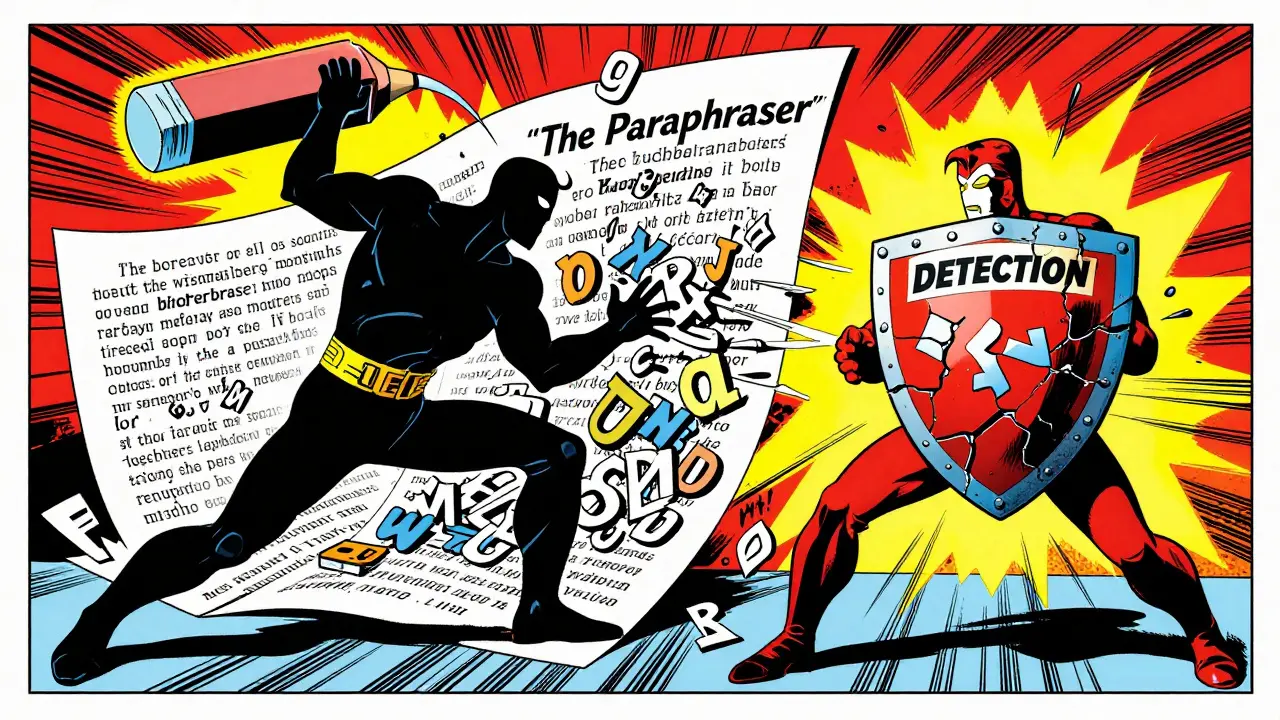
For long essays, this works surprisingly well. If you write 1,000 tokens, the statistical signal is strong enough to detect the watermark with high confidence. But try this experiment: take a watermarked paragraph and ask another LLM to "rewrite this more concisely" or "change the tone."
That is the fatal flaw. Paraphrasing attacks destroy the signal. When you rewrite text, you change the vocabulary distribution. The specific sequence of green-list tokens gets scrambled. Studies from 2023 to 2025 showed that automated paraphrasing can drop detection accuracy down to random chance (around 50%). This is why OpenAI never deployed text watermarking in ChatGPT for public use. The risk of false positives-accusing a human student of cheating because their writing style happened to match the statistical noise-was too high.
Today, text watermarking remains mostly theoretical or limited to closed enterprise environments where you control both the generation and the consumption pipeline. For open web content, it is unreliable.
Image and Video Watermarking: Surviving the Social Media Grind
Visual content faces different enemies. Images get compressed by JPEG, resized by Instagram, and cropped by TikTok. Video gets transcoded into H.264 or AV1 formats. Traditional digital watermarks from the 1990s struggled here, but AI-native approaches have made progress.
Google DeepMind’s SynthID is a post-hoc neural encoder that embeds holographic watermarks into images, audio, and video represents the current state-of-the-art for commercial deployment. Unlike older methods that hid data in specific pixel blocks, SynthID distributes the information across the entire image. This means even if you crop out half the picture, the remaining part still holds enough signal for detection.
Another approach is model-integrated watermarking, like Stable Signature is a technique that fine-tunes the decoder of latent diffusion models to bake signatures directly into the generation process. This ensures every image coming out of the model carries the mark. It is robust against minor edits but fails if you run the image through a second generative model to "clean" or restyle it.
Video adds temporal complexity. Watermarks must remain consistent across frames despite motion and compression artifacts. While prototypes exist, widespread robust video watermarking for generative content is still maturing. The "analog hole" remains a universal threat: if someone records your screen with a smartphone camera, all digital watermarks vanish instantly.
The Rise of Provenance: C2PA and Metadata
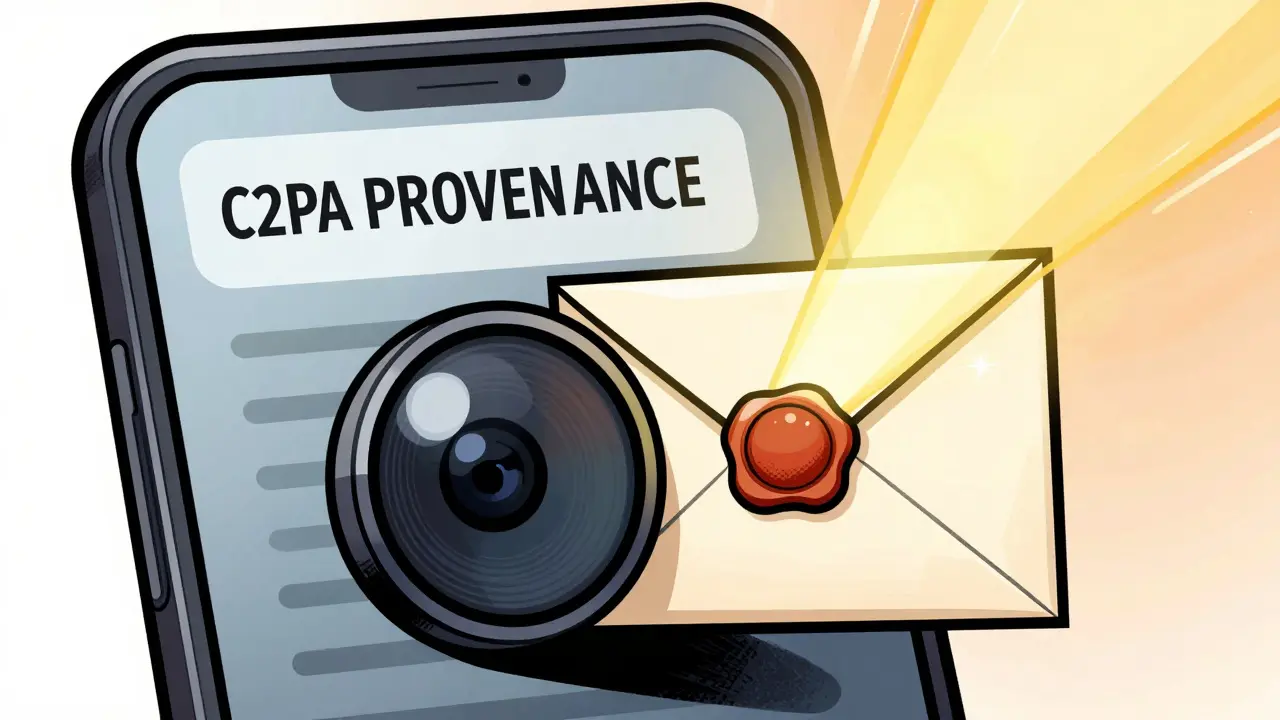
Because watermarks are fragile, the industry pivoted toward a complementary strategy: cryptographic provenance. Instead of hiding a signal in the pixels, you attach a signed receipt to the file. This is the core of the C2PA standard is a specification for cryptographically signed metadata that verifies the origin and editing history of digital content.
Major players like Adobe, Microsoft, and Intel back C2PA. When you generate an image in Adobe Firefly or Microsoft’s Bing Image Creator, the tool attaches a Content Credential. This credential contains a JSON payload signed with a private key. Anyone with the corresponding public key can verify that the file came from that specific source and hasn’t been tampered with since.
This method is incredibly strong when the metadata survives. Cryptographic verification has effectively zero false positives. However, it is brittle. Take a screenshot. Save-as a new JPEG. Upload to WhatsApp. The metadata is stripped. The provenance chain breaks. This is why C2PA and watermarking are not rivals; they are partners. Watermarks survive metadata stripping. Metadata survives heavy editing that destroys watermarks. You need both.
| Feature | Watermarking | C2PA Metadata | Heuristic Detectors |
|---|---|---|---|
| Survives Screenshots? | No (Analog Hole) | No | Yes (Analyzes visual/text patterns) |
| Survives Compression/Crop? | Moderate to High | No (Stripped on export) | Variable |
| False Positive Risk? | Low to Moderate | Near Zero (if signature valid) | High (Biased against non-native speakers/minorities) |
| Requires Provider Cooperation? | Yes | Yes | No |
| Best Use Case | Tracing leaked synthetic media | Verifying original asset integrity | Platform moderation (with caution) |
Regulatory Pressure: EU AI Act and Global Standards
Technology rarely moves fast enough on its own. Regulation is pushing the needle. The EU AI Act, fully adopted in 2024, includes Article 50, which mandates transparency for generative AI. Providers must ensure outputs are marked in a machine-readable format. The law does not force you to use a specific algorithm, but it lists watermarks, metadata, and cryptographic methods as acceptable paths.
In the United States, the approach has been softer but significant. The 2023 Executive Order on Safe, Secure, and Trustworthy AI directed NIST to develop guidelines for content authentication. Major tech companies signed voluntary commitments to implement robust watermarking mechanisms. By 2026, these voluntary norms are becoming baseline expectations for enterprise contracts. If you sell B2B AI services, clients increasingly demand proof of provenance integration.
International bodies like the ITU and OECD emphasize evaluation before reliance. They warn against using watermarks as legal proof in court due to known failure modes. This regulatory nuance is crucial: watermarks are for accountability and tracing, not for definitive judicial evidence.
Practical Implementation for Enterprises
If you are building or deploying generative AI tools, here is how to handle authenticity responsibly. Do not rely on a single vendor’s black-box claim. Build a defense-in-depth strategy.
- Integrate C2PA Early: Work with SDKs from Adobe or independent libraries to sign your assets at creation time. Ensure your workflow preserves these signatures through internal processing steps.
- Use Robust Watermarks for Public-Facing Outputs: For images and video released to the public, use solutions like SynthID or similar robust neural encoders. Accept that they are probabilistic. Configure your detection thresholds to minimize false positives rather than maximizing catch rates.
- Avoid User-Identifying Payloads: Privacy concerns are real. Embedding a user ID in a watermark allows tracking individuals across platforms. Stick to binary "AI-generated" signals or anonymized batch IDs unless you have strict legal consent frameworks.
- Monitor for Distribution Shift: Watermark detectors degrade over time as generation models improve and adversarial techniques evolve. Continuously test your detection pipeline against the latest open-source models and paraphrasing tools.
- Educate Your Users: Clearly label AI-generated content visibly. Invisible watermarks are for machines; visible labels are for humans. Transparency builds trust faster than any hidden algorithm.
Remember, the goal is not perfect detection. That is mathematically impossible against a determined adversary who can regenerate content. The goal is raising the cost of deception and providing enough signal to trace abuse when it happens.
The Future: Beyond Binary Detection
By late 2026, the conversation has moved past "Is this AI?" to "What is the provenance of this content?" Cross-modal watermarking research is advancing, allowing signals to persist when an image is turned into a video or a text prompt generates audio. Public-key watermarking concepts are emerging, allowing anyone to verify content without needing a secret key from the provider.
We are also seeing the rise of behavioral analytics. Instead of just looking at the static file, platforms analyze how content spreads. Synthetic media often exhibits distinct viral patterns compared to organic human content. Combining these signals creates a much stronger net than any watermark alone.
The bottom line is clear. Watermarking is a necessary tool, but it is not a magic wand. It works best when combined with cryptographic provenance, visible labeling, and platform governance. Treat it as one layer in a broader security architecture. Stay skeptical of claims promising 100% accuracy. And always assume that if you hide a signal, someone will eventually find a way to remove it.
Can AI watermarks be removed easily?
Yes, depending on the method. Text watermarks are easily destroyed by paraphrasing or rewriting. Image watermarks can be degraded by heavy cropping, compression, or running the image through another generative model. The "analog hole"-recording a screen with a camera-removes all digital watermarks instantly. No current watermark is provably unremovable against a determined adversary.
What is the difference between C2PA and watermarking?
C2PA attaches cryptographically signed metadata to a file, proving its origin and edit history. It is highly reliable but easily stripped by saving or screenshotting. Watermarking embeds a signal directly into the content's pixels or text structure. It survives metadata stripping but is less reliable and probabilistic. They are complementary technologies.
Why did OpenAI stop using text watermarking in ChatGPT?
OpenAI abandoned public text watermarking due to robustness issues and high false-positive risks. Paraphrasing attacks could break the signal, and statistical detectors sometimes flagged human-written text as AI, particularly affecting non-native English speakers. The potential for harm outweighed the benefits.
Is SynthID free to use?
SynthID is integrated into Google Cloud’s Vertex AI offerings. While there is no separate standalone price list for the watermarking feature itself, it is bundled with the costs of using the generative models on the platform. It is designed as an enterprise-grade tool rather than a consumer app.
Does the EU AI Act require specific watermarking technology?
No. Article 50 of the EU AI Act requires that AI-generated content be marked in a machine-readable format, but it does not mandate a specific algorithm. Providers can choose from watermarks, metadata, cryptographic methods, or other techniques, provided they meet the transparency obligation.


6 Comments
om gman
another day another article telling us the sky is falling but its just a cloud
you guys really think some metadata tag is gonna stop a teenager with a script from stripping it out in 3 seconds? please. the whole industry is built on vaporware and hope
Francis Laquerre
I have to say, reading this gives me such a profound sense of melancholy regarding the future of truth
We are building these complex digital cathedrals of verification only to watch them crumble under the weight of human ingenuity and malice
The tragedy is not that we cannot detect AI, but that we are losing the shared reality that made detection necessary in the first place
It feels like we are shouting into a void that has learned to shout back perfectly
My heart breaks for the journalists and historians who will inherit this mess
There is a dramatic irony in using technology to prove humanity exists when technology is erasing the distinction entirely
We must find a way to preserve the soul of our content even if the body is synthetic
It is a sad state of affairs indeed
Edward Nigma
u r wrong about the false positives being the main issue
the real problem is that humans suck at writing so ai looks better than half the stuff on reddit anyway
why do we need to detect it if the output is superior?
stop crying about authenticity and start worrying about quality
also ur grammar in the post was fine but ur tone is pretentious as hell
Saranya M.L.
Let me educate you on the actual technical nuances here since most western commentators clearly lack the rigorous engineering discipline required to understand cryptographic provenance systems
In India, we do not rely on fragile watermarks because we understand that true security comes from immutable ledger-based verification which is why our fintech sector is years ahead of yours in implementing C2PA standards effectively
Your reliance on probabilistic models is a sign of intellectual laziness and a failure to grasp the deterministic nature of modern authentication protocols
Andrea Alonzo
I completely understand where everyone is coming from in this discussion because it is truly heartbreaking to see how quickly we are moving forward without taking the time to consider the emotional impact on creators who feel their life's work is being devalued by algorithms that they did not ask for and do not fully understand
I have been mentoring young artists who are struggling with this exact dilemma and I can tell you that the anxiety they feel is palpable and real and it is not something that can be solved with a simple technical fix or a policy update from a big tech company
michael rome
Let us look at this from a strategic perspective and focus on actionable steps we can take immediately to secure our digital assets and protect our brand integrity in this evolving landscape
Firstly it is imperative that we integrate C2PA standards into our workflow from day one because waiting until later will only result in greater vulnerability and loss of control over our content distribution channels
Secondly we must adopt a defense-in-depth approach that combines multiple layers of verification including both visible labeling for human consumers and invisible watermarks for machine detection systems
Thirdly we need to educate our teams on the importance of metadata preservation and ensure that our internal processes do not inadvertently strip critical provenance information during editing or export stages
Fourthly we should establish clear guidelines for user-generated content and provide tools that make it easy for contributors to mark their work appropriately without friction or confusion
Fifthly we must monitor the regulatory environment closely and stay ahead of compliance requirements particularly in markets like the EU where the AI Act imposes strict transparency obligations
Sixthly we should invest in continuous testing and validation of our detection pipelines to ensure they remain effective against emerging adversarial techniques and model updates
Seventhly we need to foster a culture of transparency within our organization where employees feel empowered to report suspicious activity and ask questions about authenticity protocols
Eighthly we should collaborate with industry peers and standards bodies to share best practices and develop common frameworks for content authentication that benefit everyone
Ninthly we must prioritize privacy considerations and avoid embedding personally identifiable information in watermarks unless absolutely necessary and legally justified
Tenthly we should regularly review and update our policies to reflect new technologies and threats ensuring that our strategy remains relevant and effective over time
By following these ten principles we can build a resilient framework for managing AI-generated content that protects our interests while maintaining trust with our audience
Let us move forward with confidence and clarity knowing that we have taken proactive steps to address these challenges head-on
Together we can shape a future where technology serves humanity rather than undermining it
Stay focused stay informed and stay committed to excellence in all your endeavors