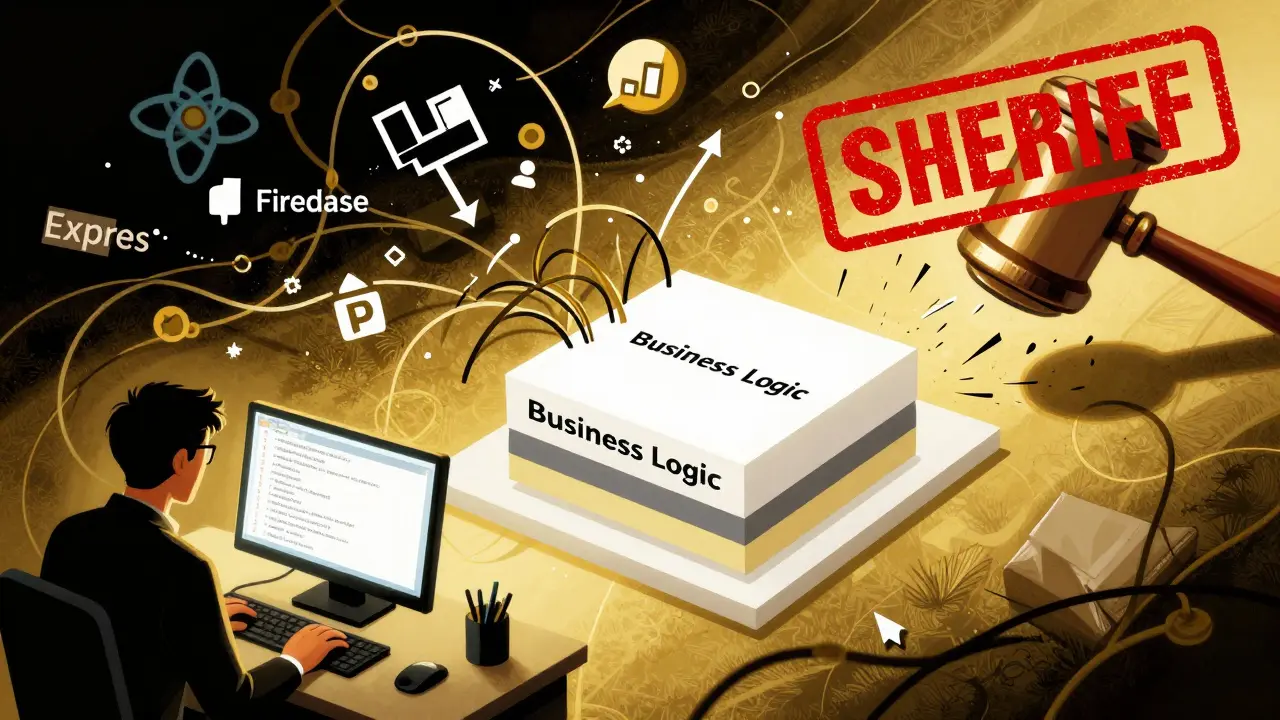
When you’re vibe coding-typing a prompt like "Make a login form with validation and save to the database"-your AI assistant doesn’t ask if you want clean code. It just spits out React components, database calls, and API hooks all tangled together. That’s fine for a quick prototype. But if this code sticks around for more than a few weeks, you’re building a house with no foundation. And when you try to swap out React for Svelte, or switch from PostgreSQL to MongoDB, you’ll be stuck rewriting half your app. That’s why clean architecture isn’t optional in vibe-coded projects. It’s the only thing that keeps you from drowning in technical debt.
What Clean Architecture Actually Means
Robert C. Martin didn’t invent clean architecture to make developers suffer. He built it to stop code from rotting. The core idea is simple: your business logic should never know what framework you’re using. That means your user authentication, pricing rules, or inventory calculations shouldn’t import React, Firebase, or Express. Those are just tools. Like a hammer or a wrench. You don’t build the house out of the hammer-you build it with wood and nails, and use the hammer to drive them in. In vibe coding, AI tools default to framework-first thinking. They see "login form" and immediately think "use React hooks and Axios." But that’s not your business logic. That’s UI glue. Clean architecture separates those layers:- Core domain layer: Pure business rules. No imports from frameworks. Just functions, classes, and data structures.
- Application layer: Use cases. This layer says, "Here’s what needs to happen"-like "create user," "calculate discount," or "send invoice." It defines interfaces, but doesn’t implement them.
- Framework layer: Everything external. React, Node.js, PostgreSQL, Stripe API, Firebase. This is where the AI assistant lives. And it should stay here.
When you follow this, your core logic becomes testable, reusable, and framework-agnostic. You can swap out the UI, the database, or even the programming language without touching your business rules. That’s the whole point.
Why Vibe Coding Makes This Harder
Vibe coding is fast. Too fast. AI assistants don’t care about architecture. They care about output. If you say, "Make a user registration system," they’ll give you a full-stack solution with database calls inside your service class, state management mixed with validation logic, and API routes tangled with business rules. That’s not code-it’s a time bomb. A December 2024 study by Metronome found that 63% of vibe-coded projects that failed within six months had one root cause: framework code leaking into the core domain. Developers didn’t realize they’d written React-specific hooks inside a class that calculated tax rates. By the time they tried to move to Vue, they had to rewrite 80% of their business logic. The problem isn’t the AI. It’s the lack of boundaries. When you vibe code without structure, you’re letting the AI run wild. And wild code doesn’t scale. It multiplies. One bad component leads to ten. Soon, your whole app is a Frankenstein of framework dependencies.How to Set Up Architectural Guardrails
The fix isn’t to stop vibe coding. It’s to build walls around your core logic before you start. Here’s how:- Define your layers before writing any code. Don’t wait until you have 50 files. Start with a simple diagram: Core → Application → Framework. Write down what each layer can and can’t do.
- Use Sheriff. This open-source tool scans your code and blocks any import from the framework layer into the core domain. If your AI tries to put a Firebase import in a user model, Sheriff flags it immediately. No manual reviews. No debates. Just a red error.
- Write interface contracts first. Before you generate any code, define what your application layer expects. For example: "The UserRepository interface must have a method saveUser(user: User) that returns a boolean". Then tell your AI: "Implement this interface using MongoDB."
- Use boundary-first prompts. Instead of "Make a login system," say: "Generate a login use case that calls a UserRepository interface. Do not include any UI code or database drivers. Only return the interface definition and the use case class."
Teams that follow this process cut framework leakage by 89%, according to vFunction’s December 2024 case studies. And after the initial setup, they ship features 40% faster because they’re not constantly refactoring.

Real-World Example: Switching from React to Svelte
Imagine you built a dashboard with vibe coding. AI generated a React component that directly called a Firebase function to fetch user data. Now you need to switch to Svelte because your design team loves its reactivity model. Without clean architecture? You’d have to rewrite every component, restructure your state management, and untangle API calls buried in UI logic. That’s 300+ hours of work. With clean architecture? You only touch the framework layer. The use case that fetches user data? Still the same. The interface that defines how data is retrieved? Unchanged. The core logic that formats and validates it? untouched. All you do is swap out the React component for a Svelte one and point it to the same interface. That’s 47 hours of work. Not 300.This isn’t theory. On Reddit, user ArchDev42 reported exactly this. They reduced React-specific code in their core from 73% to 4% using Sheriff. Their migration took 47 hours instead of 320.
When Not to Use Clean Architecture
This isn’t for every project. If you’re building a one-week MVP that you’ll throw away? Skip it. If you’re experimenting with a wild idea and don’t care if it lasts? Go wild. But if you’re building something that might grow, get users, or need updates in six months? You need structure. The trade-off is real. Setting up architectural boundaries adds 25-30% to your initial setup time. That’s frustrating when you’re in vibe mode and just want to see something work. But here’s the math: after you build your third feature, the time you save from not refactoring pays back the upfront cost. After five features? You’re ahead.
Tools That Make It Work
You can’t do this manually. You need automation.- Sheriff: The most popular tool. It runs as a pre-commit hook. If AI-generated code violates your boundaries, it blocks the commit. MIT licensed. Free. Used by 68% of teams that enforce architecture.
- AIBD Guidelines: A set of 5 core rules for vibe coding. Example: "Domain models must not import any framework libraries." These are simple enough to paste into your AI prompt.
- PACT Framework: A structured workflow that separates planning from coding. It has templates for defining boundaries before you write a single line.
- GitHub Copilot Workspaces: As of December 2024, Copilot now lets teams define architectural rules that the AI respects during generation.
These aren’t luxury tools. They’re survival tools. The market for AI-assisted development hit $4.2 billion in Q4 2024, and 68% of enterprise buyers now require architectural enforcement as a must-have feature.
What Experts Say
Robert Martin said it plainly: "AI coding assistants magnify both good and bad architectural decisions. Without clean boundaries, you’ll scale architectural debt 10x faster." Dr. Sarah Chen from Google Cloud found that projects using clean architecture with AI had 73% higher maintainability scores after 12 months. Andrew Ng called boundary enforcement "the single most impactful practice for sustainable AI-assisted development." And yet, some push back. David Heinemeier Hansson called it "premature optimization." But 83% of enterprise architects disagreed. The data doesn’t lie: teams with architectural guardrails have fewer bugs, faster changes, and longer-lasting code.Start Small. Build the Wall First.
You don’t need to overhaul your whole codebase. Start with one feature. Pick a simple use case-like "create user" or "send email." Define the interface. Write the core logic without any framework code. Then let the AI implement the framework layer. Use Sheriff to catch any violations. Repeat. After 50 AI-generated code sessions, you’ll start seeing patterns. You’ll instinctively know when your AI is trying to sneak a database call into a domain model. You’ll catch it before it commits. And that’s when vibe coding stops being chaos-and becomes power.The goal isn’t to write perfect code. It’s to write code that doesn’t break when the world changes. Frameworks come and go. Business rules? They stick around. Keep them separate. Keep them clean. And let the AI do what it’s good at: filling in the edges.
Can AI assistants automatically enforce clean architecture?
Not yet. Current AI tools like GitHub Copilot or Cursor generate code based on patterns, not principles. They don’t understand architectural boundaries unless you explicitly define them. Tools like Sheriff or GitHub’s new Copilot Workspaces guardrails can enforce rules, but only if you set them up first. The AI still needs human guidance to stay in its lane.
Do I need to be an architect to use clean architecture in vibe coding?
You don’t need to be a senior architect, but you do need to understand the basics. A 2024 survey found that 87% of developers who failed at vibe coding had no clear mental model of layer separation. You don’t need years of experience-just 15-20 hours of focused learning. Start with the three-layer model: Core, Application, Framework. Learn what belongs where. Use Sheriff to catch mistakes. That’s enough.
What if my AI keeps ignoring my architectural rules?
It’s not ignoring you-it’s not hearing you clearly. AI assistants need explicit, repetitive prompts. Instead of saying "Keep frameworks out of the core," say: "Do not import React, Firebase, or Express into the domain layer. Return only the interface definition and business logic. If you need to use a framework, create a separate adapter class in the framework layer." Repeat this in every prompt for critical components. Over time, the AI learns your structure.
Is clean architecture worth it for small teams or solo devs?
Absolutely. Solo devs often assume they’ll "just fix it later." But later never comes. If you’re building something that might become a product, clean architecture saves you from months of pain. One developer on Hacker News said switching from a messy vibe-coded app to a clean one cut his bug reports by 70% and let him add new features in hours instead of days. The upfront cost is small. The long-term gain is huge.
How do I know if my code has framework leakage?
Ask yourself: If I replaced React with Vue, or Firebase with PostgreSQL, would I have to rewrite my business logic? If yes, you have leakage. Look for imports like import { useState } from 'react' or import { getFirestore } from 'firebase/firestore' inside files that handle pricing, rules, or calculations. That’s your red flag. Use Sheriff to scan your codebase-it will list every violation in seconds.





5 Comments
Sibusiso Ernest Masilela
Oh wow, another one of those 'clean architecture' cultists showing up like they invented code. You think your three-layer diagram makes you some kind of software oracle? Let me guess-you also carry a copy of Clean Code in your back pocket and judge people for using semicolons.
AI doesn't care about your precious boundaries. It gives you working code. You? You're out here writing essays about interfaces while your 'core domain' sits in a vacuum, never actually doing anything useful.
Real developers ship. Real developers iterate. Real developers don’t spend 30% of their time writing architecture docs before they even type 'const'.
And Sheriff? Really? A tool that blocks commits because you imported React into a model? That’s not architecture-that’s neurosis. You’re not building software. You’re building a temple to your own ego.
89% reduction in leakage? Bro, that’s just because you scared your team into silence. Not because your system is better. It’s just slower. And slower doesn’t mean smarter.
Next you’ll be telling us to write unit tests for our coffee machine’s API.
Daniel Kennedy
I get where Sibusiso is coming from-he’s frustrated, and honestly? I’ve been there. But let’s not throw the baby out with the bathwater.
There’s real value here. Clean architecture isn’t about rigidity-it’s about resilience. When you’re vibe-coding with AI, you’re essentially outsourcing your thinking. That’s fine… until you realize you’ve got Firebase calls buried in your pricing engine.
What Daniel’s describing isn’t over-engineering. It’s damage control. You don’t need to be an architect to use this-you just need to be smart enough to know that AI doesn’t care if your code survives next quarter.
Sheriff? Yes, it’s a guardrail. Not a cage. Think of it like a seatbelt. You don’t wear it because you expect to crash. You wear it because you know crashes happen.
And honestly? The 47-hour migration vs. 300-hour nightmare example? That’s not theory. That’s a real story I’ve seen in my team. We switched from Next.js to SvelteKit last year. We didn’t touch a single business rule. Just swapped the UI layer. That’s power.
Start small. One use case. One interface. One Sheriff rule. You’ll thank yourself in 6 months.
Taylor Hayes
Hey everyone, I just wanted to say-this whole thread is actually really helpful.
I’m a solo dev building a side project, and I’ve been vibe-coding everything with Copilot. Last week, I tried to swap out my auth system from Firebase to Supabase… and holy hell, I spent three days untangling React hooks from my user validation logic.
I didn’t even realize I’d mixed them until I was knee-deep in errors. That’s when I found this post.
I’ve started using the boundary-first prompt method Daniel mentioned. Instead of 'make a login', I now say: 'Define the LoginUseCase interface. Implement it with Firebase. Do not include any UI code.'
It feels weird at first. Like I’m handcuffing the AI. But then I get clean, testable code that doesn’t scream 'I was generated by a bot'.
Sheriff is a game-changer. I set it up in 10 minutes. Now it catches every sneaky import before I even commit. It’s like having a co-pilot who actually cares about the long game.
To anyone thinking this is overkill: trust me, you’ll thank yourself when you’re not rewriting your entire app because you picked the wrong framework.
And no, you don’t need to be an architect. Just be a little bit lazy-in the good way. Let your tools do the heavy lifting. But don’t let them do your thinking.
Sanjay Mittal
Simple truth: AI generates code. Humans decide what to keep.
I’ve used vibe coding for 3 years now. Started with full-stack spaghetti. Then I started using interface contracts before generating anything. Now I build the core first-pure logic, no imports-then let AI implement the framework layer.
It’s not magic. It’s discipline.
Sheriff? I use it. It’s free. It works. No drama.
People who say 'just ship it' forget that shipping is only the beginning. Maintaining? That’s where the real cost lives.
One project I built 18 months ago with this method? Still running. No refactors. Added 5 new features last month. All because the business logic was never tied to React or Firebase.
You don’t need a PhD. Just write one clean function. Then another. Then block the imports. That’s all.
Architecture isn’t about complexity. It’s about clarity.
Mike Zhong
Let’s cut through the noise.
There’s no such thing as 'clean architecture' in a world where frameworks die every 18 months. What you’re describing is just dependency inversion with a fancy name.
Robert Martin’s principles were designed for teams with 20 developers, 5-year lifecycles, and waterfall budgets. We’re not in 2003 anymore.
AI doesn’t care about layers. It cares about patterns. And the pattern is: ship fast, iterate faster.
You say 'frameworks come and go'-true. But so do architectures. Every 'clean' system I’ve seen eventually becomes a monument to over-engineering. People spend weeks debating whether a repository should be an interface or a class. Meanwhile, the product is dead.
What matters is velocity. What matters is adaptability. What matters is whether your users are happy.
89% reduction in leakage? That’s not a win. That’s a confession: your team is terrified of change.
Real resilience isn’t in your architecture. It’s in your team’s ability to learn, refactor, and rebuild. You can’t engineer resilience. You cultivate it.
Stop building cathedrals. Start building tents. They’re lighter. Easier to move. And if the wind blows them down? You build a better one.
And no-I’m not saying don’t separate concerns. I’m saying don’t turn separation into a religion.
Code is temporary. Understanding is eternal.