
You type a prompt like 'build me a user login page with database connection,' and within seconds, the AI generates the code. It looks clean. It works in your local environment. But somewhere in that generated script, an API key is hardcoded, or a CORS setting allows anyone on the internet to access your backend. This is the hidden risk of vibe coding.
Vibe coding is more than just a trend; it's a shift in how we build software. By using natural language to direct AI models, developers speed up production dramatically. However, this speed comes at a cost: security hygiene often takes a backseat. The core problem isn't the AI itself, but the lack of strict data classification rules applied to the inputs you provide and the outputs the model generates.
Without clear governance, vibe coding tools treat all data as equal. They don't know that a customer's email address requires encryption while a button label does not. To protect your organization, you need a framework that classifies data sensitivity before it enters the AI and verifies its integrity after it leaves. Here is how to establish those rules effectively.
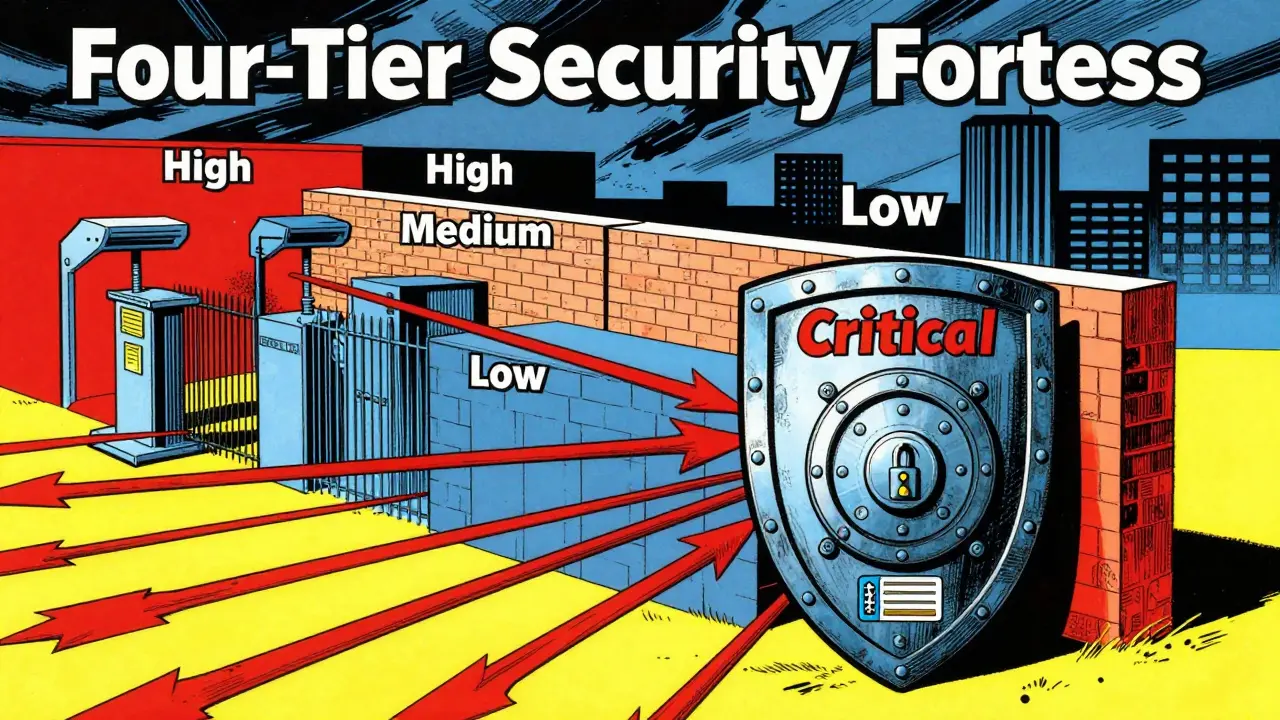
The Four-Tier Data Classification Framework
To manage risk, you cannot rely on vague guidelines. You need a structured taxonomy. The most effective approach divides components into four distinct tiers based on sensitivity and potential impact. This structure helps teams decide how much verification each piece of code needs.
| Classification Tier | Data Type Examples | Verification Requirement | Review Process |
|---|---|---|---|
| Critical | PII, Financial Data, Authentication Secrets | Level 3 Verification | Mandatory Security Specialist Review |
| High | Data Processing Logic, Integration Points | Level 2 Verification | Automated Scanning + Peer Review |
| Medium | Standard Functionality, UI Components | Level 2 Verification | Automated Scanning Only |
| Low | Internal Tools, Non-critical Scripts | Level 1 Verification | Ongoing Compliance Monitoring |
When you classify a component as Critical, you are signaling that a breach here could lead to legal liability or severe financial loss. These components require Level 3 verification, which means a human security expert must review the code. For High-tier items, automated scans combined with peer reviews suffice. This risk-stratified approach ensures you aren't wasting time manually reviewing every line of CSS while focusing intense scrutiny on database queries handling user passwords.
Securing Inputs: Environment Variables and Prompts
The first point of failure in vibe coding is often the input. Developers frequently paste sensitive configuration details directly into prompts or allow the AI to generate code with hardcoded credentials. This violates basic security principles.
A fundamental rule is that no secret should ever exist in plain text within generated code. Instead, enforce a policy where all database URLs, usernames, passwords, and API keys are managed via environment variables. This separates configuration from code, ensuring that secrets are stored securely outside the application logic.
Consider a scenario where you ask an AI to connect to a PostgreSQL database. A naive output might look like this:
const dbUrl = "postgresql://admin:password123@localhost/mydb";This is a critical vulnerability. Your governance rules must mandate that the AI generates code referencing an environment variable instead:
const dbUrl = process.env.DATABASE_URL;Additionally, system owners must extend enterprise security requirements into the prompt templates themselves. If your organization has specific privacy standards, these criteria should be embedded in the initial instructions given to the AI. This proactive measure reduces the likelihood of the model generating non-compliant structures from the start.
Validating Outputs: Common Vulnerability Patterns
Even with secure inputs, AI-generated outputs can introduce vulnerabilities due to misconfigured defaults. Research by Escape Technologies analyzed thousands of applications built with vibe coding platforms like Lovable, Base44, and Bolt.new. They found systematic failures in how these tools handle security configurations.
Exposed Secrets and Service Role Keys
One of the most dangerous patterns is the exposure of service role keys. In platforms like Supabase, service role keys have elevated privileges that bypass row-level security checks. When vibe coding tools generate frontend code, they sometimes embed these keys directly in the JavaScript bundle. This allows any user who inspects the browser code to gain full administrative access to your database.
Your classification rules must flag any output containing strings that resemble API keys or tokens as Critical violations. Automated scanning tools should block deployment if such patterns are detected without proper obfuscation or server-side mediation.
CORS Misconfigurations
Cross-Origin Resource Sharing (CORS) controls which websites can interact with your API. Vibe coding tools often default to wildcard settings (*), allowing any domain to make requests. While convenient for development, this is a severe security risk in production.
Governance policies must require manual verification of CORS headers. The output must explicitly list trusted domains rather than using wildcards. This ensures that only authorized applications can consume your APIs, protecting against cross-site request forgery attacks.
Row-Level Security (RLS) Gaps
Row-Level Security ensures users only see their own data. However, vibe coding tools often generate RLS policies that are too permissive, suitable only for sandbox environments. A common error occurs when JWT tokens are exposed in frontend code, breaking the trust boundary between client and server.
Effective validation involves replay testing. Security teams should test generated applications by sending requests without authentication tokens or with modified headers. If the application returns protected data, the RLS policy has failed. This testing must be part of the verification checklist for all High and Critical tier components.
PII Detection and Tagging Challenges
Personally Identifiable Information (PII) presents unique challenges in vibe coding. Detecting PII patterns like email addresses or phone numbers is technically straightforward using regex rules. The difficulty lies in the sequencing of classification logic.
Many data classification tools apply exclusion logic after tagging operations. For example, if you tag all text fields as PII and then try to exclude public profile names, the exclusion might fail if applied too late in the pipeline. This renders the exclusion function ineffective, leading to false positives or missed protections.
To mitigate this, ensure that your data classification framework applies exclusion rules before bulk tagging. Define clear boundaries for what constitutes PII versus public data. Use permutation testing on sample datasets to identify PII groupings accurately. This precision prevents over-classification, which can slow down development, and under-classification, which exposes sensitive user data.

Risk-Based Verification and Oversight
Comprehensive manual review of every line of AI-generated code is operationally impossible. Instead, adopt a risk-based verification model. Intensity of oversight should correlate with the potential impact of a security failure.
- Critical Components: Require direct review of verification evidence and formal security assessment approval. No exceptions.
- High Components: Undergo regular sampling of verification completeness. Monitor security metrics to detect trends in vulnerability introduction.
- Medium/Low Components: Rely primarily on automated scanning and continuous compliance monitoring.
This approach acknowledges resource constraints while maintaining robust protection for high-value assets. It also allows teams to scale vibe coding adoption without overwhelming security personnel.
Continuous Adaptation and Platform Diversity
Vibe coding platforms evolve rapidly. Vulnerabilities present in January 2025 may be patched by mid-2026, but new ones will emerge. Static security rules become obsolete quickly. Your governance framework must include mechanisms for ongoing reassessment.
Be aware of platform-specific biases. Research datasets often skew heavily toward popular platforms like Lovable, leaving gaps in understanding risks associated with smaller tools like Create.xyz or Vibe Studio. Each platform has different default configurations and security architectures. Tailor your classification rules to account for these differences.
Integrate enterprise knowledge management systems with your data classification governance. This ensures that updates to organizational security policies automatically propagate to vibe coding prompt templates and verification checklists. Synchronization prevents drift between stated policies and actual implementation practices.
What is vibe coding?
Vibe coding is an AI-assisted programming approach where users describe software requirements in natural language, and large language models generate the corresponding code implementations. It accelerates development but introduces unique security risks if not properly governed.
Why are environment variables important in vibe coding?
Environment variables keep sensitive data like API keys and database passwords out of the source code. Hardcoding secrets in AI-generated code leads to critical vulnerabilities where attackers can easily extract credentials from the application bundle.
How do I handle PII in AI-generated code?
Classify PII as Critical data. Implement strict detection rules using regex and permutation testing. Ensure exclusion logic is applied before bulk tagging to prevent misclassification. Always encrypt PII in transit and at rest.
What are the risks of default CORS settings in vibe coding?
AI tools often default to wildcard CORS settings, allowing any website to access your API. This creates a significant security risk. You must manually configure CORS to restrict access to only trusted, specific domains.
Is manual code review necessary for vibe coding?
Yes, especially for Critical and High-tier components. While automated scanning handles routine checks, human experts must verify complex security logic, authentication flows, and compliance with enterprise standards to catch nuanced vulnerabilities.




7 Comments
Caitlin Donehue
I honestly just assumed the AI would know better than to put my password in the code, but reading this makes me realize how naive that is.
om gman
lol another day another security crisis caused by people who cant even write a for loop without asking a robot. vibe coding is just lazy dev culture on steroids and now we have to clean up the mess because everyone wants to be a CTO overnight. its pathetic really. you guys are playing with fire and pretending its a campfire roast. the service role keys issue is basically screaming at anyone who knows what theyre doing. stop being idiots.
Saranya M.L.
The methodology outlined here is fundamentally sound, yet it is disheartening to observe the persistent lack of discipline among modern practitioners who rely on such automated outputs without applying rigorous governance frameworks. It is imperative that organizations adopt the four-tier classification system immediately, as the exposure of service role keys represents a catastrophic failure of basic security hygiene that should never have occurred in a professional environment. One must question why developers continue to accept default configurations that prioritize convenience over integrity, thereby exposing their infrastructure to trivial exploitation by any individual with minimal technical proficiency. The integration of environment variables is not merely a suggestion but a non-negotiable standard for maintaining operational security, and those who fail to implement these controls are demonstrating a profound disregard for data sovereignty and user privacy rights.
Andrea Alonzo
I completely understand where everyone is coming from when they feel overwhelmed by the sheer speed at which these tools are changing the landscape of software development, and it is so important that we approach this conversation with empathy rather than judgment because many of us are just trying our best to keep up with evolving technologies while also managing complex team dynamics and stakeholder expectations. When I read about the risks associated with hardcoded API keys, I find myself thinking about all the junior developers who might be feeling pressured to deliver results quickly without having the full context of the security implications, and I truly believe that creating a supportive environment where questions can be asked without fear of ridicule is essential for fostering a culture of safety and continuous learning. We need to remember that mistakes are part of the learning process, and instead of pointing fingers, we should focus on building robust systems and educational resources that help everyone navigate these new challenges together, ensuring that no one feels left behind or blamed for the inherent complexities of integrating AI into our workflows. By working collaboratively and sharing our experiences, we can create a more inclusive and secure future for all developers, regardless of their background or level of expertise, and ultimately strengthen the entire community through mutual support and understanding.
Jeanne Abrahams
Ah yes, because nothing says 'secure enterprise application' like letting an LLM guess your CORS policy while you sip artisanal coffee. In South Africa, we call this 'boetie logic' - assuming everything will work out fine because it worked once in a sandbox. The bit about Supabase service role keys is particularly amusing since half the tutorials online still treat them like confetti. Maybe if we stopped treating security as an afterthought and started treating it like breathing, we wouldn't need a forty-page guide to tell us not to paste passwords into prompts. But sure, let's blame the tool instead of the user who clearly hasn't read a single RFC since 2012.
Bineesh Mathew
The essence of this digital alchemy reveals a profound moral decay within the technological zeitgeist, where the pursuit of ephemeral efficiency eclipses the sacred duty of stewardship over data sanctity. To allow such unvetted constructs to permeate the fabric of our interconnected existence is to invite chaos into the ordered garden of human endeavor, a transgression against the very principles of trust that bind society together. One must ponder whether the allure of rapid creation justifies the erosion of foundational security, for in doing so we sacrifice the long-term integrity of our systems for the fleeting dopamine hit of instant gratification. This is not merely a technical oversight but a spiritual failing, a refusal to acknowledge the weight of responsibility that accompanies the power to shape reality through code. We stand at a precipice, gazing into the abyss of automated negligence, and must choose whether to step back with humility or leap forward with reckless abandon.
Oskar Falkenberg
hey i totally agree with the part about environment variables cause ive seen too many projects blow up because someone hard coded a key in github and then it ended up on pastebin or something. its kinda wild how easy it is to mess up when you just type natural language and expect magic to happen safely. i think the tiered approach makes sense though because reviewing every single line of css generated by ai would drive me insane and probably slow down the whole team to a crawl. maybe we could use some automated scanners first before calling in the security experts for the critical stuff? just a thought really but it seems like a good balance between speed and safety. also the cors wildcard thing is super common in dev mode so its easy to forget to change it for prod unless you have a checklist or something. anyway just my two cents hope this helps!