It is easy to look at a chatbot or an image generator in 2026 and think this technology appeared out of nowhere. But the path from simple probability math to the massive Generative AI systems that define our current era is long, winding, and filled with dead ends. This is not just a story of better computers; it is a story of changing mathematical ideas about how machines can create something new rather than just sorting what already exists.
We often hear about the "AI boom" starting around 2017, but the roots go back nearly a century. To understand where we are, we have to look at the tools we threw away along the way. You will see that every major breakthrough built on the failures of the previous generation, trading speed for accuracy, or memory for context. Here is the technical journey from early probability chains to the attention mechanisms that power modern intelligence.
The Probabilistic Foundations: Markov and Early Attempts
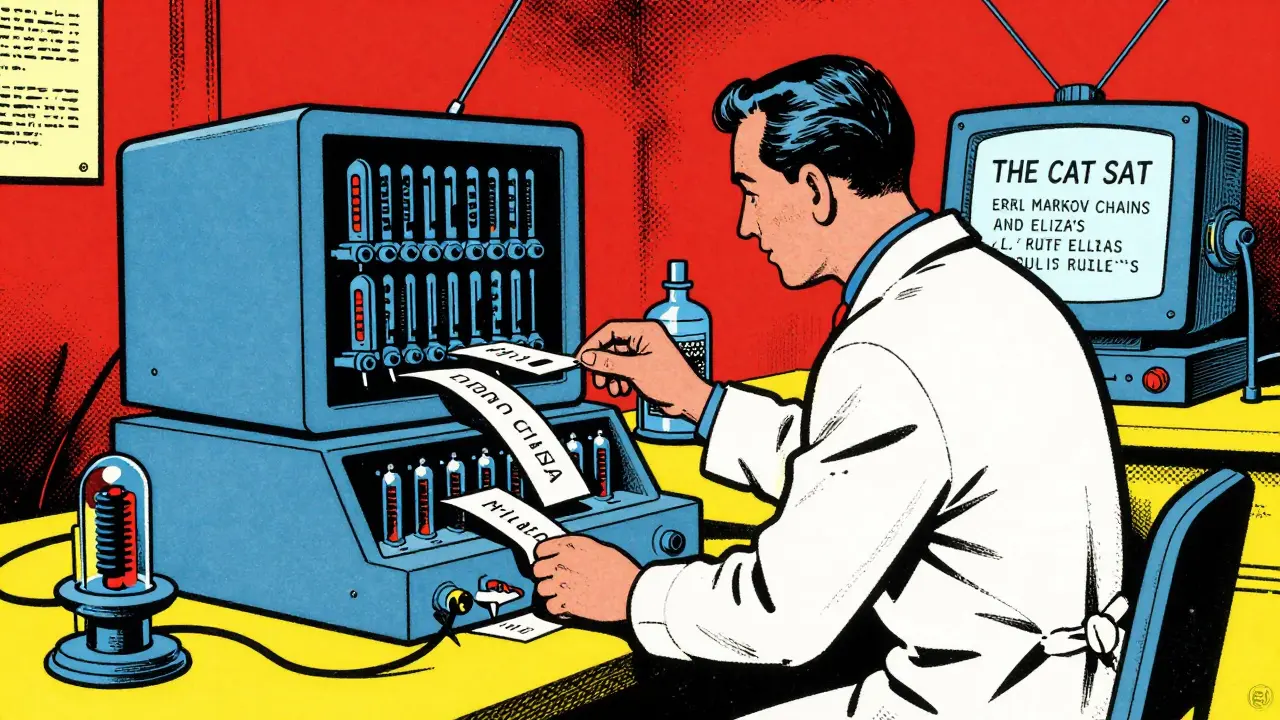
The story begins with Russian mathematician Andrey Markov and his work on Markov chains around 1913. At its core, a Markov chain is a system where the next state depends only on the current state, not on the entire history of how you got there. It is a "memoryless" process. If you were writing a poem using a basic Markov model, the computer would pick the next word based solely on the word immediately preceding it. It creates sequences, but they lack deep structure or long-term coherence.
This probabilistic approach laid the groundwork for sequence generation. Decades later, in the 1950s, engineers developed Hidden Markov Models (HMMs) and Gaussian Mixture Models to handle sequential data like speech recognition. These models could predict the likelihood of a sound following another, but they struggled with complex patterns. They were statistical engines, not creative ones. Then came 1964, when Joseph Weizenbaum released ELIZA at MIT. ELIZA didn't use neural networks; it used pattern matching and substitution rules to simulate a Rogerian psychotherapist. It proved that humans would anthropomorphize even the simplest scripts, a phenomenon known as the "ELIZA Effect." However, ELIZA had no understanding of context beyond its immediate script, highlighting the limitation of rule-based systems.
The Neural Awakening: Perceptrons and Recurrent Networks
The field hit a wall during the "AI winters" of the 1970s and 80s, largely because symbolic logic and simple statistics couldn't handle the nuance of real-world data. The breakthrough came from biology-inspired computing. In 1958, Frank Rosenblatt introduced the perceptron, the first operational neural network. It was a single layer of nodes that could learn to distinguish between shapes. It was primitive, but it showed that machines could adjust their internal weights based on error signals.
For decades, perceptrons remained limited until the development of Recurrent Neural Networks (RNNs) in 1982. Unlike feedforward networks, RNNs had loops. They maintained an internal state, allowing them to process sequences of inputs. This made them suitable for tasks like language translation, where the meaning of a sentence depends on the order of words. But RNNs had a fatal flaw: the "vanishing gradient" problem. As the sequence grew longer, the network forgot earlier inputs. It could remember the start of a short sentence, but failed on paragraphs. By the mid-90s, researchers realized that without a way to retain long-term memory, neural networks would never achieve true generative capability for complex text.
Solving Memory: LSTMs and the Rise of Deep Learning
In 1997, Jürgen Schmidhuber and Sepp Hochreiter introduced Long Short-Term Memory (LSTM) networks. LSTMs added specialized "gates"-input, output, and forget gates-that controlled the flow of information through the cell's memory. This allowed the network to decide what to keep and what to discard over long sequences. It was a game-changer. By 2001, Schmidhuber demonstrated that LSTMs could learn formal languages that traditional Hidden Markov Models could not.
The practical impact became clear in 2006 with the introduction of Connectionist Temporal Classification (CTC), which allowed LSTMs to align unsegmented input data with output sequences. This enabled end-to-end speech recognition. By 2016, Google Translate switched from statistical machine translation to neural machine translation powered by these architectures. LSTMs could finally hold context across hundreds of words. Yet, they still processed data sequentially, one step at a time. This created a bottleneck. Training an LSTM required waiting for step N before calculating step N+1, making training slow and expensive as models grew larger.

The Adversarial Era: GANs and VAEs
While LSTMs improved text processing, image generation lagged behind. Early attempts produced blurry, indistinct blobs. The landscape shifted dramatically in 2014 with Ian Goodfellow’s introduction of Generative Adversarial Networks (GANs). A GAN consists of two neural networks playing a game against each other: a generator creates fake images, and a discriminator tries to spot the fakes. As the discriminator gets better, the generator is forced to improve to avoid detection. This adversarial process produced incredibly sharp, realistic images.
Simultaneously, Diederik Kingma and Max Welling developed Variational Autoencoders (VAEs) in 2013. VAEs took a different approach, compressing data into a latent space and then decoding it back out. While GANs won the prize for visual fidelity, they were notoriously unstable and difficult to train. Around 2015, diffusion models emerged, generating data by reversing a noise-adding process. Initially overlooked, these models would later become the backbone of high-quality image generators like Stable Diffusion, offering a more stable alternative to GANs.
The Transformer Revolution: Attention Is All You Need
The pivotal moment arrived in 2017 with the publication of "Attention is All You Need" by researchers at Google. They introduced the transformer architecture. Instead of processing words sequentially like an LSTM, transformers used a mechanism called self-attention. Self-attention allows the model to weigh the importance of every word in a sentence relative to every other word, regardless of distance. This eliminated the sequential bottleneck.
The technical superiority was immediate. LSTMs had O(n) computational complexity per step, meaning training time scaled linearly with sequence length but could not be parallelized effectively. Transformers achieved O(1) parallelization potential, allowing GPUs to process entire sequences simultaneously. Although the attention matrix required O(n²) memory, the explosion in GPU power made this trade-off favorable. NVIDIA’s advancements accelerated transformer training by up to 100x compared to CPU-based LSTM implementations.
| Architecture | Key Mechanism | Primary Limitation | Peak Era |
|---|---|---|---|
| Markov Chains / HMMs | Probabilistic transition | No long-term memory | 1950s-1980s |
| RNNs | Sequential loops | Vanishing gradients | 1980s-1990s |
| LSTMs | Gated memory cells | Slow sequential training | 1997-2017 |
| GANs | Adversarial training | Instability and mode collapse | 2014-Present |
| Transformers | Self-attention | Quadratic memory cost | 2017-Present |

Scaling Laws and the Emergence of Large Language Models
The transformer architecture unlocked the ability to scale. In 2018, OpenAI released GPT-1, followed by GPT-2 in 2019 and GPT-3 in 2020 with 175 billion parameters. The jump in size revealed emergent capabilities. Smaller models could answer questions; massive models could reason, write code, and perform few-shot learning without explicit fine-tuning. The largest practical LSTMs rarely exceeded 100 million parameters due to instability, whereas transformers thrived at billions.
This scaling brought multimodal capabilities. In 2021, DALL-E demonstrated that transformers could generate images from text descriptions by linking textual tokens to visual patches. By 2022, Stable Diffusion combined diffusion models with transformer components to democratize photorealistic image generation. The March 2023 release of GPT-4 marked another inflection point, handling inputs up to 25,000 words and showing significantly improved reasoning. However, the costs are steep. Training GPT-3 required approximately 1,300 megawatt-hours of electricity, raising serious environmental concerns.
Current Challenges and Future Directions
Despite their dominance, transformers are not perfect. Their quadratic memory complexity limits context window efficiency, and they struggle with precise mathematical reasoning. Experts like Geoffrey Hinton have noted that transformers lack explicit world models, potentially hindering progress toward Artificial General Intelligence (AGI). Yann LeCun suggests future architectures may incorporate energy-based models to address computational inefficiencies.
The industry is now focusing on efficiency. Microsoft’s Phi-2 model, released in January 2024, achieved GPT-3.5-level performance with only 2.7 billion parameters through advanced training techniques. Retrieval-Augmented Generation (RAG) has become standard, with 67% of enterprise implementations using it by late 2023 to reduce hallucinations. Meanwhile, alternatives like the Mamba architecture, published by DeepMind in December 2023, claim to overcome transformer limitations using state-space modeling. As we move through 2026, the focus shifts from raw scale to efficient, reliable, and verifiable generation.
Why did Markov models fail to become the basis for modern Generative AI?
Markov models are "memoryless," meaning they only consider the immediate previous state to predict the next step. They cannot capture long-range dependencies or complex structures in data, such as the relationship between the beginning and end of a paragraph. Modern AI requires understanding context over thousands of tokens, which Markov chains cannot do.
What is the main advantage of Transformers over LSTMs?
The primary advantage is parallelization. LSTMs process data sequentially, one token at a time, which makes training slow. Transformers use self-attention to process entire sequences simultaneously, allowing them to leverage the massive parallel computing power of modern GPUs. This enables training on vastly larger datasets and models.
Are GANs still relevant in 2026?
GANs remain relevant for specific tasks requiring high-fidelity image synthesis, but they have been largely superseded by diffusion models for general-purpose image generation. Diffusion models are more stable to train and offer better control over the generation process, though GANs are still studied for their adversarial learning principles.
What is the "quadratic memory complexity" problem in Transformers?
Self-attention requires calculating relationships between every pair of tokens in a sequence. If you double the sequence length, the number of calculations quadruples (O(n²)). This consumes significant memory, limiting how much context a model can process efficiently unless optimized with techniques like sparse attention or sliding windows.
How does Retrieval-Augmented Generation (RAG) help Generative AI?
RAG connects the AI model to external knowledge bases. Instead of relying solely on its pre-trained memory, the model retrieves relevant documents before generating a response. This reduces hallucinations, provides up-to-date information, and allows enterprises to use smaller, cheaper models while maintaining high accuracy.