You can throw more money at it. You can buy more GPUs. But at some point, physics starts saying "no." If you're trying to scale a Large Language Model (LLM) today, you aren't just fighting code inefficiencies or data quality issues-you're hitting hard physical walls. We are currently living through a paradox in AI development: model parameters can theoretically grow forever, but the silicon required to run them is running out of room, power, and bandwidth.
The Large Language Model is a type of deep learning algorithm that uses billions or trillions of parameters to predict text. While software improvements have made these models smarter, their growth is increasingly bottlenecked by hardware constraints such as GPU memory capacity, memory bandwidth, power consumption, and interconnect latency. Researchers from NVIDIA, MIT, and recent papers like MoE-Lens (2025) highlight that we are approaching the physical limits of current computing architectures.
The Memory Wall: Why Bandwidth Matters More Than Speed
Most people think faster chips mean faster AI. That’s not quite right. The real problem isn’t how fast the GPU can calculate; it’s how fast it can get the data to do the calculations. This is known as the memory wall.
Modern GPUs like the NVIDIA H100 are computational monsters, capable of performing quadrillions of operations per second. However, they need to feed these cores with data constantly. If the data doesn't arrive fast enough, the powerful compute units sit idle. This is called being "memory-bound."
Here is the reality check:
- HBM Capacity: Current top-tier GPUs offer between 80GB and 141GB of High-Bandwidth Memory (HBM). For a 70-billion parameter model, this sounds like a lot. But when you add optimizer states, gradients, and activation values during training, you easily exceed 280GB. You can't fit it on one chip.
- Bandwidth Limits: Even the NVIDIA H200, released in late 2024 with 141GB of HBM3e, has a finite bandwidth ceiling. As models grow, the ratio of compute-to-memory worsens. You end up paying for expensive transistors that spend most of their time waiting for bits to move across the bus.
This imbalance forces engineers into awkward compromises. You either shard the model across multiple GPUs (which introduces communication overhead) or use quantization (reducing precision), which saves memory but risks degrading model accuracy.
Power and Thermal: The Silent Killer of Scaling
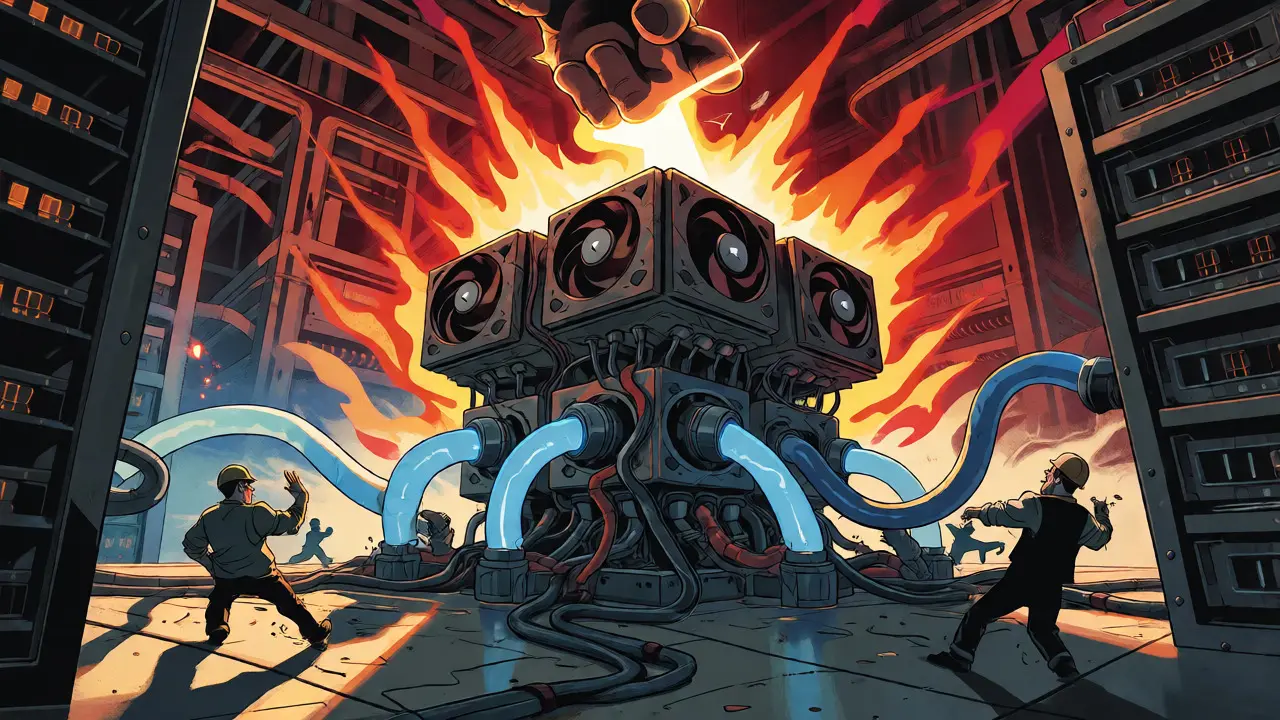
If memory is the brain’s bottleneck, power is its heart attack. Training frontier models requires industrial-scale electricity. A single NVIDIA H100 GPU draws up to 700 watts under full load. Now, multiply that by thousands.
A cluster of 1,024 H100s consumes roughly 700kW continuously. And that’s just the GPUs. Add networking switches, storage arrays, and cooling systems, and your facility needs megawatts of power. Many data centers are capped by their local grid connection. You literally cannot install more GPUs because the building can’t supply the juice.
Then there’s heat. Each 700W GPU dumps that energy as heat. Air cooling hits a limit around 15-20kW per rack. Beyond that, you need liquid cooling, which costs upwards of $50,000 per cabinet to implement. This thermal constraint means that even if you have the budget and the space, you might not have the infrastructure to dissipate the heat generated by scaling further.
The Interconnect Bottleneck: Talking Between Chips
When a model doesn’t fit on one GPU, you split it. This is called model parallelism. But splitting a model means the parts need to talk to each other constantly. This is where network bandwidth becomes the limiting factor.
NVIDIA’s NVLink provides blazing-fast speeds (900 GB/s) between adjacent GPUs inside the same server. But once you cross the boundary to another server, you’re relying on Infiniband or Ethernet, which drops to around 200-400 GB/s. In a massive cluster, this latency adds up. GPUs spend significant time idling while waiting for gradient updates from their peers.
Recent research on Mixture of Experts (MoE) architectures highlights this issue. MoE tries to solve scaling by activating only a subset of parameters for any given token. However, routing tokens to the correct "expert" experts across different GPUs creates complex communication patterns. If the interconnect isn’t optimized, the theoretical efficiency gains of MoE vanish under the weight of data shuffling.
Quadratic Complexity: The Sequence Length Trap
Transformers, the backbone of modern LLMs, have a nasty habit: their cost scales quadratically with sequence length. Double the context window, and you quadruple the compute and memory requirements.
We want models to remember more. We want 100,000-token contexts. But maintaining attention over long sequences eats VRAM alive. To serve a model with a long context window, you often have to reduce batch size drastically, killing throughput. Or you implement sparse attention mechanisms, which save memory but introduce new engineering complexities and potential accuracy trade-offs.
This architectural constraint means that simply buying bigger GPUs doesn’t fix the problem. It shifts the bottleneck from total capacity to specific utilization patterns. You might have enough memory for weights, but not enough for the intermediate activations required for long-sequence inference.
Economic Reality: Diminishing Returns
Let’s talk money. Hardware constraints aren’t just technical; they’re financial. An NVIDIA H100 costs roughly $40,000. But the sticker price is misleading. Infrastructure-power delivery, cooling, networking, floor space-adds 30-40% to the total cost of ownership.
Training a GPT-4 scale model required an estimated $100 million to $1 billion in hardware. As we push toward trillion-parameter models, the capital expenditure becomes prohibitive for all but the largest tech giants. This economic barrier acts as a natural limiter on scaling. It forces companies to ask: Is the marginal improvement in intelligence worth the exponential increase in cost?
Cameron R. Wolfe’s analysis on RL Scaling Laws suggests that proper investment requires understanding these hardware-software co-design tradeoffs. You can’t just brute-force your way to AGI if the return on investment turns negative due to hardware inefficiencies.
Mitigation Strategies: How We Keep Going
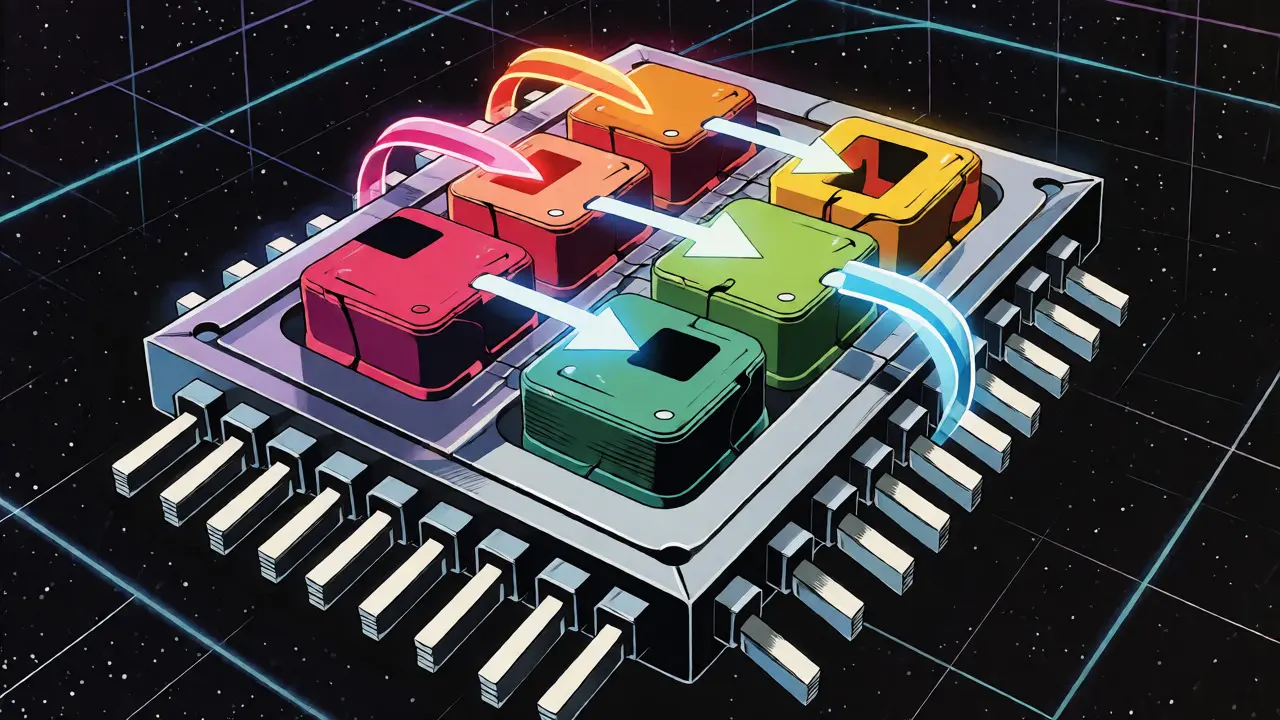
So, what do we do? We optimize. The industry is moving away from raw scaling toward smarter scaling.
- Quantization: Moving from FP32 to BF16, FP8, or even INT4 reduces memory footprint and bandwidth needs. It’s not free-precision loss is real-but it allows larger models to fit on existing hardware.
- Mixture of Experts (MoE): By activating only relevant parts of the network, MoE decouples model size from compute cost. Papers like MoE-Lens (2025) show that with careful system design, you can achieve 4.6x higher throughput compared to dense models.
- Inference Optimization: Techniques like KV-cache compression and speculative decoding help squeeze more performance out of limited memory during serving.
These strategies don’t remove the hardware constraints; they work within them. They represent a shift from "bigger is better" to "smarter is sustainable."
| Constraint Type | Specific Limitation | Impact on Scaling | Mitigation Strategy |
|---|---|---|---|
| Memory Capacity | GPU VRAM capped at 80-141GB | Models >70B params require multi-GPU sharding | Model Sharding, Quantization |
| Memory Bandwidth | Data transfer speed lags behind compute speed | GPUs idle waiting for data (Memory-bound) | Better HBM, Kernel Fusion |
| Power Consumption | ~700W per GPU; Grid limits | Limits cluster size per facility | Liquid Cooling, Energy-Efficient Chips |
| Interconnect Latency | Cross-node communication slower than intra-node | Synchronization overhead in distributed training | NVLink, Advanced Network Topologies |
| Sequence Length | O(n²) complexity in Transformers | Long contexts explode memory usage | Sparse Attention, Sliding Window |
Frequently Asked Questions
Why can't we just make GPUs bigger?
Physical size is constrained by manufacturing yield and thermal density. Making a single die larger increases the chance of defects and makes heat dissipation exponentially harder. Instead, we use multi-chip modules or clusters, which introduces communication latency between chips.
Does quantization always hurt model performance?
Not necessarily. Modern techniques like FP8 or INT4 with calibration can maintain near-FP16 accuracy for many tasks. However, extremely low precision (like INT2) often leads to noticeable degradation in reasoning capabilities and numerical stability.
What is the biggest bottleneck for inference vs. training?
For training, the bottleneck is often memory capacity and bandwidth combined with interconnect latency for synchronization. For inference, especially with large batch sizes, memory bandwidth is the primary killer. The model weights must be read repeatedly for every token generated, making high-bandwidth memory critical.
How does Mixture of Experts (MoE) help with hardware constraints?
MoE allows a model to have a huge number of parameters (high capacity) while only activating a small fraction for each input (low compute). This decouples memory storage requirements from compute intensity, allowing larger models to run efficiently on hardware that would otherwise be too slow for a dense equivalent.
Are specialized AI chips like TPUs better than GPUs for scaling?
TPUs are designed specifically for matrix multiplication and often offer better performance-per-watt for specific transformer workloads. However, GPUs offer greater flexibility and a larger ecosystem. The choice depends on whether you prioritize absolute peak performance and flexibility (GPUs) or cost-efficiency and throughput for specific frameworks (TPUs).