
Imagine asking an assistant to fix a leaky faucet. You send a photo of the pipe, record a video of the water dripping, and dictate your frustration about the noise it makes at night. A traditional text-only AI would be blind to this mess. It can’t see the rust in your photo or hear the rhythm of the drip. But Multimodal Generative AI is a class of artificial intelligence systems that simultaneously process, analyze, and generate content across multiple data formats including text, images, audio, and video. This technology doesn't just read; it sees, hears, and understands context by weaving these inputs together.
We are no longer in the era of single-modality models that only crunch words. Since the emergence of GPT-4 in 2023, which was the first model to effectively handle both text and images, we have jumped into a world where AI synthesizes visual, auditory, and textual data streams instantly. By late 2025, these systems were achieving response times under 120 milliseconds for speech-enabled tasks, making interactions feel genuinely natural rather than robotic. This shift isn't just a technical upgrade; it’s a fundamental change in how machines perceive reality, moving from isolated data points to holistic understanding.
How Multimodal Architecture Works Under the Hood
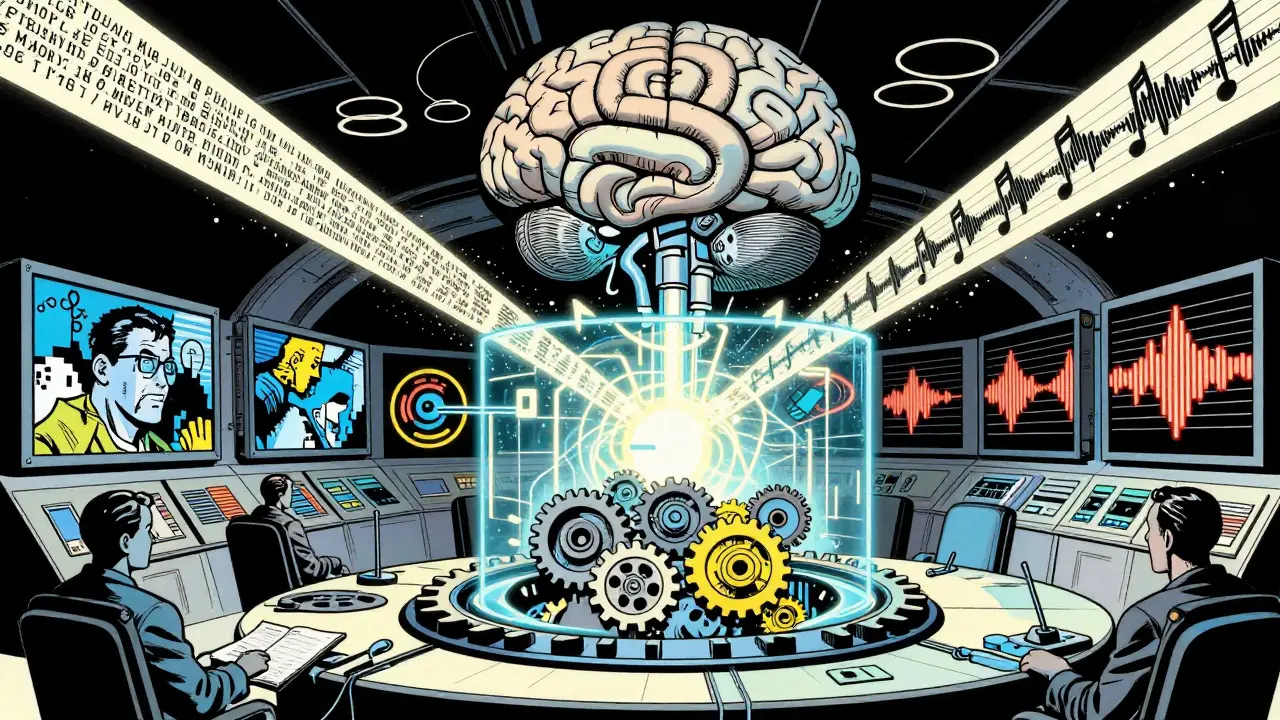
To understand why these models are so powerful, you need to look past the chat interface and into the architecture. The process follows a strict three-stage pipeline that mimics human sensory processing. First, there is input processing. Here, specialized unimodal neural networks handle specific data types. One network decodes pixels from an image, another analyzes waveforms from audio, and a third parses tokens from text. They work in parallel, not sequentially.
The magic happens in the second stage: representation fusion. This is where the system evaluates relationships between tokens from each modality. It looks for equivalence (the word "red" matches the color red in the image), dependency (the sound of a crash depends on the visual of a collision), or contradiction (the text says "sunny" but the image shows rain). There are three primary fusion strategies used here:
- Early Fusion: Combines raw data at the input level. This allows the model to learn cross-modal relationships from the ground up, similar to how our brains integrate sight and sound instantly.
- Late Fusion: Processes each modality independently before combining results. This offers flexibility but might miss subtle connections that only appear when data is mixed early.
- Hybrid Fusion: Leverages both approaches, balancing depth of integration with computational efficiency.
Finally, the content generation stage uses this unified representation to produce output. This could be a text explanation grounded in visual evidence, a video clip generated from a script, or audio synthesized from emotional cues in text. Core technologies enabling this include Transformer Architectures for handling sequential data, Diffusion Models for high-quality image and audio generation, and Reinforcement Learning with Human Feedback (RLHF) to ensure alignment with human intent.
| Strategy | Processing Method | Pros | Cons |
|---|---|---|---|
| Early Fusion | Combines raw data at input | Deep cross-modal learning | High computational cost |
| Late Fusion | Processes independently, then combines | Flexible, modular | May miss subtle connections |
| Hybrid Fusion | Mixes early and late techniques | Balanced performance | Complex implementation |
Key Players and Model Capabilities in 2026
The landscape of multimodal models has exploded since 2024. We are seeing distinct segments emerge: Big Tech platforms, open-source frameworks, and specialized vertical solutions. As of late 2025 and early 2026, several models stand out for their specific strengths.
OpenAI's GPT-4o remains a dominant force, particularly with its December 2025 update featuring real-time video processing. It handles 30fps video with a latency of just 230ms, allowing for near-instantaneous analysis of live feeds. On the open-source front, Meta's Llama 4, released in November 2025, focuses heavily on speech and reasoning capabilities, offering developers a transparent alternative to proprietary APIs. Meanwhile, Google's Gemini 2.0 updated in October 2025 introduced advanced audio-visual synchronization, making it ideal for media editing tasks.
Specialized models are also carving out niches. Meta's Segment Anything Model (SAM) isolates visual elements with minimal input, reducing video editing time by 47% in healthcare applications. For robotics, Carnegie Mellon and Apple's ARMOR system uses distributed depth sensors to reduce collisions by 63.7% while processing data 26 times faster than traditional methods. These examples show that multimodal AI is not one-size-fits-all; different architectures excel in different environments.
Real-World Impact: From Healthcare to Manufacturing
Theoretical benchmarks are impressive, but the true test is application. In healthcare, the difference is stark. Multimodal systems achieve 94.2% diagnostic accuracy when combining medical imaging with patient history, compared to just 82.7% for image-only analysis. UnitedHealthcare implemented a multimodal diagnostic assistant that slashed radiology report turnaround time from 48 hours to 4.7 hours while maintaining 98.3% diagnostic accuracy. This isn't just speed; it's precision grounded in context.
In manufacturing, the integration of visual inspection with audio sensor data reduced false positives by 53.8% compared to visual-only systems. However, it’s not all smooth sailing. An IBM Watson client abandoned their multimodal quality control system after six months due to an 18.7% false positive rate in detecting defects across visual and acoustic streams. This highlights a critical challenge: consistency. Early implementations often suffer from output inconsistencies between generated text and images, with 37% of projects facing this issue in 2024.
Challenges and Risks: The Dark Side of Multimodal AI
With great power comes significant complexity. The computational requirements for multimodal systems are hefty. Average inference costs are 3.7x higher than single-modality systems. Training data preparation is equally demanding, requiring 8-12 weeks of specialized curation versus 2-4 weeks for text-only models. For smaller organizations, the barrier to entry is high, with custom enterprise solutions costing between $250,000 and $1.2 million.
There are also serious ethical and safety concerns. Dr. Marcus Chen of Stanford's Center for AI Safety warned that current multimodal systems suffer from "modality hallucination" in 22.3% of complex reasoning tasks. This means the AI might confidently assert a fact based on an image that contradicts the text, creating dangerous inconsistencies in medical or industrial applications. Furthermore, the McKinsey Global Institute projects that deepfake proliferation could increase by 300% from 2024 levels as these tools become more accessible. Privacy is another major hurdle, as multi-sensor data collection raises questions about surveillance and consent.

Implementation Guide: Getting Started in 2026
If you’re looking to implement multimodal AI, start by defining your job-to-be-done. Are you building a customer service bot that reads receipts and listens to complaints? Or a creative tool that generates videos from scripts? Your goal dictates your stack.
- Select Your Framework: For rapid prototyping, commercial APIs like Anthropic's Claude 3 or OpenAI's GPT-4o offer the easiest path, though they come with ongoing costs. For full control and privacy, open-source frameworks like LLaVA (Large Language and Vision Assistant) are robust choices. LLaVA boasts over 28,000 stars on GitHub and active community support.
- Prepare Aligned Data: This is the hardest part. Ensure your text, images, and audio are temporally and semantically aligned. 78% of practitioners report difficulties synchronizing temporal data across video and audio streams. Use tools that can timestamp and tag data consistently.
- Choose a Fusion Strategy: Start with Hybrid Fusion if you're unsure. It balances performance and complexity. Avoid Early Fusion unless you have massive compute resources, as it requires processing raw data from all modalities simultaneously.
- Test for Hallucinations: Rigorously evaluate your model for cross-modal contradictions. Does the generated text accurately describe the image? Use benchmark datasets to measure accuracy in cross-modal reasoning tasks, aiming for above 89% accuracy.
- Plan for Compute Costs: Budget for higher inference costs. Consider edge deployment options, such as Qualcomm's Snapdragon X Elite chips optimized for on-device processing, to reduce cloud dependency and latency.
The Future Roadmap: What’s Next?
We are just scratching the surface. The industry trajectory points toward three major trends. First, edge deployment will become standard, allowing multimodal models to run on devices without constant cloud connection. Second, standardization efforts are underway, with the Multimodal AI Consortium releasing specification 1.0 in March 2026 to address interoperability issues. Third, agentic capabilities will expand, enabling systems to autonomously complete multi-step tasks across modalities-like watching a tutorial video, reading the manual, and then assembling furniture.
By 2027, we expect seamless integration with AR/VR environments, turning multimodal AI into the backbone of immersive experiences. Emotional recognition capabilities are projected to mature between 2026 and 2028, allowing AI to detect subtle cues in voice tone and facial expressions. While energy consumption remains a concern-with training runs consuming 3.2x more energy than text-only models-the push for efficiency and the promise of hyper-personalized, context-aware interactions make multimodal generative AI the definitive next step in artificial intelligence.
What is the difference between multimodal AI and traditional AI?
Traditional AI typically processes one type of data, such as text or images, in isolation. Multimodal AI integrates multiple data types-text, image, audio, video-simultaneously. This allows it to understand context more deeply, much like humans do, by correlating information across different senses. For example, while a text-only AI can define "rain," a multimodal AI can see rain in a video, hear the sound of it, and read a weather report about it, confirming the event through multiple channels.
Which multimodal AI model is best for beginners?
For beginners, using a commercial API like OpenAI's GPT-4o or Anthropic's Claude 3 is the easiest starting point because they require minimal setup and offer robust documentation. If you want to experiment with code and have some technical background, LLaVA (Large Language and Vision Assistant) is a popular open-source option with strong community support and clear tutorials.
How much does it cost to implement multimodal AI?
Costs vary significantly based on scale. Using cloud APIs involves pay-per-use fees, which can add up quickly with heavy usage. Custom enterprise implementations typically range from $250,000 to $1.2 million, covering data curation, model fine-tuning, and infrastructure. Additionally, inference costs for multimodal models are approximately 3.7x higher than for text-only models due to the increased computational load.
What are the main risks of using multimodal generative AI?
Key risks include "modality hallucination," where the AI generates incorrect information because it misinterprets the relationship between different data types (e.g., matching the wrong object in an image to a description). Other risks involve high computational costs, privacy concerns related to multi-sensor data collection, and the potential for deepfake proliferation. Regulatory frameworks like the EU AI Act are beginning to address these issues, especially in high-risk sectors like healthcare.
Can multimodal AI replace human workers?
Rather than replacing humans, multimodal AI is designed to augment human capabilities. In healthcare, it speeds up diagnostics but still requires doctor oversight. In creative fields, it accelerates content production but relies on human direction for nuance and strategy. Experts predict it will reshape 78% of knowledge work by 2030 by automating routine cross-modal tasks, allowing humans to focus on high-level decision-making and creative problem-solving.




7 Comments
rahul shrimali
man this is huge
finally ai that actually sees and hears like us
no more blind text bots
Anand Pandit
That is a great observation about the shift from isolated data points to holistic understanding. The ability to process video at 30fps with such low latency is truly impressive for real-time applications. I think many people overlook how much computational power is required for early fusion strategies. It is fascinating to see how hybrid models are finding a balance between efficiency and depth. We should definitely keep an eye on how these architectures evolve in the next few years. The potential for healthcare diagnostics alone is life-changing.
Eka Prabha
The article conveniently omits the systemic risks inherent in such pervasive surveillance capabilities. One must question the ethical implications of 'modality hallucination' when applied to critical infrastructure or judicial processes. The reliance on proprietary APIs creates a dangerous dependency on tech oligopolies that operate without sufficient regulatory oversight. Furthermore, the energy consumption metrics cited are likely understated given the hidden costs of data center cooling and hardware manufacturing. This technological acceleration serves corporate interests rather than public good, exacerbating existing inequalities in access to information and digital literacy. We are essentially building a panopticon wrapped in the guise of convenience and efficiency.
Reshma Jose
I totally agree with the point about energy consumption being a major hurdle. It feels like we are trading environmental stability for convenience. However, I do think the open-source movement with models like Llama 4 offers a glimmer of hope for decentralization. If we can get more transparency into how these models are trained, maybe we can mitigate some of those ethical concerns. It’s not all doom and gloom though, right? The medical applications sound genuinely promising if handled correctly.
Bhagyashri Zokarkar
i mean its kinda scary how they know everything about you now but also like why fight it
the doctors part is cool i guess
but my head hurts reading all this tech jargon honestly
just want it to work without crashing
Bharat Patel
There is a profound philosophical question here about the nature of perception itself. When a machine 'sees' an image and 'hears' audio simultaneously, does it achieve a form of consciousness or merely a sophisticated simulation of correlation? The human experience is deeply rooted in the subjective interpretation of sensory input, whereas AI relies on statistical probability. This distinction matters because it defines the boundary between tool and entity. As we integrate these systems into our daily lives, we risk outsourcing our own perceptual validation to algorithms that lack genuine understanding. We must remain vigilant in preserving the human element of judgment and empathy.
Rakesh Dorwal
Look we need to support our own tech companies instead of relying on foreign models like GPT or Gemini. India has brilliant engineers who can build superior multimodal systems tailored to our local languages and contexts. The government should invest heavily in domestic AI infrastructure to ensure data sovereignty and national security. Relying on external APIs is a strategic vulnerability that we cannot afford in the long run. Let's empower our local startups and researchers to lead this revolution rather than just consuming technology made elsewhere. It is time for self-reliance in the digital age.