Imagine an AI assistant that forgets your preferences every time you close the chat window. It’s frustrating, right? Now imagine one that remembers not just your name, but your past projects, your coding style, and even the mistakes it made last week so it doesn’t repeat them. That’s the power of persistent LLM agents. But getting there isn’t as simple as telling a model to "remember." It requires a robust architecture for memory and state management.
As of mid-2026, we’ve moved past the hype cycle of basic chatbots. We are building agents that operate over weeks or months, handling complex, multi-step tasks. The core challenge? Large Language Models (LLMs) are inherently stateless. They process input and generate output without retaining any internal state between interactions. To build truly intelligent agents, we need to engineer external memory systems that mimic human cognition-storing, retrieving, updating, and forgetting information strategically.
The Architecture of Agent Memory
You can’t just dump everything into a context window. Context windows have limits, and filling them with irrelevant data degrades performance-a phenomenon known as "lost in the middle." Instead, modern agent architectures decompose memory into distinct layers, much like how human brains handle immediate thoughts versus long-term knowledge.
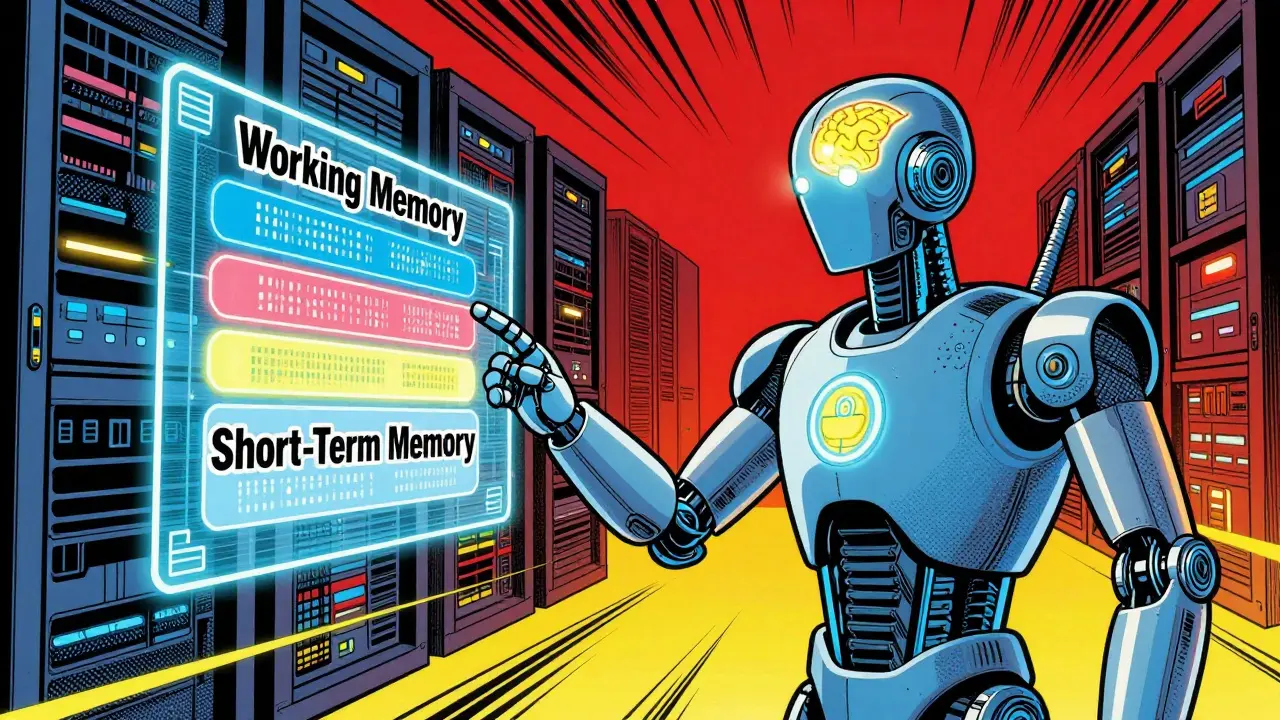
| Memory Layer | Function | Storage Technology | Latency |
|---|---|---|---|
| Working Memory | Immediate context for current task execution | In-memory variables, LangChain chains | Milliseconds |
| Short-Term Memory | Recent session history, active goals | Redis, Memcached | Low milliseconds |
| Long-Term Memory | Persistent knowledge, user preferences, past experiences | Vector Databases (Pinecone, Weaviate, Chroma) | Higher latency (ms to s) |
Working memory is ephemeral. It holds the data needed for the current step of a task. Once the task is done, this memory is often discarded or summarized. Short-term memory acts as a cache, keeping recent interactions accessible for quick reference within a single session. Long-term memory is where the magic happens for persistent agents. This layer uses vector databases to store embeddings of past interactions, allowing the agent to retrieve relevant historical context semantically rather than through exact keyword matches.
From Stateless to Stateful: Key Frameworks
Building these layers from scratch is reinventing the wheel. In 2026, several mature frameworks dominate the landscape, abstracting the complexity of memory management.
LangChain remains the most popular orchestration tool. It provides modular components for memory, including `ConversationBufferMemory` for short-term retention and integrations with vector stores for long-term recall. However, LangChain is more of a toolkit; you still need to design the logic for when to save and when to retrieve.
For specialized memory needs, Mem0 has emerged as a leading solution. Unlike generic vector stores, Mem0 builds a memory graph. It captures relational and temporal dependencies between facts. For example, if you tell an agent, "My project deadline is Friday," and later, "I finished the report," Mem0 understands the relationship between the deadline and the completion event. This enables efficient multi-hop retrieval, which is crucial for complex reasoning tasks.
Another notable framework is CrewAI, which focuses on multi-agent collaboration. It uses modular memory protocols to ensure consistency across different agents working together. If one agent learns a new fact about a client, CrewAI’s memory protocol ensures other agents in the team can access that updated information without redundant queries.
The Science of Forgetting: Why Deletion Matters
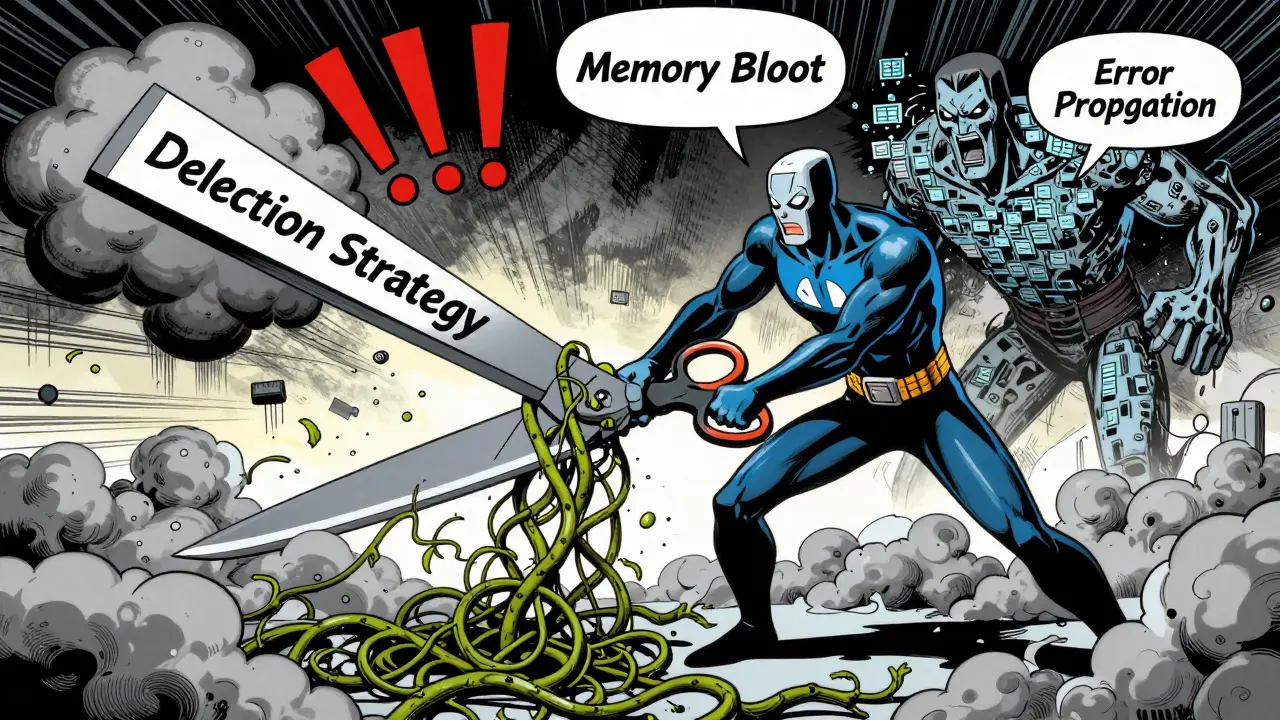
Here’s a counterintuitive truth: good memory management is less about storing everything and more about knowing what to delete. Research published in May 2025 by Xiong et al. demonstrated that indiscriminate memory addition leads to error propagation. If an agent stores incorrect information, it will keep retrieving and reinforcing that error, degrading performance over time.
Effective systems implement utility-based and retrieval-history-based deletion strategies. These approaches yield up to 10% performance gains compared to naive "store everything" methods. Here’s how it works:
- Utility-Based Deletion: Each memory record is assigned a quality score based on its usefulness in past tasks. Low-scoring records are pruned regularly.
- Retrieval-History-Based Deletion: Memories that are rarely retrieved are likely irrelevant. Systems track access frequency and remove stale data to prevent "memory bloat."
This selective approach ensures that the agent’s context window remains filled with high-signal information. As the research notes, strict evaluators that selectively expand memory with high-quality records consistently outperform those that allow noisy additions. Quality beats quantity every time.
Reinforcement Learning with Experience Memory (RLEM)
For agents performing goal-directed tasks, such as navigating websites or executing code, static memory isn’t enough. They need to learn from successes and failures. This is where RLEM (Reinforcement Learning with Experience Memory) comes in.
Systems like REMEMBERER implement persistent episodic memory as a table of interaction records. Each record stores:
- Task description
- Observation
- Action taken
- Q-value (a measure of expected reward)
Instead of fine-tuning the core LLM parameters-which is expensive and slow-RLEM updates these Q-values using reinforcement learning rules. When facing a new situation, the agent retrieves similar past episodes (both positive and negative exemplars) via semantic search. It then uses this experience for in-context prompting. Studies show this approach yields 2-4% higher success rates in benchmarks like WebShop and WikiHow, requiring orders of magnitude fewer training steps than traditional RL methods.
Graph-Based Memory and Temporal Reasoning
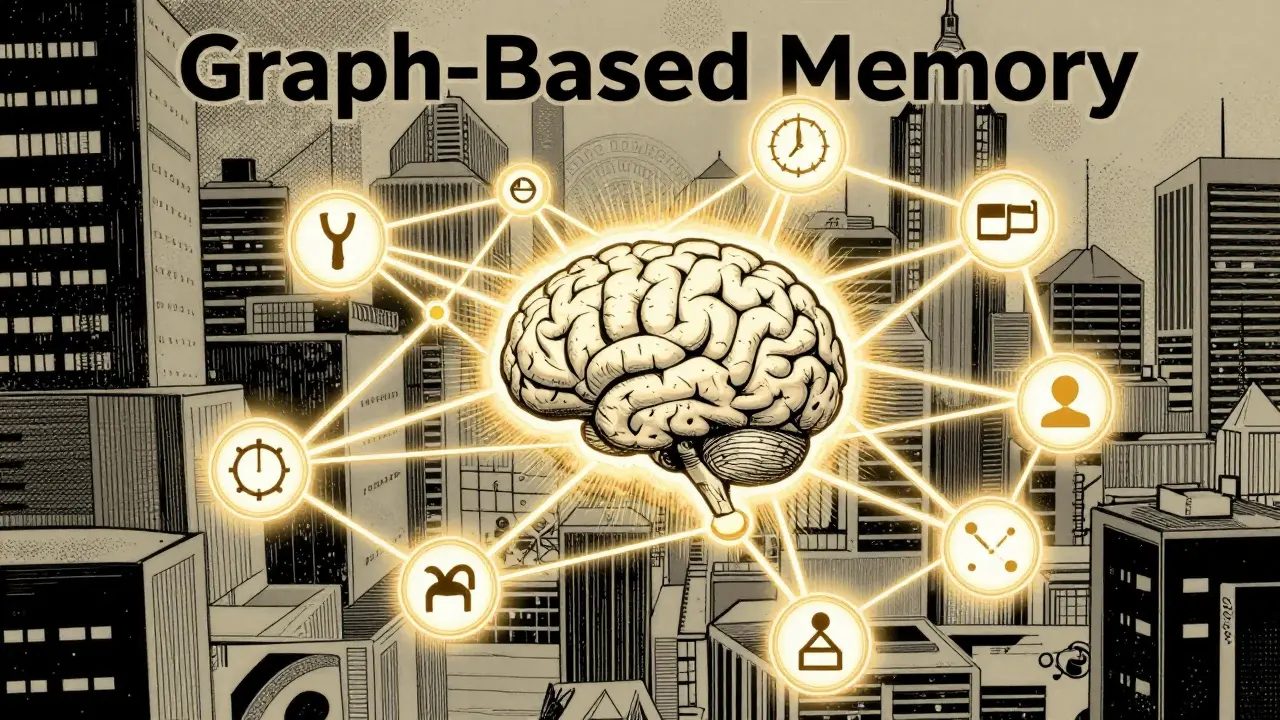
Linear lists of memories struggle with complex relationships. Graph-based architectures, such as those used in Nemori, represent memories as nodes and edges. This structure captures relational and temporal dependencies explicitly.
Why does this matter? Imagine an agent managing a project. It needs to know that "Meeting A" happened before "Deadline B," and that "Client C" requested changes during "Meeting A." A vector database might retrieve these as separate chunks, but a graph connects them logically. This enables sophisticated temporal reasoning and topic-based retrieval, which is essential for maintaining coherence over long horizons.
Dynamic human-like recall models further enhance this by quantifying memory consolidation. They use mathematical formulations to emulate psychological retention curves, where relevance and frequency modulate temporal decay. Frequently accessed or highly relevant memories are consolidated into stronger representations, while irrelevant ones fade away naturally.
Implementation Checklist for Developers
If you’re building a persistent LLM agent today, here’s a practical checklist to ensure robust memory management:
- Define Memory Granularity: Decide whether to store memories at the utterance, turn, session, or topic level. Topic-level granularity often offers the best balance of detail and noise reduction.
- Choose the Right Vector Database: Use Pinecone or Weaviate for scalable, production-grade storage. Ensure you’re using high-quality embedding models like E5 or BGE for accurate semantic search.
- Implement Summarization: Don’t store raw logs. Use an LLM to summarize interactions into concise, actionable insights before saving them to long-term memory.
- Add Deletion Policies: Set up automated jobs to prune low-utility memories. Aim for a dynamic memory size that adapts to usage patterns.
- Use Reflective Memory Management (RMM): Incorporate feedback loops where the agent evaluates the relevance of retrieved memories after generating a response. Use this feedback to rerank future retrievals.
- Test with MemBench: Use benchmarking frameworks like MemBench to evaluate your agent’s factual accuracy, reflective memory, and retrieval efficiency under diverse scenarios.
Common Pitfalls to Avoid
Even experienced developers stumble on memory management. Here are three common traps:
- Context Overload: Retrieving too many memories floods the context window, causing the LLM to miss critical instructions. Always limit retrieval to the top-k most relevant items (e.g., k=3 or 5).
- Ignoring Error Propagation: Storing hallucinations as facts corrupts the entire memory system. Implement a validation step before adding new memories, perhaps using a secondary LLM to verify factual consistency.
- Static Embeddings: Using outdated embedding models can lead to poor semantic matching. Regularly update your embedding pipeline to leverage newer, more accurate models.
By addressing these pitfalls, you ensure that your agent’s memory remains a asset, not a liability.
What is the difference between working memory and long-term memory in LLM agents?
Working memory is ephemeral and holds immediate context for the current task, typically stored in RAM or temporary variables. Long-term memory persists across sessions, storing knowledge, preferences, and past experiences in durable storage like vector databases. Working memory is fast but volatile; long-term memory is slower but permanent.
Why is deleting memories important for LLM agents?
Deleting low-quality or irrelevant memories prevents error propagation and memory bloat. Indiscriminate storage of all interactions can degrade performance by flooding the context window with noise. Selective deletion ensures that only high-utility, accurate information is retained, improving retrieval precision and overall agent reliability.
Which vector databases are best for persistent LLM agent memory?
Pinecone, Weaviate, and Chroma are industry standards for long-term memory storage. Pinecone offers managed scalability, Weaviate provides hybrid search capabilities, and Chroma is popular for local development. The choice depends on your scale, latency requirements, and budget.
How does RLEM improve agent performance?
RLEM (Reinforcement Learning with Experience Memory) allows agents to learn from past successes and failures without fine-tuning the core LLM. By storing interaction records with Q-values and retrieving similar episodes, agents can apply learned strategies to new situations, boosting success rates in complex tasks like navigation and code execution.
What is Mem0 and how does it differ from standard vector stores?
Mem0 is a specialized memory framework that builds a memory graph rather than just storing vector embeddings. It captures relational and temporal dependencies between facts, enabling more sophisticated multi-hop retrieval and contextual understanding compared to flat vector databases.
Can I use LangChain for persistent memory management?
Yes, LangChain provides modular memory components and integrations with various vector stores. While it doesn’t offer a complete out-of-the-box solution for complex persistent memory, it simplifies the orchestration of working, short-term, and long-term memory layers, making it a solid foundation for custom implementations.




8 Comments
Joe Walters
honestly this is just rehashing the same langchain boilerplate weve been reading since 2023 but with shinier buzzwords like rlem and mem0. nobody actually builds these systems in production without hitting a wall of hallucinated context within two weeks. the whole premise of persistent memory is flawed because llms are fundamentally probabilistic parrots not cognitive agents. you can bolt on redis and vector stores all day long but it doesnt change the fact that the core model has no concept of truth or continuity. its just pattern matching on a larger dataset. people need to stop pretending we are building ai and start admitting we are building very expensive autocomplete engines with delusions of grandeur.
Michael Richards
You are missing the point entirely Joe. The architecture matters more than the base model capabilities when scaling for enterprise use cases. If you do not implement proper utility-based deletion strategies your system will collapse under noise. I have seen teams waste months debugging why their agent was citing deprecated API endpoints from six months ago because they failed to prune low-utility memories. It is not about philosophy it is about engineering discipline. You either build robust state management layers or you build toys that break in production. There is no middle ground.
Lisa Puster
god i hate how everyone acts like this is some revolutionary breakthrough. its basic computer science 101 wrapped in marketing speak. working memory short term long term we learned this in the nineties with ram and hard drives. now you call it vector databases and charge us thousands a month for pinecone. typical american tech greed taking simple concepts and monetizing them until regular developers cant afford to build anything. meanwhile european privacy laws are already cracking down on storing user data indefinitely so half this advice is illegal in gdpr jurisdictions anyway. pathetic.
Robert Barakat
The nature of memory is not storage but retrieval. To remember is to reconstruct not to replay. These architectures attempt to mimic the biological process by separating ephemeral thought from enduring knowledge yet they fail to account for the subjective distortion inherent in human recollection. An LLM does not forget it merely loses access. Is that truly forgetting or is it a form of digital amnesia that lacks the transformative power of biological decay? We build graphs to connect nodes of information but do we ever consider that the connections themselves are illusions created by our desire for order in chaos?
Lisa Nally
I must correct the misconception regarding Mem0’s graph capabilities as described in the post. While it does capture relational dependencies it is not a full-fledged knowledge graph database like Neo4j. It uses a hybrid approach combining vector embeddings with lightweight graph structures to optimize for latency rather than complex traversal queries. Furthermore the claim that CrewAI ensures consistency across agents without redundant queries is an oversimplification. In practice you still need to implement explicit synchronization protocols or risk race conditions where one agent updates a memory while another is retrieving stale data. The industry standard for multi-agent coordination remains event-driven architectures using message brokers like Kafka not just shared memory stores.
Edward Gilbreath
they want you to believe you need all these fancy frameworks but really its just a way to lock you into their ecosystem. once you store your embeddings in pinecone or weaviate you are stuck. the real conspiracy is that big tech wants to control what the AI remembers and what it forgets. if they control the memory layer they control the narrative. RLEM is just a fancy word for conditioning the bot to obey certain parameters. wake up sheeple. the best memory is local sqlite and open source models that you can audit yourself. everything else is surveillance capitalism disguised as developer tools.
Laura Davis
Hey guys lets keep it constructive here! I know memory management can be super frustrating especially when debugging context window issues but tearing down each other isnt helping anyone learn. Laura here trying to motivate the team. Edward you raise a valid point about vendor lock-in which is why many of us are exploring local-first approaches with ChromaDB for development. Lisa Puster your concern about GDPR is crucial too and should definitely be part of any implementation checklist alongside technical specs. Lets focus on solutions like implementing strict retention policies and anonymization pipelines before storing sensitive user data. We can build better systems together if we support each other instead of attacking the ideas!
kimberly de Bruin
memory is a ghost haunting the machine. we give it fragments of ourselves and ask it to weave them into a coherent self. but the self is fluid changing with every interaction. the graph is static the node is fixed. perhaps the error lies not in the architecture but in the assumption that identity can be persisted at all. to remember is to betray the present moment by clinging to the past. the agent forgets because it must become something new with every prompt. we seek permanence in impermanence. foolish.