You have a pre-trained model. You have a specific task. But you don't have enough high-quality data to bridge the gap. This is the bottleneck facing every developer trying to customize large language models today. Buying more labeled data is expensive and slow. Generating it blindly creates noise that ruins performance. The solution lies in how you augment your data-specifically, by blending synthetic data generation with rigorous human validation.
Data augmentation in the context of Large Language Model (LLM) fine-tuning is not just about making your dataset bigger. It is about making it smarter, more diverse, and robust against edge cases. When done correctly, it allows models like GPT-4 or open-source alternatives like Llama 3 to excel at niche tasks without forgetting their foundational knowledge. Let's break down how to execute this strategy using modern techniques like Parameter-Efficient Fine-Tuning (PEFT) and hybrid human-AI workflows.
The Core Problem: Why Raw Data Isn't Enough
Fine-tuning is a transfer learning process. You take a model that already understands general language patterns and adjust its parameters to fit a specific domain, such as legal contract analysis or medical diagnosis support. However, if your training data is narrow, the model will overfit. It memorizes your examples instead of learning the underlying logic.
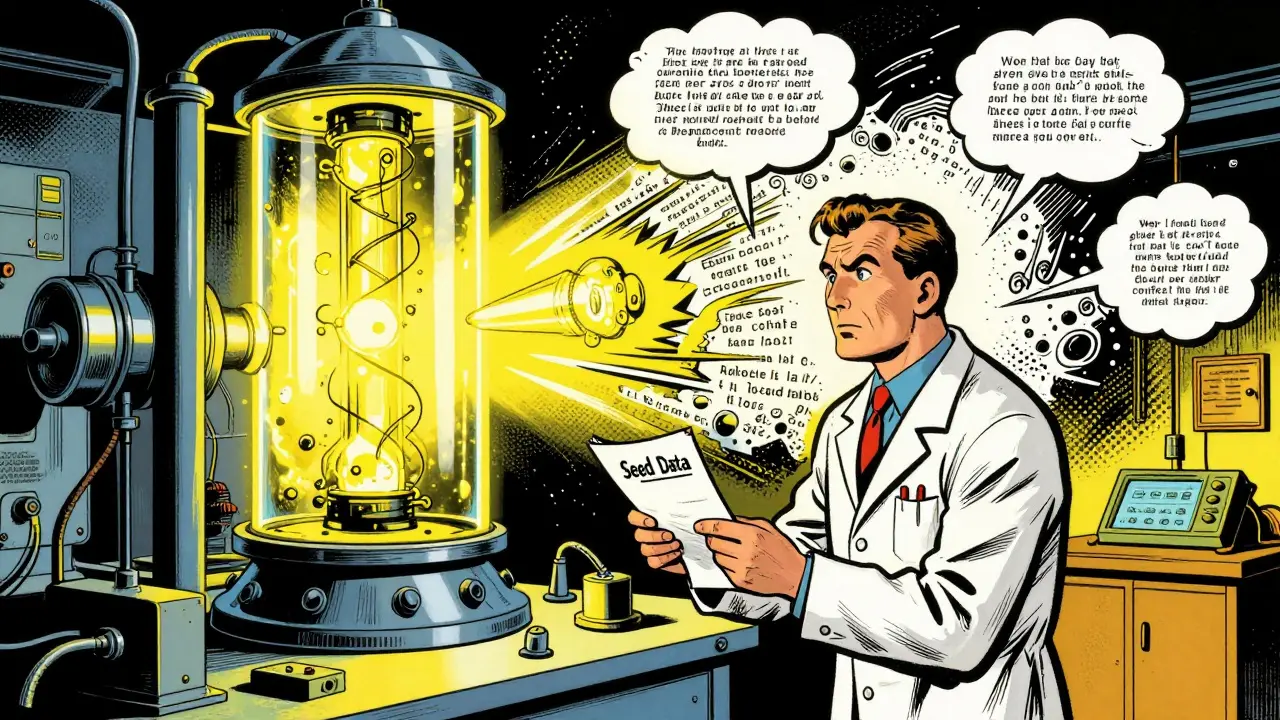
Consider a customer support bot. If you only train it on polite inquiries, it will fail when users get angry or use slang. Traditional data augmentation in computer vision involves rotating images or changing colors. In text, it’s harder. You can’t just "rotate" a sentence. You need semantic variation. This is where Synthetic Data Generation comes in. It uses smaller, faster LLMs to create variations of your seed data, expanding instruction sets and response pairs automatically.
Synthetic Data: Speed vs. Quality
Generating synthetic data is fast and cheap. You feed a small set of high-quality examples into a generator model, and it produces thousands of new training instances. Recent research highlights families of data augmentation models trained on sufficiently small LLMs to keep inference costs low while supporting key functionalities like instruction expansion and refinement.
Here is how synthetic augmentation typically works:
- Instruction Expansion: Taking a single prompt (e.g., "Summarize this email") and generating dozens of variations ("Give me a brief overview," "Condense the main points," etc.).
- Response Variation: Keeping the prompt same but generating different valid responses to teach the model flexibility.
- Noise Injection: Intentionally adding typos or grammatical errors to make the model robust to real-world user input.
The risk? Hallucinations. If your generator model makes up facts or introduces logical inconsistencies, your fine-tuned model learns those errors. This is why pure synthetic pipelines often degrade performance after a certain volume. You need a filter.
Human-in-the-Loop: The Quality Gate
This is where the "Human-in-the-Loop" (HITL) approach becomes critical. HITL does not mean humans write every line of training data. That is too slow. Instead, humans act as validators, editors, and strategists within the augmentation pipeline.
In a practical workflow, an AI generates 100 synthetic variations of a training example. A human reviewer-or a sophisticated automated filter based on human-defined rules-selects the top 10 most accurate and diverse ones. This curation step ensures that the diversity added by synthesis doesn't come at the cost of accuracy.
For high-stakes domains like healthcare or finance, HITL is non-negotiable. A doctor might review generated medical Q&A pairs to ensure clinical accuracy before they enter the training set. This hybrid approach balances the scale of machine generation with the precision of human judgment.

Optimizing with Parameter-Efficient Fine-Tuning (PEFT)
Even with perfect data, fine-tuning massive models is computationally expensive. Full fine-tuning updates every weight in the model, which requires significant GPU memory and time. This is where Parameter-Efficient Fine-Tuning (PEFT) changes the game.
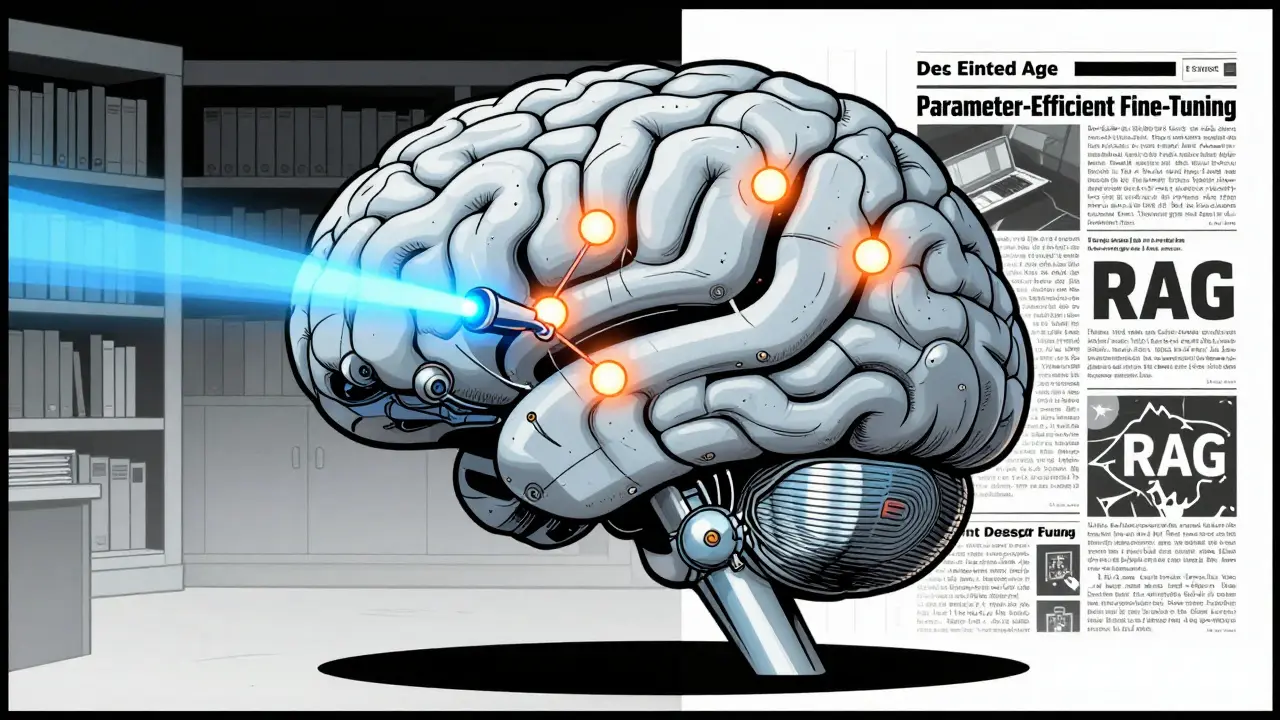
PEFT methods, such as Low-Rank Adaptation (LoRA), freeze the original model weights and inject trainable rank decomposition matrices into each layer of the Transformer architecture. LoRA can reduce the number of trainable parameters by up to 10,000 times compared to full fine-tuning.
When you combine data augmentation with LoRA, you get a powerful synergy. Because LoRA is lightweight, you can iterate faster. You can test multiple augmented datasets, tweak your synthetic generation prompts, and re-train the model in hours rather than days. This agility allows you to refine your data quality continuously without burning through your compute budget.
| Strategy | Compute Cost | Data Requirement | Best Use Case |
|---|---|---|---|
| Full Fine-Tuning | Very High | High Quality, Large Volume | Fundamental capability shifts |
| LoRA / QLoRA | Low to Medium | Moderate, Augmented Data | Domain adaptation, style tuning |
| RAG (Retrieval-Augmented Generation) | Low (Training), High (Inference) | External Knowledge Base | Factual, up-to-date information |
Tooling the Pipeline
To implement this, you need the right infrastructure. The Hugging Face Transformers Library remains the standard for accessing pre-trained models and utilities. For scaling up, libraries like DeepSpeed from Microsoft help accelerate the fine-tuning process, especially when dealing with larger batches of augmented data.
However, tools alone aren't enough. You must define clear success metrics. Are you optimizing for sentiment analysis accuracy? Named Entity Recognition (NER) precision? Your augmentation strategy should align with these goals. For NER, for instance, you might specifically augment data by obfuscating entity names to force the model to recognize structural cues rather than memorizing proper nouns.
Alternative: When Not to Fine-Tune
Before investing in data augmentation and fine-tuning, consider if Retrieval-Augmented Generation (RAG) is a better fit. RAG combines natural language generation with information retrieval, grounding the model in external, up-to-date documents.
If your primary challenge is providing the model with current facts (like stock prices or recent news), RAG is superior. Fine-tuning bakes knowledge into the model, which can become stale. RAG fetches it dynamically. Use fine-tuning with data augmentation when you need to change the model's behavior, style, or reasoning pattern, not just its knowledge base.
Practical Implementation Steps
Start small. Choose a base model that fits your resource constraints. Models with 7B or 8B parameters are often sufficient for many enterprise tasks and are far cheaper to tune than 70B+ models. Use LoRA for efficiency. Then, build your augmentation loop:
- Seed Creation: Curate a small, high-quality dataset (50-100 examples) manually reviewed by experts.
- Synthetic Expansion: Use a strong LLM to generate 5-10 variations per seed example.
- Human Validation: Have subject matter experts score or filter the synthetic outputs. Remove hallucinations and low-quality generations.
- Training: Fine-tune using LoRA with the curated augmented dataset.
- Evaluation: Test on a held-out validation set that was NOT part of the augmentation process to check for overfitting.
Monitor hyperparameters closely. Learning rate, batch size, and epochs play a huge role. Early stopping prevents the model from memorizing the augmented noise. If performance plateaus, revisit your data quality, not just your code. Cleaner data almost always beats more complex algorithms.
What is the difference between synthetic data and human-labeled data?
Human-labeled data is created directly by people, ensuring high accuracy but at a high cost and slow speed. Synthetic data is generated by AI models to mimic human data. It is faster and cheaper but carries a risk of hallucinations or bias if not properly validated. The best approach often combines both, using humans to validate synthetic outputs.
Why use LoRA instead of full fine-tuning?
LoRA (Low-Rank Adaptation) is a form of Parameter-Efficient Fine-Tuning (PEFT). It freezes the majority of the model's weights and only trains a small subset of parameters. This reduces computational costs significantly, allowing you to fine-tune large models on consumer-grade hardware or cloud instances with limited resources, while still achieving performance comparable to full fine-tuning.
How do I prevent my model from overfitting to augmented data?
Overfitting occurs when the model memorizes the training data instead of learning generalizable patterns. To prevent this, use a separate validation dataset that contains no augmented examples. Implement early stopping to halt training when validation performance stops improving. Additionally, ensure your synthetic data is diverse and includes noise to mimic real-world variability.
Is RAG a replacement for fine-tuning?
No, they serve different purposes. RAG (Retrieval-Augmented Generation) is best for providing models with up-to-date factual information from external sources. Fine-tuning is used to change the model's behavior, tone, or reasoning capabilities. You can use both together: fine-tune the model for style and structure, and use RAG for factual grounding.
What tools are best for implementing data augmentation?
Popular tools include the Hugging Face Transformers library for model access and fine-tuning, DeepSpeed for optimization and acceleration, and various open-source scripts for text transformation. For synthetic data generation, you can use existing LLM APIs or run local models via frameworks like vLLM or Ollama.