
Running a large language model (LLM) in production is expensive. The bills for GPU compute can spiral out of control fast, especially when you are serving thousands of requests per second. If you are trying to deploy models like Llama-3 or Mistral on a budget, you quickly hit a wall: full-precision models are too heavy, too slow, and too costly for most real-world applications. This is where model compression comes in.
Model compression isn't just about making files smaller. It is an economic strategy. By reducing the computational and memory requirements of your AI models, you directly slash your cloud infrastructure bills. Two techniques dominate this space right now: quantization and knowledge distillation. When used correctly, they can reduce deployment costs by up to 90% while keeping performance nearly identical to the original model.
The Cost Problem with Large Language Models
To understand why compression matters, you need to look at the raw numbers. A standard 7-billion parameter model running in FP32 (32-bit floating point) precision requires roughly 28 GB of VRAM just to load. That forces you to rent expensive GPUs like the NVIDIA A100 or H100. These cards cost hundreds of dollars per month per unit. If your application needs high throughput, you scale horizontally, adding more GPUs, and the costs multiply.
Inference is where the money burns. Every token generated requires matrix multiplications across billions of parameters. According to industry benchmarks from 2024, inference costs account for over 60% of total LLM operational expenses. Without compression, many startups and enterprises simply cannot afford to run state-of-the-art models at scale. The goal of compression economics is to break this link between model size and operational cost.
Quantization: Shrinking Precision to Save Space
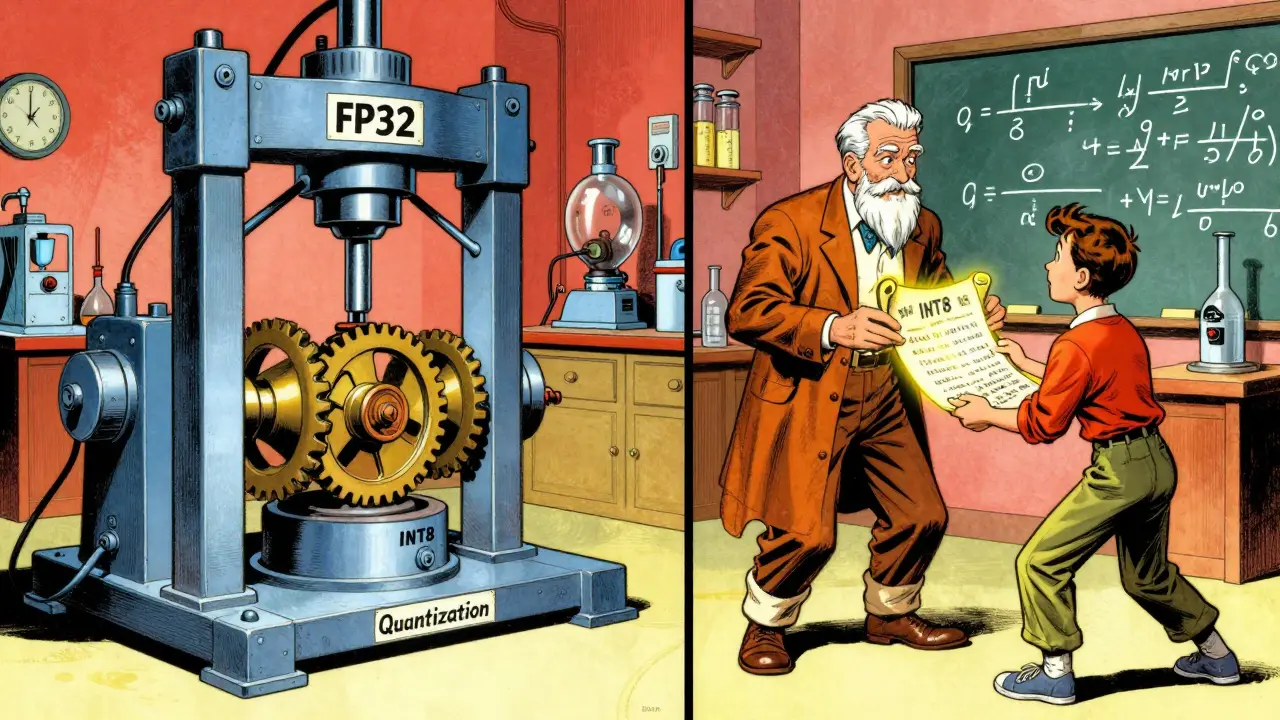
Quantization is a technique that reduces the numerical precision of model weights to save memory and speed up computation. Think of it like converting a high-resolution photo to a slightly lower resolution. You lose some detail, but the image looks almost the same, and the file size drops dramatically.
Most LLMs are trained in FP32 format. Each weight uses 32 bits of data. Quantization converts these weights into smaller formats, typically INT8 (8-bit integers) or INT4 (4-bit integers). Here is what that means for your bottom line:
- INT8 Quantization: Reduces model size by 4x. Accuracy loss is usually negligible (less than 1%). This is the sweet spot for most production deployments. It allows you to fit larger models on cheaper hardware.
- INT4 Quantization: Reduces model size by 8x. You might see a 2-5% drop in performance on complex tasks, but for general chat and summarization, it often remains acceptable. This enables running 7B models on consumer-grade GPUs like the RTX 4090.
- 2-Bit Quantization: Offers extreme compression (16x reduction), but risks significant accuracy degradation (up to 15% on translation tasks). Use this only for very simple tasks or edge devices with severe memory constraints.
Hardware support plays a huge role here. Modern GPUs, such as those based on NVIDIA's Ampere architecture, have Tensor Cores optimized for INT8 arithmetic. This means quantized models don't just take up less space; they run faster. You get higher throughput per dollar spent on hardware. However, older CPUs lack this support, so if you are deploying on legacy infrastructure, the benefits may be limited to memory savings rather than speed gains.
Knowledge Distillation: Teaching Smaller Models
Knowledge Distillation is a process where a small 'student' model learns to mimic the behavior of a larger 'teacher' model. Unlike quantization, which keeps the same architecture but shrinks the numbers, distillation creates a fundamentally different, smaller model.
In this setup, you train a compact student model (often 1/10th to 1/50th the size of the teacher) using the outputs of the large teacher model. The student doesn't just learn from raw labels; it learns the "soft" probabilities and reasoning patterns of the teacher. This allows the student to capture nuances that simple label training would miss.
The trade-off is clear. Distillation offers massive compression ratios-up to 50x in some cases-but it is computationally expensive upfront. Training the student model requires substantial GPU resources and time. For example, recent research on distilling Gemma-2 models showed that creating a high-quality student model can require trillions of tokens of training data, costing nearly as much as pretraining a new model from scratch.
However, once trained, the student model runs incredibly cheaply. It has fewer parameters, meaning less memory bandwidth usage and faster inference. This makes distillation ideal for scenarios where you need a specialized, low-latency model for a specific domain, such as medical diagnosis or legal document review, derived from a general-purpose giant.
Comparing Quantization vs. Distillation
Choosing between these two methods depends on your specific constraints: time, budget, and performance requirements. Let's break down the key differences.
| Feature | Quantization | Knowledge Distillation |
|---|---|---|
| Compression Ratio | 4x - 8x (INT8/INT4) | 5x - 50x (depending on student size) |
| Implementation Effort | Low (minutes to hours) | High (days to weeks of training) |
| Upfront Cost | Negligible | High (GPU compute for training) |
| Accuracy Retention | 95% - 99% | 90% - 98% (varies by task) |
| Best Use Case | Rapid deployment, latency-sensitive apps | Edge devices, specialized domains, long-term cost savings |
Quantization is the quick win. You can apply it to any existing model in minutes using tools like NVIDIA's TensorRT-LLM or Hugging Face's Optimum library. It is perfect for when you need to cut costs immediately without retraining. Distillation is the long-game investment. It requires engineering effort and compute upfront, but the resulting model is often more efficient and tailored to your specific use case.
The Power of Hybrid Approaches
For maximum efficiency, top-tier companies rarely rely on just one technique. They combine them. Research from Amazon Science in 2022 demonstrated that combining distillation with quantization outperforms either method alone. In their tests, a distilled BART model that was further quantized achieved a 95% size reduction while maintaining 98.2% of its question-answering accuracy.
This hybrid approach works because distillation removes unnecessary architectural complexity, and quantization then squeezes out the remaining numerical redundancy. Newer techniques like BitDistiller (introduced in late 2024) even integrate both processes during training, boosting sub-4-bit model performance by 7.3% compared to post-training quantization alone.
If you are building a serious production system, consider this workflow: First, prune the least important weights from your base model. Second, distill a smaller student model from the pruned teacher. Third, apply INT4 or INT8 quantization to the student. This sequential compression can yield models that are tiny, fast, and surprisingly accurate.

Real-World Implementation Pitfalls
While the theory is straightforward, implementation has traps. One common issue is the "accuracy cliff." Developers often push quantization too far, dropping to 2-bit precision, only to find that complex reasoning tasks fail completely. Stanford researchers noted that below 4-bit precision, models suffer from "catastrophic forgetting" of rare linguistic patterns, leading to an 18.5% degradation in handling low-frequency words.
Another pitfall is activation outliers. Some neurons in a neural network have unusually large values that skew the quantization range. Techniques like SmoothQuant help here by shifting these outliers from dynamic activations to static weights, improving 4-bit accuracy by over 5%. Always use calibration datasets that represent your actual production traffic. If you calibrate on generic text but serve technical queries, your quantized model will perform poorly.
Hardware compatibility is also critical. Ensure your target infrastructure supports the precision level you choose. Deploying INT8 models on old CPUs won't give you the speed boost you expect. Check for support in frameworks like ONNX Runtime or TensorRT before committing to a specific bit-width.
Economic Impact and Market Trends
The market for model compression is exploding. Gartner forecasts the sector will reach $4.7 billion by 2026, driven by the urgent need to make AI affordable. Enterprises are adopting these techniques not just to save money, but to enable new use cases. Edge computing, for instance, requires models that run on smartphones or IoT devices with limited battery and memory. Only compressed models can meet these constraints.
A fintech startup reported reducing its inference costs from $1.20 to $0.07 per 1,000 queries by implementing combined quantization and distillation on a Llama-2 model. That is a 94% cost reduction. Such margins can mean the difference between profitability and failure for AI-driven businesses. As regulations like the EU AI Act begin to demand transparency around model reliability, understanding how compression affects output quality becomes a compliance issue as well as a financial one.
What is the best quantization level for production LLMs?
INT8 is generally the best balance for production. It offers a 4x size reduction with minimal accuracy loss (under 1%). INT4 is viable if you need extreme compression and can tolerate a slight dip in performance on complex tasks. Avoid 2-bit unless you are strictly constrained by hardware memory.
Is knowledge distillation worth the effort?
Yes, if you plan to run the model at scale for a long time. The upfront training cost is high, but the resulting student model runs significantly cheaper and faster than the teacher. It is especially valuable for specialized domains where you can tailor the student to your specific data distribution.
Can I use quantization on any hardware?
You can deploy quantized models on most hardware, but you won't get speed benefits on older CPUs. To leverage the performance gains of INT8 or INT4, you need hardware with dedicated low-precision arithmetic units, such as NVIDIA Tensor Cores or Apple M-series chips.
How does pruning fit into model compression?
Pruning removes redundant weights from the model. It is often used as a first step before quantization or distillation. While it offers moderate compression (2-10x), combining it with other techniques yields the best results by simplifying the model structure before reducing precision.
What tools should I use for model compression?
For quantization, NVIDIA's TensorRT-LLM and Hugging Face's Optimum library are industry standards. For distillation, Hugging Face Transformers provides robust frameworks. Open-source tools like AutoGPTQ and Bitsandbytes are also popular for easy experimentation with INT4 and INT8 quantization.