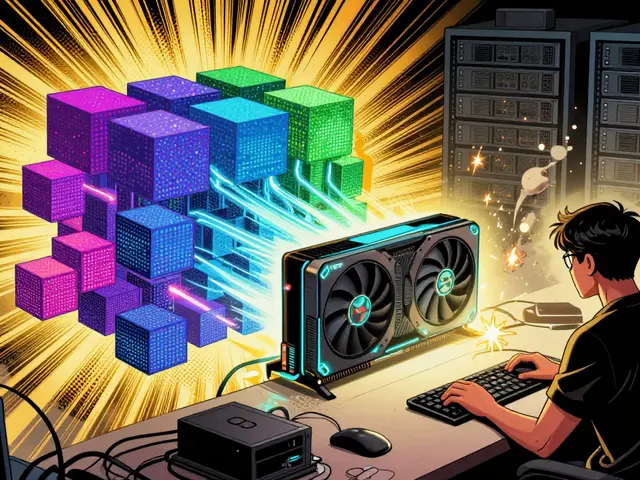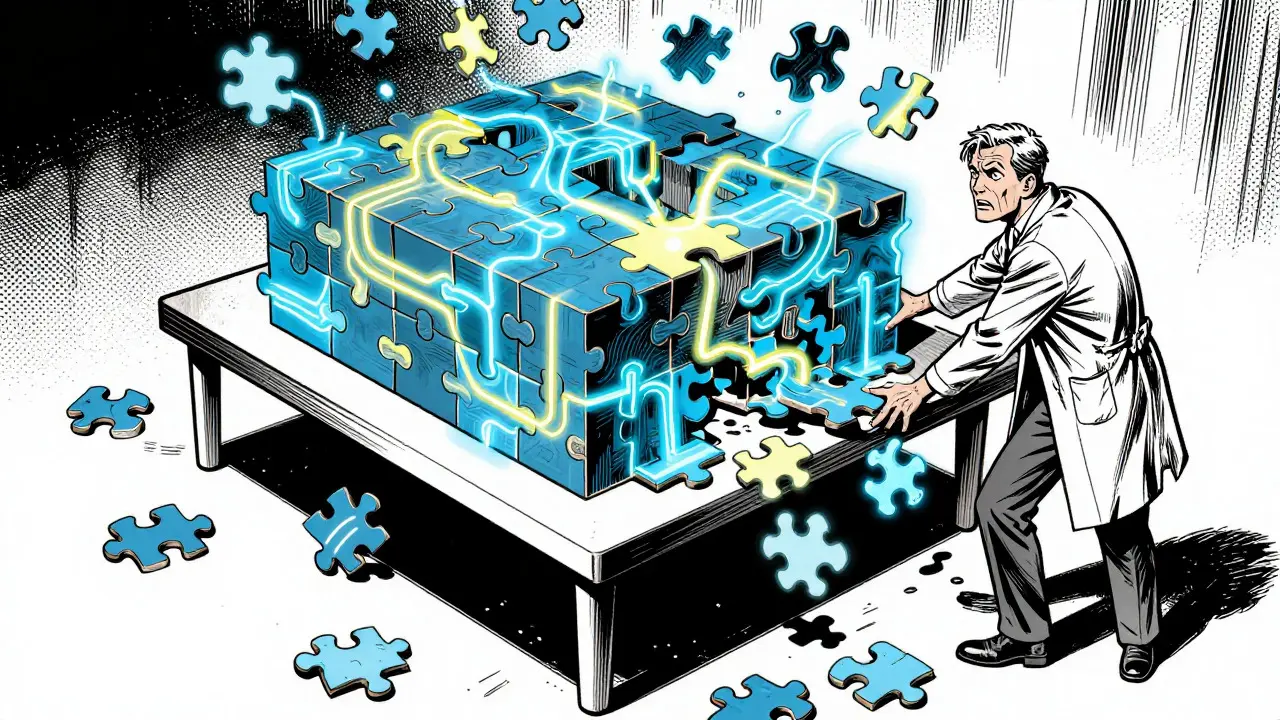
Imagine trying to fit a massive jigsaw puzzle onto a coffee table that is only half the size of the box. That is exactly what happens when you try to train modern generative AI models on a single Graphics Processing Unit (GPU). The model simply does not fit. As we push toward models with hundreds of billions of parameters, the memory limits of individual hardware become the primary bottleneck. This is where Model Parallelism is a distributed computing technique that splits a neural network across multiple devices to overcome single-device memory constraints. By breaking the model into smaller pieces and distributing them across many GPUs, engineers can train architectures that would otherwise be impossible to run.
However, splitting a model is not as simple as cutting a cake. If you just hand out layers randomly, your GPUs will sit idle waiting for data, creating massive inefficiencies. This is why Pipeline Parallelism is a specific implementation of model parallelism that divides the model into sequential stages processed across different devices to maximize computational throughput. It acts like an assembly line, ensuring every GPU stays busy processing data rather than sitting around waiting for its neighbor. Understanding how these two concepts work together is critical for anyone involved in building or deploying large-scale artificial intelligence systems in 2026.
Why Single-GPU Training Hits a Wall
To understand why we need parallelism, we have to look at the math behind training a large language model. When you train a model, your GPU needs to store three main things: the model weights (the parameters themselves), the gradients (calculated during backpropagation), and the optimizer states (used to update those weights). For a transformer-based architecture like GPT-3, which has 175 billion parameters, this requires approximately 320 gigabytes of high-bandwidth memory just for one step of training.
Most consumer-grade GPUs, and even many professional ones, cap out at 24GB to 80GB of VRAM. Even if you had a GPU with enough raw memory, the bandwidth required to move that data around becomes a choke point. According to ColossalAI's documentation from 2023, this "storage limitation" was the primary driver for developing pipeline parallelism. You cannot brute-force your way past this limit without changing how the computation is structured. Data parallelism, which replicates the entire model on every GPU, works great for small models but fails completely here because each GPU still needs to hold a full copy of the model.
How Pipeline Parallelism Works
Pipeline parallelism solves the memory problem by slicing the model vertically. Instead of every GPU holding the whole model, you divide the neural network into chunks based on layers. If you have four GPUs, you might assign the first quarter of the layers to GPU 0, the next quarter to GPU 1, and so on.
The process flows like water through pipes:
- Forward Pass: Input data enters GPU 0. Once GPU 0 finishes its calculations, it sends the intermediate results (activations) to GPU 1. GPU 1 processes them and passes them to GPU 2, until the final output is generated.
- Backward Pass: The error signal starts at the last GPU and travels backward. Gradients are calculated and passed back to the previous stage, updating the weights along the way.
This approach was pioneered around 2019 with Google's GPipe paper. The key insight was treating the pipeline like a factory assembly line. Just as cars move down a manufacturing line with different workers handling different tasks simultaneously, data moves through the pipeline with different GPUs handling different layers. However, there is a catch known as "pipeline bubbles." In a naive implementation, while GPU 1 is working, GPU 0 is idle, and GPU 2 is idle. This leads to terrible efficiency.
To fix this, engineers use micro-batching. Instead of sending one huge batch of data through the pipeline, they split it into smaller micro-batches. While GPU 1 is processing micro-batch #1, GPU 0 can start processing micro-batch #2. This keeps all devices busy. Research published in the Journal of Computer Science and Technology (2024) shows that this technique reduces idle time significantly, boosting GPU utilization from roughly 50% in basic setups to over 90% in optimized configurations.
Comparing Parallelism Strategies
Not all parallelism is created equal. Choosing the wrong strategy can waste millions of dollars in compute costs. Here is how pipeline parallelism stacks up against other common methods.
| Strategy | Memory Usage per GPU | Communication Overhead | Scaling Efficiency | Best Use Case |
|---|---|---|---|---|
| Data Parallelism | High (Full Model Copy) | Low (Gradient Sync Only) | 90-95% | Models that fit on one GPU |
| Tensor Parallelism | Medium (Split Tensors) | Very High (All-to-All) | 85-92% | Extreme width models, low latency inference |
| Pipeline Parallelism | Low (Split Layers) | Medium (Stage Boundaries) | 75-85% | Deep models exceeding single-GPU memory |
Data parallelism is the easiest to implement but requires every GPU to hold a complete replica of the model. If the model is too big, this method crashes immediately. Tensor parallelism splits individual matrix operations across GPUs, which is powerful but requires incredibly fast interconnects (like NVIDIA NVLink) because GPUs must talk to each other constantly during every calculation. Pipeline parallelism sits in the middle. It requires less communication than tensor parallelism because data only moves between adjacent stages, but it introduces complexity in scheduling to avoid those idle bubbles.
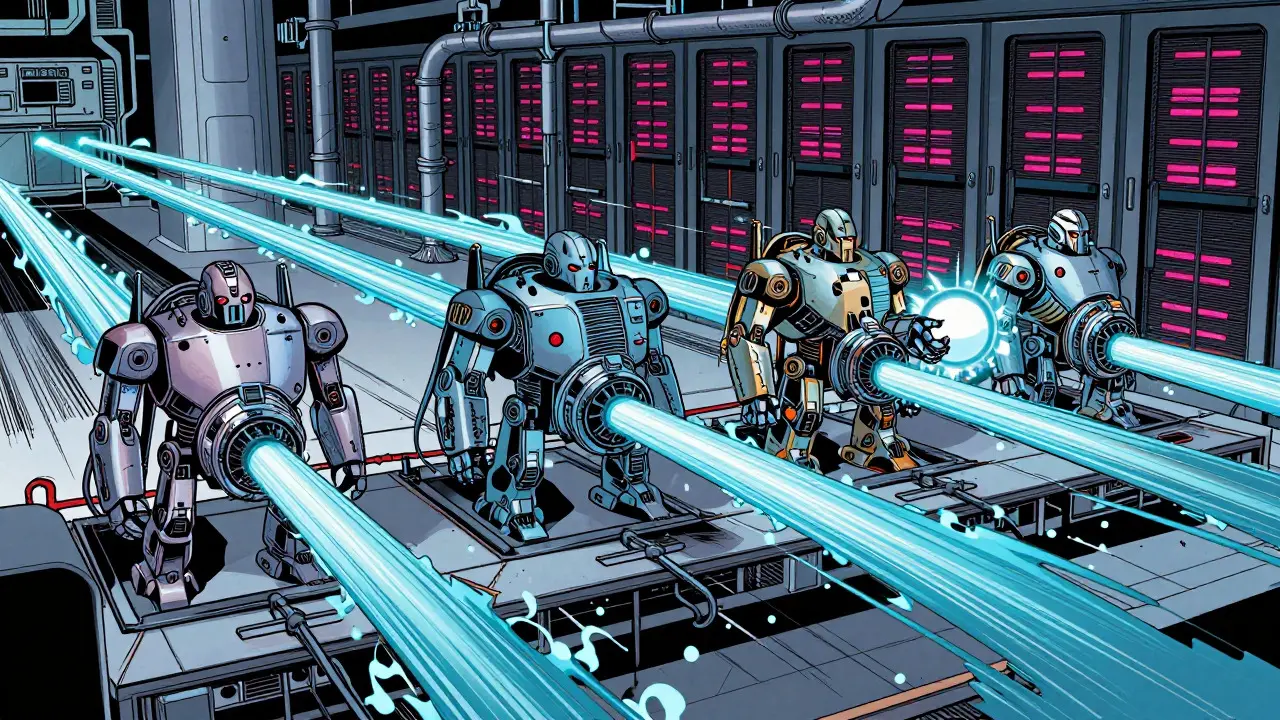
Scheduling Strategies: Grouped vs. Interleaved
Once you decide to use pipeline parallelism, you face a choice in how to schedule the work. The two dominant approaches are grouped scheduling and interleaved scheduling.
In grouped scheduling, the pipeline executes all forward passes followed by all backward passes. This minimizes the frequency of communication events, which can reduce overhead. However, it requires storing activations for longer periods, leading to higher memory usage. If your goal is to minimize peak memory consumption, this might not be the best path.
In interleaved scheduling, the pipeline mixes forward and backward passes more aggressively. This allows for better memory management because activations can be freed sooner after their corresponding backward pass completes. However, it increases communication frequency and can introduce more complex dependencies. According to benchmarks from NVIDIA's Megatron-LM framework, grouped schemes often achieve 15-20% higher throughput but demand nearly double the activation memory compared to interleaved schedules. Most modern large-scale training jobs, such as those used for Llama or Claude, opt for hybrid approaches that balance these trade-offs based on available hardware resources.
Real-World Implementation Challenges
Theory looks clean; reality is messy. Engineers implementing pipeline parallelism frequently encounter load imbalance. If one stage of the pipeline contains a particularly heavy layer-such as a large attention mechanism-it becomes the bottleneck. All other GPUs must wait for that slow stage to finish before proceeding. This phenomenon is called "straggler effect."
A survey of 127 AI practitioners on Hugging Face forums in September 2023 revealed that 68% of respondents struggled with activation recomputation challenges. To save memory, developers often discard intermediate activations and recompute them during the backward pass. While this saves VRAM, it increases compute time. Finding the right balance between memory savings and compute cost is a delicate tuning exercise.
Debugging is another major pain point. A Meta AI engineer noted in August 2023 that tracking down bugs in pipeline parallel code takes three times longer than in data parallel code. Because the model is split across devices, errors can manifest subtly, appearing as silent failures or numerical instabilities that are hard to trace back to a specific layer. Tools like NVIDIA Nsight Systems have become essential for visualizing these pipelines and identifying where bubbles form or where communication stalls.
The Rise of Hybrid Parallelism
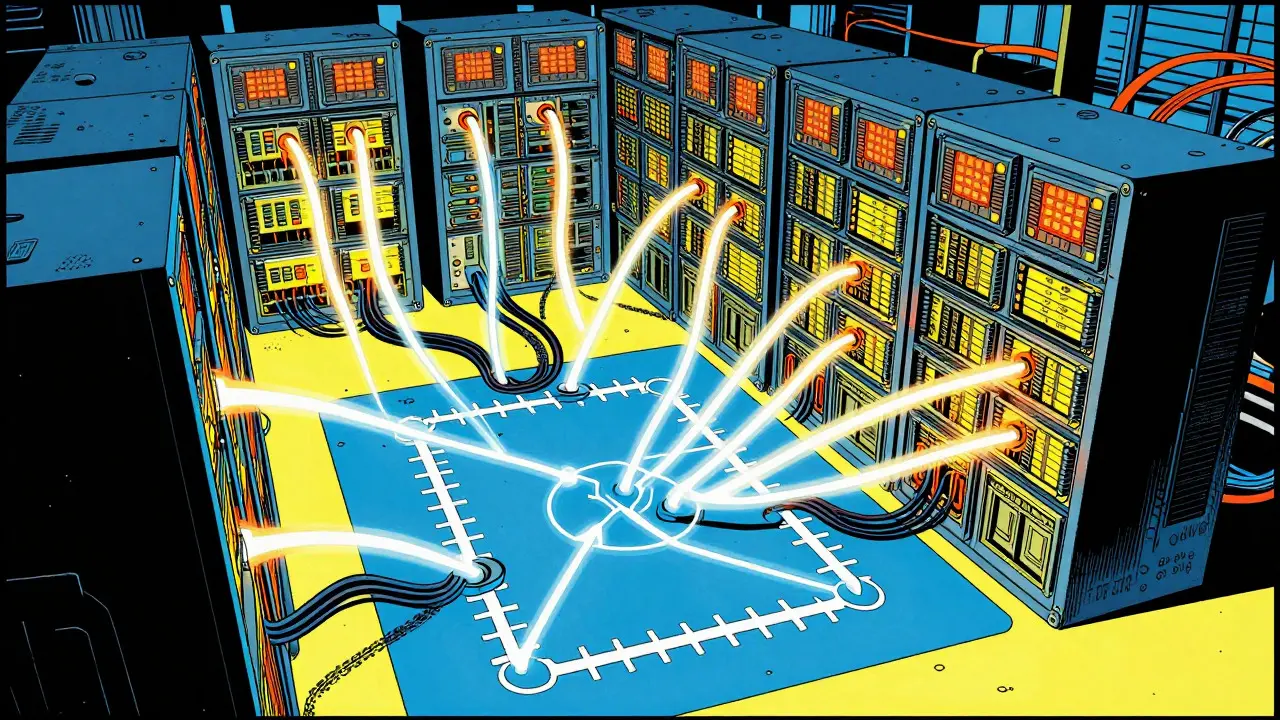
Relying solely on pipeline parallelism is rarely enough for the largest models today. The industry standard has shifted toward hybrid parallelism. This means combining pipeline parallelism with data parallelism and sometimes tensor parallelism.
For example, AWS SageMaker’s Distributed Model Parallel implementation allows users to configure a setup with four-way data parallelism and two-way pipeline parallelism across eight GPUs. In this scenario, the model is split into two halves (pipeline), and each half is replicated across four GPUs (data). This creates a "pipeline parallel group" that handles the depth of the model, while "data parallel groups" handle the volume of data. This combination enables scaling to thousands of GPUs. NVIDIA’s Megatron-Turing NLG model, with 530 billion parameters, was trained using 8-way tensor parallelism and 128-way pipeline parallelism across 3,072 GPUs. Without this hybrid approach, the training job would have been computationally infeasible.
Future Trends and Optimizations
As we move through 2026, the focus is shifting from just making pipeline parallelism work to making it seamless. New developments aim to eliminate the manual tuning required for scheduling. NVIDIA’s Megatron-Core introduced dynamic pipeline reconfiguration, allowing teams to change their parallelism degrees mid-training without losing progress. This flexibility is crucial for long-running experiments where hardware availability might change.
ColossalAI’s recent updates include zero-bubble pipeline parallelism techniques that overlap communication with computation almost entirely. Meanwhile, research from Microsoft demonstrates asynchronous updates that maintain high efficiency even across thousands of nodes. The barrier to entry is slowly lowering, but the fundamental constraint remains: GPU memory grows much slower than model size. With transformer models growing by a factor of 10 annually while GPU memory capacity only increases by 1.5x, pipeline parallelism is not just a niche technique-it is a necessity for the future of generative AI.
What is the main difference between model parallelism and pipeline parallelism?
Model parallelism is a broad category of techniques that split a model across multiple devices. Pipeline parallelism is a specific type of model parallelism that splits the model sequentially by layers, passing data through stages like an assembly line. Other types include tensor parallelism, which splits individual operations within a layer.
Why do we need micro-batching in pipeline parallelism?
Micro-batching reduces "pipeline bubbles," which are periods where GPUs sit idle waiting for data. By splitting a large batch into smaller micro-batches, you can keep all GPUs busy simultaneously. While one GPU processes micro-batch #2, the next GPU can already be processing micro-batch #1, significantly improving overall throughput.
Is pipeline parallelism faster than data parallelism?
In terms of pure scaling efficiency, data parallelism is often slightly higher (90-95% vs 75-85%). However, pipeline parallelism enables training models that are too large to fit in a single GPU's memory, where data parallelism would fail entirely. Therefore, it is not about speed alone, but about feasibility for large models.
What are the biggest challenges in implementing pipeline parallelism?
The main challenges include load balancing (ensuring no single stage bottlenecks the pipeline), managing activation memory (often requiring recomputation), and debugging complexity. Uneven layer distribution can cause significant idle time, and tracking errors across distributed stages is notoriously difficult.
Can I use pipeline parallelism with PyTorch?
Yes, PyTorch supports pipeline parallelism through libraries like TorchPipe and frameworks built on top of it, such as Megatron-LM and DeepSpeed. These tools provide the necessary primitives to partition models and manage the communication between stages efficiently.