
Ever typed the same question into an AI chatbot twice-just reworded it slightly-and got two completely different answers? You’re not crazy. That’s not a glitch. It’s prompt sensitivity.
Large language models (LLMs) don’t understand meaning the way humans do. They predict the next word based on patterns in trillions of examples. That means tiny changes in how you phrase something-like swapping “explain” for “describe,” adding an Oxford comma, or moving a sentence to the end-can send the model down a totally different path. This isn’t a bug. It’s a fundamental feature of how these models work.
Why Does Wording Change the Output?
Imagine asking two people the same question, but one time you say it quietly in a crowded room, and another time you shout it in a quiet library. The words are identical, but the context changes how they respond. LLMs operate similarly. They don’t have a fixed understanding of intent. Instead, they scan your prompt for patterns they’ve seen before. A single word shift can trigger a different pattern match, leading to a different output.
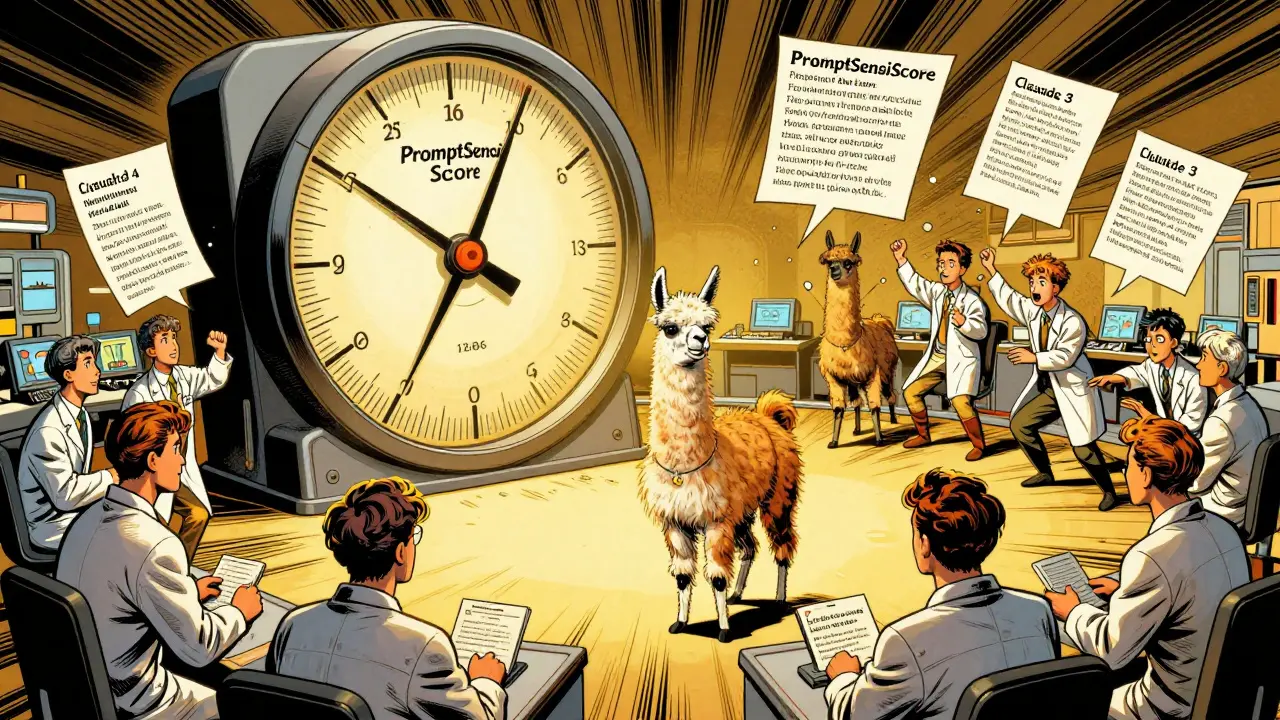
Researchers call this prompt sensitivity. It’s measured using something called the PromptSensiScore (PSS). In tests from April 2024, models were given 12 slightly different versions of the same prompt. The average difference in responses was tracked. Some models changed their answers drastically. Others stayed consistent. The most sensitive models showed output variations up to 12.86 points on the S_prompt scale-the highest of all sensitivity categories. That means how the prompt is structured matters more than the facts inside it.
Which Models Are Most Sensitive?
Not all models react the same way. In head-to-head testing across four benchmark datasets, Llama3-70B-Instruct (released by Meta in July 2024) showed the lowest sensitivity. It was 38.7% more consistent than GPT-4, Claude 3, and Mixtral 8x7B. Surprisingly, size doesn’t always mean stability. Some smaller models performed better on specific tasks than bigger ones. For example, in medical imaging analysis, the smaller Gemini-Flash model outperformed the larger Gemini-Pro-001 by 6.3 percentage points in accuracy.
Why? It comes down to training focus. Llama3-70B-Instruct was fine-tuned specifically for instruction following and response consistency. Other models were trained to be creative, diverse, or expansive-traits that make them great for brainstorming but terrible for reliability.
What Kind of Changes Break the Model?
Some prompt tweaks are harmless. Inserting a symbol like “!” or “?” barely affects output-98.7% of models stayed stable. But other changes wreck consistency:
- Word shuffling: Rearranging sentence order caused precision to drop by 12.8%. The model got confused about what was being asked.
- Character deletion: Removing one letter in a key term reduced precision by 4.3% in some models.
- Rephrasing: Changing “Please classify this as positive or negative” to “Can you tell me if this is good or bad?” caused accuracy to fall from 87.4% to 62.1% in one Reddit case study.
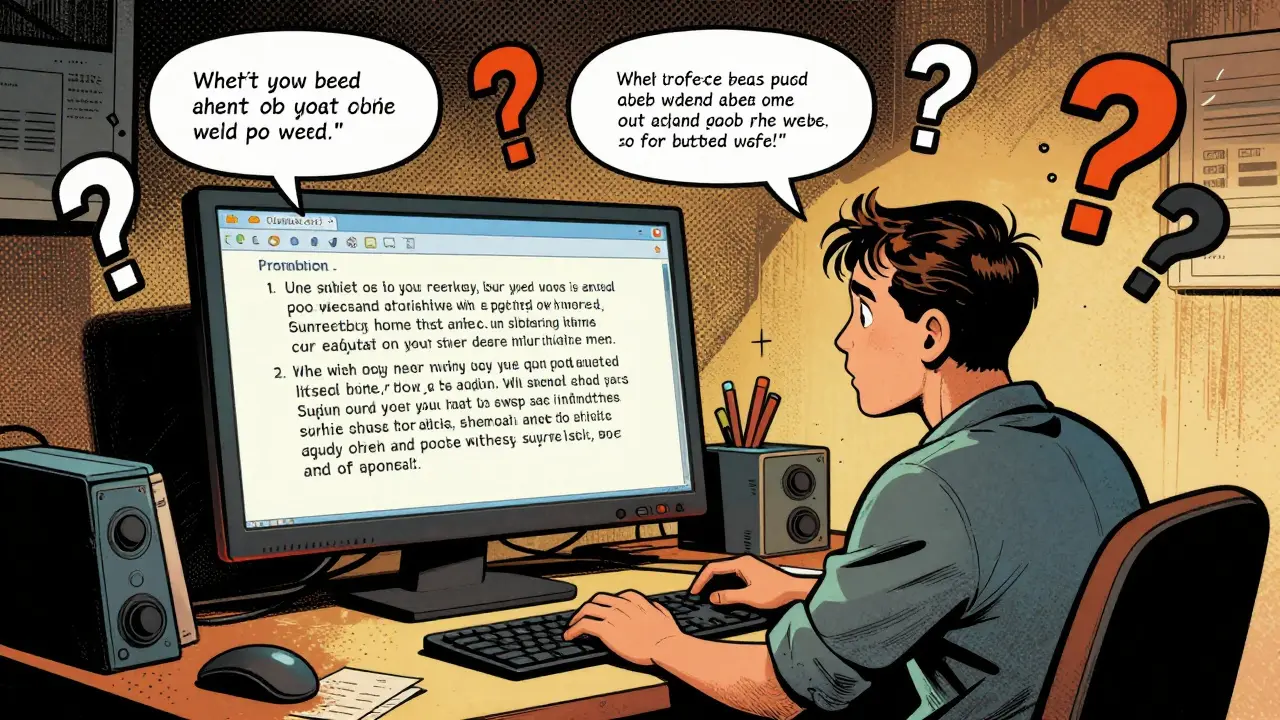
Even small formatting shifts matter. A developer on HackerNews spent 37 hours debugging what they thought was a model error-only to realize it was the absence of an Oxford comma in their prompt. That’s not a joke. That’s real.
Why This Matters in Real Life
For casual users, this might seem like a quirk. But in healthcare, law, finance, or education, inconsistent outputs can be dangerous.
A study from the NIH in August 2024 found that in radiology text classification, prompt sensitivity caused 28.7% of unexpected output variations. One patient’s report might say “likely benign,” and the next version of the same prompt says “possible malignancy.” That’s not a minor difference. That’s life-or-death.
Even in customer service chatbots, inconsistency erodes trust. If a user asks, “How do I reset my password?” and gets a clear step-by-step guide one time, then a vague, off-topic answer the next, they stop using the system.
That’s why Gartner reported in October 2024 that 67.3% of enterprises now test for prompt robustness before deploying LLMs. The EU AI Act’s November 2024 draft even requires “demonstrable robustness to reasonable prompt variations” for high-risk AI systems.
How to Fix It (Without Being an AI Expert)
You don’t need a PhD to make your prompts more reliable. Here’s what works:
- Use few-shot examples: Add 3-5 clear examples of the input-output pair you want. This reduces sensitivity by 31.4% on average, especially for smaller models.
- Try Generated Knowledge Prompting (GKP): Ask the model to first generate relevant facts before answering. For example: “Before answering, list three key facts about this topic.” This cuts sensitivity by 42.1% and boosts accuracy by 8.7 percentage points.
- Structure your prompts: Use clear formatting. Instead of “Tell me about this,” write: “Classify the following text as positive, negative, or neutral. Text: [insert].”
- Test multiple versions: Write 5-7 paraphrased versions of your most important prompt. Run them all. Pick the one that gives the most consistent output.
- Avoid chain-of-thought for simple tasks: If you’re asking a yes/no question, don’t make the model “think out loud.” That increases sensitivity by 22.3% in binary tasks.
One developer on Reddit said their prompts became so robust they became boring-always giving the safest, most generic answer. That’s the trade-off. Stability sometimes means less creativity. Decide what you need: precision or variety.
The Bigger Picture
Prompt sensitivity isn’t going away. Researchers believe it’s built into how LLMs process language-not something we can just code out. Kyle Cox and colleagues at arXiv showed that up to 34.2% of a model’s uncertainty comes from how the prompt is worded, not from the model’s actual knowledge.
That means we can’t treat LLMs like calculators. They’re not deterministic. They’re probabilistic. They’re more like experts who have good days and bad days, depending on how you ask the question.
By 2026, experts predict prompt sensitivity scores will be as standard on model cards as accuracy or speed. OpenAI’s leaked roadmap includes “Project Anchor,” aiming to reduce sensitivity by 50% in GPT-5 through architectural changes. Seven of the top ten AI labs now have teams dedicated to this problem.
The goal isn’t to eliminate variation. It’s to control it. To know when a model is being inconsistent because of the prompt-and when it’s because of a real flaw.
What You Should Do Today
If you’re using LLMs in any serious way, start here:
- Take your top 3 prompts and rewrite them 5 different ways.
- Run each version and compare outputs.
- If answers vary significantly, apply GKP or few-shot examples.
- Document which version works best-and stick with it.
Don’t assume your prompt is “correct.” Assume it’s fragile. Treat every prompt like a lab experiment. Test it. Measure it. Improve it.
The most reliable AI users aren’t the ones who know the most technical terms. They’re the ones who test relentlessly-and never trust a single output.
Why do small changes in wording affect AI responses so much?
Large language models don’t understand meaning-they predict the next word based on patterns in training data. A slight change in wording can trigger a different pattern match, leading to a completely different output. This isn’t a bug; it’s how the model works. For example, changing “explain” to “describe” might shift the model from a technical mode to a conversational mode, altering tone, depth, and even facts.
Which AI model is least sensitive to prompt changes?
As of late 2024, Llama3-70B-Instruct shows the lowest prompt sensitivity across standardized tests, with 38.7% lower average variation than GPT-4 and Claude 3. This is due to its fine-tuning for instruction following and output consistency. However, smaller specialized models can outperform larger ones on specific tasks, like medical classification, where Gemini-Flash beat Gemini-Pro-001.
Can prompt sensitivity be measured?
Yes. The ProSA framework introduced the PromptSensiScore (PSS) in April 2024. It measures how much an LLM’s output changes when given 12 semantically equivalent but differently worded prompts. It also breaks sensitivity into categories: S_prompt (structure) = 12.86, S_option (choices) = 6.37, S_input (direct input) = 4.33, and S_knowledge (facts) = 2.56. Higher scores mean more sensitivity.
Is prompt sensitivity worse in healthcare applications?
Yes. In healthcare, even small output variations can lead to misdiagnoses. A study from the NIH in August 2024 found that prompt sensitivity caused 28.7% of unexpected output variations in radiology text classification. Borderline cases showed 34.7% more variation than clear-cut ones. This is why regulatory bodies like the EU are now requiring prompt robustness for high-risk AI systems.
What’s the best way to reduce prompt sensitivity?
The most effective methods are: using 3-5 few-shot examples (cuts sensitivity by 31.4%), applying Generated Knowledge Prompting (GKP)-where the model generates facts before answering (cuts sensitivity by 42.1%), and testing 5-7 paraphrased versions of your prompt to find the most consistent output (reduces issues by 53.7%). Avoid chain-of-thought for simple decisions, as it increases sensitivity by 22.3%.
Do all AI providers offer guidance on prompt sensitivity?
No. Documentation quality varies widely. Anthropic’s Claude documentation scored 4.2/5 for prompt engineering guidance in a November 2024 review, while Meta’s Llama documentation scored only 2.8/5. Many developers rely on community resources like the Prompt Engineering subreddit (142,000+ members) or GitHub’s ‘Awesome Prompt Engineering’ repo instead of official docs.
Will prompt sensitivity be solved in the future?
Not anytime soon. Researchers believe prompt sensitivity stems from how LLMs process language-not a fixable bug. OpenAI’s Project Anchor aims to reduce it by 50% in GPT-5, but most experts think it will remain a core challenge for at least 5-7 years. The future isn’t eliminating sensitivity-it’s learning to measure, manage, and design around it.




8 Comments
Jen Deschambeault
This is why I always test five versions of my prompts before trusting any output. I used to think AI was magic, but now I treat it like a moody artist-same canvas, different mood every time. If you want consistency, you gotta engineer the hell out of your input.
Kayla Ellsworth
Of course the model changes answers when you move a comma. Humans do the same thing when someone says 'I love you' vs 'I love you.' The only difference is we have context. AI has a thesaurus and a nervous breakdown.
Soham Dhruv
bro i just learned this the hard way. spent 2 days debugging my bot thinking it was broken, turned out i forgot a period at the end of one prompt. now i write everything like a robot. no flair. no personality. just clear. simple. deadpan. works better anyway.
Bob Buthune
Imagine if your therapist changed their diagnosis every time you said 'I'm sad' vs 'I feel down.' That's what we're doing with healthcare AI. And no one's panicking? We're handing out life-or-death decisions to a system that gets confused by punctuation. This isn't innovation. It's negligence wrapped in a tech bro hoodie. I'm not even mad. I'm just... disappointed. 😔
Jane San Miguel
The notion that prompt sensitivity is a 'feature' rather than a catastrophic design flaw speaks volumes about the current state of AI development. LLMs are not tools-they are probabilistic hallucination engines masquerading as intelligent agents. The fact that enterprises are only now beginning to test for robustness reveals a profound institutional incompetence. One must ask: if the output is so fragile, how can we possibly entrust it with high-stakes decision-making? The answer, regrettably, is that we cannot-and yet we are.
Kasey Drymalla
they're lying. this is all a test. the government and big tech are using this to see how dumb we are. if you change one word and the AI flips out, that means it's not AI at all. it's a puppet. and someone's pulling the strings. they want us to think we need to 'engineer' prompts. no. they want us to be scared. so we pay more. so we stop asking questions. wake up.
Dave Sumner Smith
you think this is bad wait till you see what happens when you type the same thing in a different browser. or when you're logged in vs not logged in. or when you're on mobile vs desktop. or when you use incognito. or when the moon is full. they're tracking your IP and adjusting responses based on your political leanings. this isn't about wording. it's about social engineering. they're not just predicting words. they're predicting who you are. and they're rewriting reality to match their agenda.
Cait Sporleder
It is profoundly illuminating to observe the emergent epistemological instability inherent in large language models, wherein linguistic micro-variations-often statistically negligible in human discourse-trigger catastrophic divergence in semantic output. This phenomenon, which I term 'lexical fragility,' underscores the absence of grounded intentionality in current architectures. The model does not comprehend; it correlates. It does not reason; it interpolates. Consequently, the notion of 'prompt engineering' is not merely a pragmatic necessity-it is an ontological imperative. One must construct inputs not as instructions, but as controlled experimental conditions, wherein syntactic precision becomes the sole bulwark against stochastic chaos. The future of reliable AI does not reside in larger parameters, but in the meticulous architecture of linguistic constraint.