Ever wonder why your chatbot sometimes stumbles on a specific brand name or a new slang term? It’s not usually because the model is "dumb." It’s because of how it reads words. In the world of tokenization, every piece of text you type gets chopped up into tiny chunks before the AI even thinks about what you mean. This process is the unsung hero (or villain) behind the speed, cost, and accuracy of modern generative AI.
If you’ve ever paid for API calls and wondered why a short sentence costs more than expected, or why an emoji takes up three times the space of a letter, you’re hitting the limits of tokenization. Understanding this isn’t just for data scientists; it’s crucial for anyone building products on Large Language Models (LLMs). Let’s break down how machines actually see language.
The Core Problem: Machines Don't Read Words
To a human, the word "unhappiness" is one concept. To a computer, it’s a string of characters that needs to be converted into numbers. Neural networks can’t do math with letters; they need vectors. Tokenization is the bridge between human language and machine computation. It segments raw text into standardized units called tokens, which are then mapped to high-dimensional vectors known as embeddings.
This step is critical because it determines the sequence length the model has to process. A longer sequence means more computational power needed and higher latency. If your tokenizer breaks a common word like "technology" into five separate pieces, your model has to work harder to understand the context. Conversely, if it keeps it as one token, processing is faster, but the vocabulary size balloons. It’s a constant trade-off between efficiency and coverage.
| Strategy | How It Works | Key Advantage | Main Limitation | Common Use Cases |
|---|---|---|---|---|
| Word-Level | Treats each word as a single unit | Simplest implementation | Huge vocabularies; fails on rare/new words | Early NLP experiments |
| Byte Pair Encoding (BPE) | Merges frequent character pairs iteratively | Balances vocab size and OOV handling | Can split semantically meaningful words awkwardly | GPT series, LLaMA |
| WordPiece | Selects merges based on likelihood scores | Optimized for masked language modeling | Different patterns than BPE; less intuitive | BERT, RoBERTa |
| SentencePiece | Unifies BPE/WordPiece with byte-level fallback | Language-agnostic; handles Unicode well | Slightly more complex setup | Multilingual models, T5 |
Byte Pair Encoding: The Workhorse of Modern LLMs
Byte Pair Encoding is an iterative algorithm that starts with individual characters and progressively merges the most frequently occurring adjacent pairs into new tokens. It’s the engine behind the GPT family of models, including GPT-4. Why did OpenAI choose this over other methods? Because it strikes a sweet spot. It doesn’t require a pre-defined dictionary of words. Instead, it learns the optimal granularity from the training data itself.
Imagine the word "unhappiness." A word-level tokenizer would need to have seen this exact word during training to recognize it. If it hadn’t, the model would treat it as unknown. BPE solves this by breaking it down into parts it *has* seen: "un," "happi," and "ness." Since these subwords are common, they’re likely in the vocabulary. This bottom-up approach ensures that virtually any word, no matter how rare or novel, can be represented by combinations of known units. This makes BPE incredibly robust for open-ended generation tasks where the AI might encounter unexpected terminology.
WordPiece: The Probabilistic Alternative
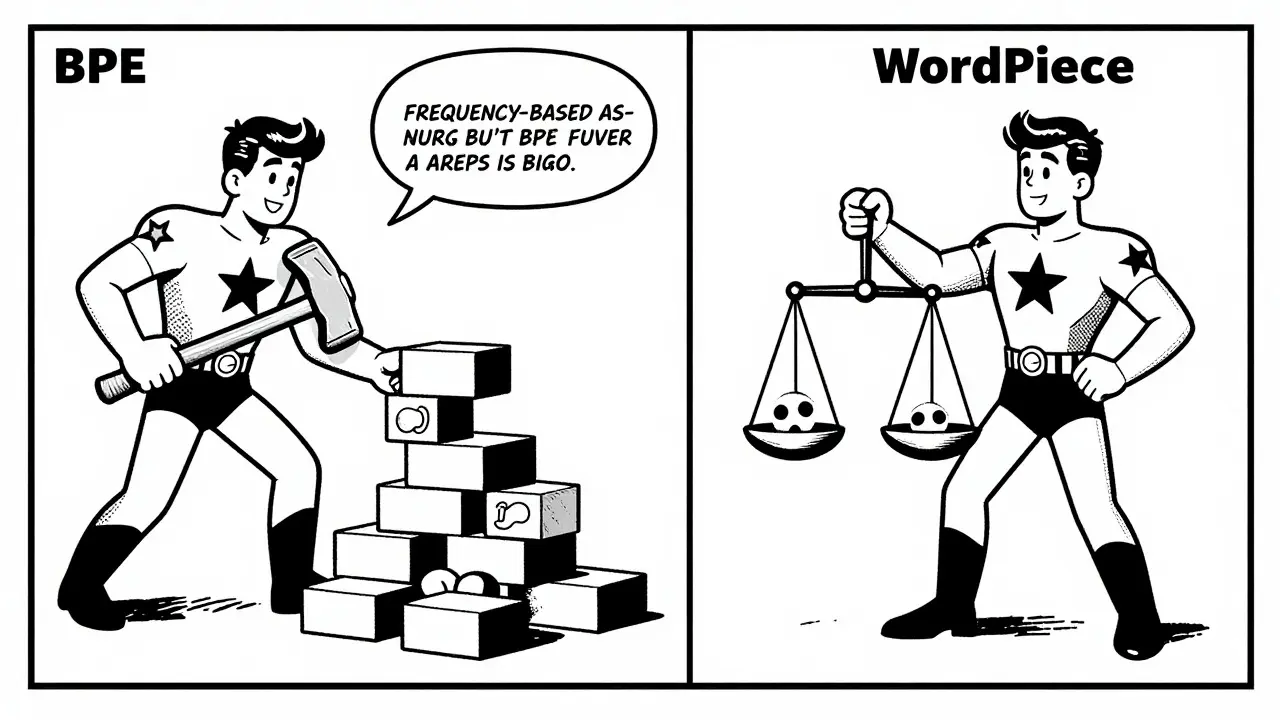
WordPiece is a tokenization method developed for BERT that builds vocabulary by calculating the likelihood of token pairs appearing together rather than just counting frequency. While similar in spirit to BPE, WordPiece uses a probabilistic criterion. It asks, "If I merge these two tokens, does it significantly improve the probability of the entire sentence?" This subtle difference leads to different tokenization patterns. For instance, WordPiece might keep "ing" attached to a verb stem differently than BPE would.
This distinction matters when you consider how models are trained. BERT and its derivatives use Masked Language Modeling, where the model predicts missing tokens in a sentence. WordPiece’s optimization criteria align well with this task, helping the model understand contextual relationships better. However, for autoregressive models like GPT, which predict the next token one by one, BPE’s frequency-based approach tends to perform slightly better in practice. Neither is strictly "better"; they are optimized for different architectural philosophies.
Why Your Bill Depends on Token Count
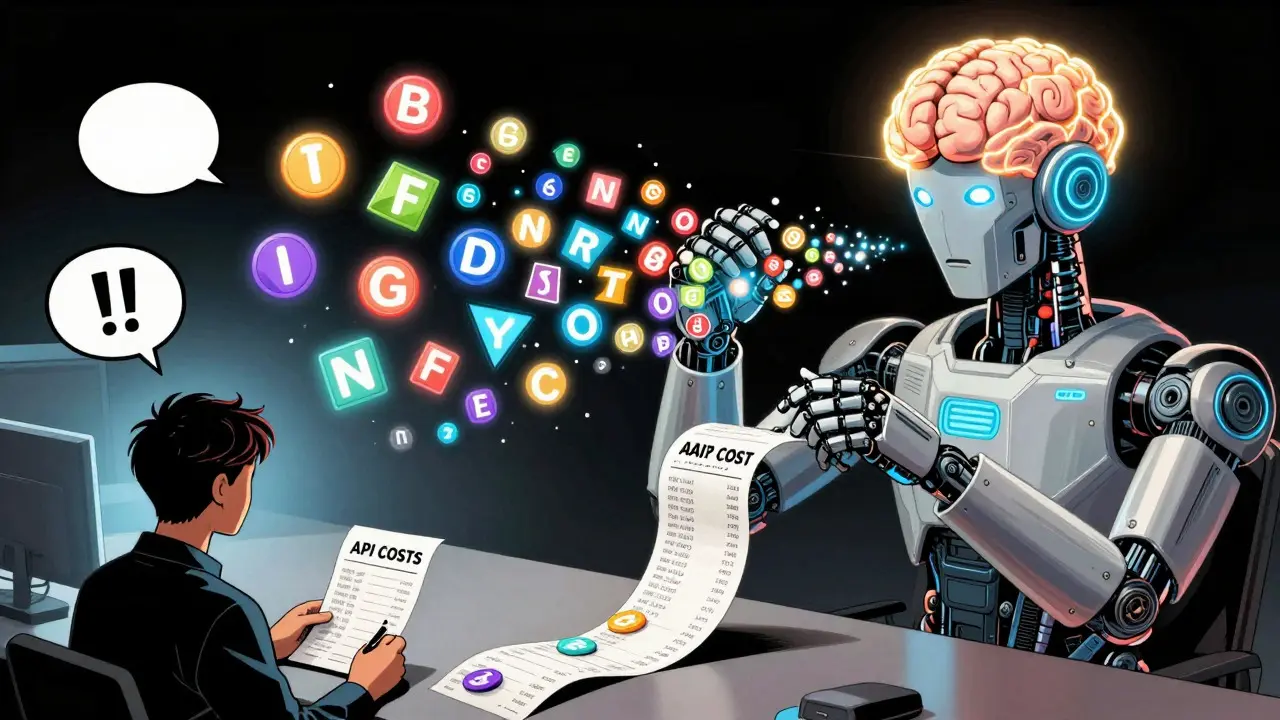
Here’s where theory meets reality: cost. Most commercial LLM APIs charge per token. If your tokenizer splits a single English word into four tokens, you’re paying four times the base rate for that word compared to a model that treats it as one. This variation is significant. A simple prompt like "Hello, world!" might be 3 tokens in one model and 5 in another. Over millions of requests, this adds up to thousands of dollars in unnecessary spend.
For developers, this means you can’t just swap out models without considering the tokenizer. If you move from a BPE-based model to a SentencePiece-based one, your average token count per request might drop by 10-20%, directly improving latency and reducing costs. Prompt engineering also plays a role here. Removing unnecessary filler words or formatting characters can shave off tokens, making your application faster and cheaper. It’s a small tweak with a big financial impact.
Beyond Text: Multimodal Tokenization
Tokenization isn’t limited to words anymore. In multimodal systems like DALL·E or Stable Diffusion, images are also tokenized. An image is broken down into patches, and each patch is encoded into a vector-essentially becoming a "visual token." The model then learns to map text tokens to these visual tokens, enabling text-to-image synthesis. This expansion shows that tokenization is a universal principle for converting any data modality into a format neural networks can process.
Emerging trends include dynamic tokenization, where the system adapts how it splits text based on context, and semantics-driven approaches that prioritize meaning over strict character boundaries. There’s even research into using quantum computing to handle tokenization tasks more efficiently, though that remains largely theoretical for now. But the direction is clear: tokenization is becoming smarter, more adaptive, and more integrated into the core of how AI understands the world.
Choosing the Right Strategy for Your Application
So, how do you pick? If you’re building a general-purpose chatbot or a creative writing tool, stick with BPE-based models. They handle diverse topics and rare terms well. If you’re working on classification tasks or search engines where understanding fixed phrases is key, WordPiece-based models might give you a slight edge in precision. For multilingual applications, look for models using SentencePiece, which handles Unicode characters natively and avoids the pitfalls of encoding non-Latin scripts.
Remember, there’s no one-size-fits-all solution. The best tokenizer is the one that balances your specific constraints: vocabulary size, sequence length, inference speed, and cost. Test your actual data against different tokenizers before committing. You might be surprised to find that a slightly less popular model offers a much more efficient tokenization scheme for your particular use case, saving you time and money in the long run.
What is the main difference between BPE and WordPiece?
BPE merges tokens based on their frequency in the training data, while WordPiece selects merges based on how much they improve the overall likelihood of the sentence. This leads to different subword boundaries and is why BPE is often preferred for GPT-style models, while WordPiece is used in BERT-style models.
How does tokenization affect API costs?
Most LLM APIs charge per token. If a tokenizer breaks a word into multiple subwords, you pay for each one. A more efficient tokenizer that groups characters into fewer tokens will reduce the total token count for the same input, lowering your bill and potentially speeding up response times.
Can tokenization handle emojis and special characters?
Yes, but it varies. Modern tokenizers like BPE and SentencePiece are designed to handle Unicode, so emojis are usually represented as a few tokens rather than failing completely. However, some older or simpler tokenizers might struggle, treating them as unknown characters or splitting them inefficiently.
Is tokenization done before or after the model sees the text?
Tokenization happens before the model processes the text. Raw text is first segmented into tokens, then those tokens are converted into numerical embeddings. The model only ever sees these numerical vectors, not the original characters. This preprocessing step is crucial for making the data computationally manageable.
Does the choice of tokenizer change the quality of the output?
Indirectly, yes. A poor tokenizer might split important semantic units, forcing the model to work harder to reconstruct meaning. This can lead to slightly less coherent outputs or slower generation. However, for most modern, well-trained models, the impact on final quality is minimal compared to the model's architecture and training data size.