
Have you ever wondered why your search engine understands exactly what you mean when you type a complex query, yet a chatbot can write you a poem in seconds? The answer lies in two different approaches to teaching machines how to handle human language. On one side, you have BERT, which is a bidirectional encoder model designed for deep language understanding. On the other, there is GPT, which is a generative decoder model built for creating new text. These two giants of natural language processing (NLP) represent fundamentally different paths to artificial intelligence.
If you are trying to decide which technology fits your project, you need to look past the hype. BERT and GPT are not just competing products; they are solving completely different problems using opposite architectural strategies. One looks at context from both sides simultaneously, while the other predicts the future word by word. Understanding this distinction is the key to building effective AI systems today.
Key Takeaways
- BERT uses an encoder-only architecture: It reads entire sentences at once, making it superior for tasks like classification, sentiment analysis, and information extraction.
- GPT uses a decoder-only architecture: It generates text sequentially from left to right, making it the go-to choice for chatbots, content creation, and translation.
- Resource requirements differ significantly: BERT-base runs on modest hardware with low latency, while large GPT models require expensive GPU clusters and higher inference costs.
- Hybrid approaches are emerging: Modern systems often combine BERT's understanding capabilities with GPT's generation skills for comprehensive solutions.
- Choose based on intent: Use BERT when you need to understand or categorize existing data. Use GPT when you need to produce new, coherent text.
The Core Architectural Difference: Bidirectional vs Unidirectional
To understand why these models behave so differently, we have to look under the hood at their neural network structures. Both BERT and GPT are built on the Transformer architecture introduced by Google researchers in 2017, but they use only half of that original design.
BERT stands for Bidirectional Encoder Representations from Transformers. As the name suggests, it relies entirely on the Encoder component. This allows it to process text bidirectionally, meaning it looks at every word in a sentence alongside all the words before it and after it simultaneously. Imagine reading a book where you could see the next page while still looking at the current one. This gives BERT a profound sense of context. When it encounters the word "bank," it checks if the surrounding words suggest money or a river, giving it high accuracy in disambiguation tasks.
In contrast, GPT (Generative Pre-trained Transformer) relies solely on the Decoder component. It processes text unidirectionally, strictly from left to right. It cannot see the future. To predict the next word, it only knows what has come before. This mirrors how humans speak-we don't know what we will say next until we say it. This causal language modeling approach makes GPT exceptional at generating flowing, coherent narratives because it is constantly predicting the most likely next token in a sequence.
| Feature | BERT (Encoder-Only) | GPT (Decoder-Only) |
|---|---|---|
| Processing Direction | Bidirectional (Left + Right) | Unidirectional (Left to Right) |
| Primary Strength | Language Understanding & Classification | Text Generation & Creation |
| Training Objective | Masked Language Modeling (MLM) | Causal Language Modeling (CLM) |
| Input Limitation | 512 tokens (standard) | Variable (up to millions in newer versions) |
| Hardware Demand | Low to Moderate (4GB+ VRAM) | High (Requires Multi-GPU setups for large models) |
| Output Type | Embeddings, Classifications, Probabilities | Generated Text Sequences |
How They Learn: Masked Prediction vs Next-Token Prediction
The way these models are trained dictates what they are good at. Training is where the rubber meets the road for any machine learning algorithm.
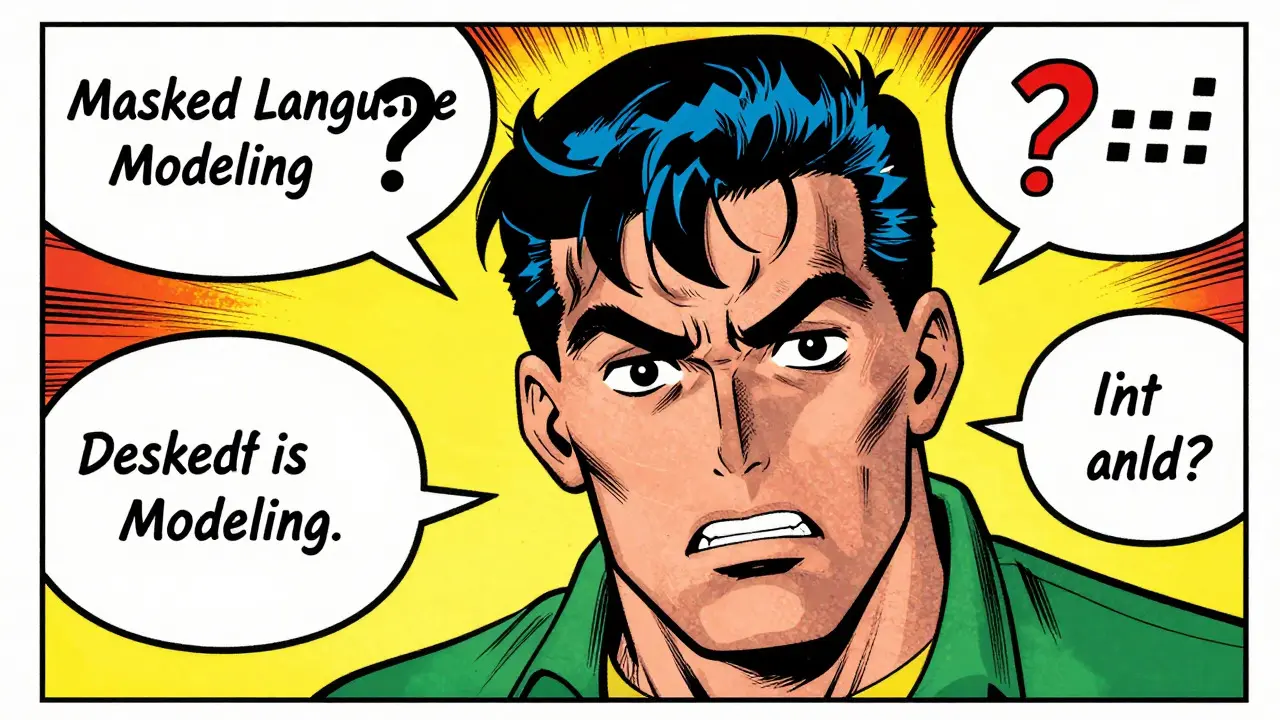
BERT learns through a technique called Masked Language Modeling (MLM). During training, about 15% of the words in a sentence are randomly hidden or "masked." The model's job is to guess those missing words based on the remaining context. For example, if the input is "The cat sat on the [MASK]," BERT must predict "mat" or "floor." Because it sees both "cat" and "sat" as well as any following words, it builds a rich, two-way understanding of relationships between words. This method forces the model to deeply analyze semantic connections rather than just relying on immediate predecessors.
GPT, however, uses Causal Language Modeling (CLM). It is fed a long stream of text and asked to predict the very next word. If the input is "The cat sat on the," GPT predicts "mat." Then the input becomes "The cat sat on the mat," and it predicts the next word. This autoregressive loop continues indefinitely. While this prevents GPT from cheating by peeking ahead, it means its understanding of a specific word is always limited by what came before it. However, this same mechanism is exactly what allows GPT to generate endless streams of creative text, code, or conversation without running out of ideas.
Performance Benchmarks: Who Wins Where?
You might be wondering which model is objectively better. The answer depends entirely on the task. In the world of NLP, benchmarks tell us how well these models perform on standardized tests.
For tasks requiring precise comprehension, BERT dominates. On the GLUE (General Language Understanding Evaluation) benchmark, BERT-large achieved a score of 80.4, setting a new standard at the time of its release. In specific applications like named entity recognition (NER), BERT reduced error rates by 32% compared to previous models. If you need to extract dates, names, or financial figures from legal documents, BERT's bidirectional context ensures it doesn't miss nuances that a unidirectional model might overlook due to lack of forward-looking context.
Conversely, GPT shines in generative metrics. On the LAMBADA benchmark, which tests a model's ability to predict the last word of a passage based on long-range context, GPT-3 achieved 57.0% accuracy compared to BERT's 47.8%. More importantly, GPT leads in perplexity scores-a measure of how uncertain a model is about its predictions-demonstrating its superior ability to maintain coherence over long generated texts. If your goal is to write a blog post, summarize a meeting transcript, or build a customer service bot, GPT's fluid output quality far surpasses BERT's static classifications.
Practical Implementation: Cost, Speed, and Complexity
When moving from theory to practice, infrastructure constraints often dictate your choice. BERT and GPT have vastly different footprints.
BERT-base is relatively lightweight, containing 110 million parameters. It can run inference on a single NVIDIA T4 GPU with just 4GB of memory, making it accessible for small businesses or edge devices. Fine-tuning BERT for a specific task, such as medical text classification, can take just a few hours on consumer-grade hardware. Developers appreciate its straightforward integration via libraries like Hugging Face Transformers. However, BERT has a hard limit of 512 tokens per input. Processing longer documents requires chunking techniques, which can break context across segments.
GPT-3 and its successors are behemoths. GPT-3 alone contains 175 billion parameters. Running a model of this size requires specialized hardware, such as multiple NVIDIA A100 GPUs with 80GB VRAM each. The cost implications are significant; fine-tuning a large GPT variant can cost thousands of dollars in cloud compute fees and take days to complete. Furthermore, inference latency is higher because the model must generate tokens one by one. For real-time applications requiring instant responses, this sequential generation can feel sluggish compared to BERT's near-instantaneous classification outputs.
When to Choose BERT Over GPT
Select BERT when your primary goal is to understand or categorize existing text. Here are the ideal scenarios:
- Sentiment Analysis: Determining if customer reviews are positive, negative, or neutral. BERT's deep contextual understanding handles sarcasm and negation better than early GPT models.
- Information Extraction: Pulling specific entities like addresses, phone numbers, or product codes from unstructured data.
- Search Engine Optimization: Improving internal company search tools to match user queries with relevant documents, similar to how Google implemented BERT to improve 10% of English searches.
- Document Classification: Sorting emails into spam/ham or routing support tickets to the correct department.
When to Choose GPT Over BERT
Select GPT when your primary goal is to create or respond with new text. Here are the ideal scenarios:
- Chatbots and Virtual Assistants: Building conversational interfaces that need to maintain a dialogue flow and adapt to user inputs dynamically.
- Content Generation: Writing marketing copy, blog posts, email drafts, or creative stories.
- Code Assistance: Generating code snippets or debugging suggestions, where the model needs to predict the next line of syntax.
- Summarization: Condensing long articles into brief summaries, leveraging its ability to rephrase and synthesize information sequentially.
The Future: Hybrid Models and Beyond
As we move further into 2026, the industry is recognizing that neither pure encoder nor pure decoder architectures are perfect solutions for every problem. We are seeing a rise in hybrid models like Facebook's BART, which combines BERT's bidirectional encoding with GPT-style autoregressive decoding. These models aim to get the best of both worlds: deep contextual understanding paired with fluent generation capabilities.
Google continues to refine BERT with quantized versions that reduce size by 75% for edge deployment, while OpenAI enhances GPT with directional attention refinements to improve context retention. For most enterprises, the winning strategy in 2026 and beyond is not choosing one over the other, but orchestrating both. Use BERT to ingest, classify, and structure your data, then pass the structured insights to GPT to generate human-readable reports or responses. This pipeline approach maximizes efficiency and accuracy while managing computational costs.
Can BERT generate text like GPT?
Not effectively. BERT is designed to output probability distributions or classifications, not coherent sequences of novel text. While you can technically force BERT to generate text by iteratively predicting masked tokens, the results are usually disjointed and lack the narrative flow that GPT produces naturally through its autoregressive architecture.
Which model is cheaper to run in production?
BERT is significantly cheaper to run for understanding tasks. Its smaller parameter count (110 million for base) allows it to operate on low-cost cloud instances or even local CPUs for simple tasks. Large GPT models require expensive GPU clusters, leading to higher operational expenses, especially for high-volume applications.
What is the maximum input length for BERT?
Standard BERT models have a strict limit of 512 tokens (roughly 380-400 words). If your document exceeds this, you must split it into chunks, which can cause the model to lose context between sections. Newer variants like Longformer or BigBird address this, but standard BERT remains constrained.
Is GPT better at understanding context than BERT?
Generally, no. Because GPT processes text left-to-right, it lacks access to future context during prediction. This can lead to misunderstandings of ambiguous terms that would be clarified by subsequent words. BERT's bidirectional nature gives it a more holistic view of the entire sentence, making it superior for nuanced comprehension tasks.
Should I use BERT or GPT for my chatbot?
Use GPT for the conversational interface because it excels at generating natural, adaptive responses. However, many advanced chatbots use BERT in the background to understand the user's intent and retrieve relevant information from a knowledge base before passing that context to GPT for response generation.




6 Comments
Bonnie Watt
Oh look, another article pretending to explain the 'nuances' of AI while ignoring the fact that both are just statistical parrots trained on our stolen data. You people act like BERT and GPT are some kind of holy grail when they're just expensive calculators making up answers with confidence. It's exhausting watching tech bro culture worship these models as if they have consciousness or intent. They don't. They're just mirrors reflecting our own biases back at us in a slightly more polished font. And don't get me started on the 'hybrid approach' nonsense. It's just band-aid engineering for broken systems. We need to stop feeding them more data and start asking why we let them run wild in the first place.
Sabrina Newland
i think its really interesting how bert sees both sides of a sentence 🤔 it feels almost like empathy in code? but then gpt is so linear like a river flowing one way which is also beautiful in its own deterministic sort of way 😌 i wonder if the future isn't about choosing one but letting them talk to each other like two different parts of a brain trying to make sense of the world maybe we are too focused on efficiency instead of understanding what these models actually feel like to use daily
Dave Gibbeson
Stop overcomplicating this! The choice is obvious based on your output needs. If you want classification, use BERT. If you want generation, use GPT. It is not rocket science. Most junior devs waste weeks debating architecture when they should just pick the tool that fits the job description. BERT is fast and cheap for embedding tasks. GPT is powerful for creative tasks. Just deploy it and move on. Hesitation kills projects. Get your metrics defined, select the model, and iterate. Stop reading philosophy blogs and start coding.
Meagan Mueller
they want you to believe it's just about architecture but it's about control google and openai are playing chess with our attention spans bert categorizes us into neat little boxes for advertisers while gpt generates endless noise to keep us scrolling never stopping never thinking just consuming the next token the next word the next distraction until we forget we ever had free will it's all part of the grand design to automate human thought processes so we become mere batteries for their server farms wake up sheeple
Amara Akbar
I find the discussion regarding hybrid models quite illuminating. It suggests a maturation of the field where we recognize that singular solutions are rarely optimal. While the cost implications of GPT are significant, the versatility it offers cannot be understated. Perhaps we should view BERT not as a competitor but as a foundational layer for data structuring before engaging the generative capabilities of GPT. This layered approach seems prudent for enterprise environments seeking balance between accuracy and fiscal responsibility.
Mark Harvey
great breakdown honestly most people just throw gpt at everything because it's trendy but you hit the nail on the head about bert being better for search and classification i've seen teams save thousands by using bert for intent detection before passing context to gpt it's all about knowing when to use the right tool for the job keep sharing this kind of practical advice