
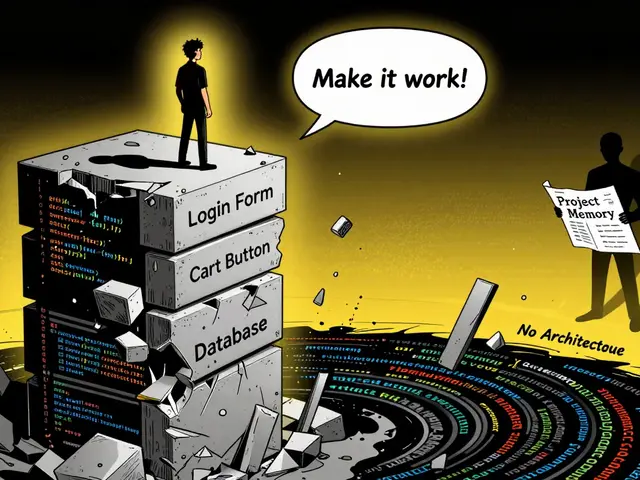
You've spent weeks perfecting your LLM prompts and setting up your infrastructure, but your RAG strategy is still producing weird, off-topic answers. The culprit usually isn't the LLM itself-it's the embedding model. If your model can't accurately turn your company's proprietary data into numbers that actually mean something, the LLM is just guessing based on bad directions. This is the "garbage in, garbage out" problem of the AI era.
Getting your embedding model right is the difference between a tool that actually helps your employees and a chatbot that hallucinates with confidence. For an enterprise system, you aren't just looking for a model that works on a laptop; you need a solution that handles millions of documents, stays fast under load, and doesn't leak sensitive data. Here is how to navigate the selection process without wasting months on trial and error.
| Model | Dimensions | Best Use Case | Key Trade-off |
|---|---|---|---|
| BGE-M3 | 3,072 | Multilingual & Complex Data | Higher Compute Cost |
| Mistral Embed | Variable | Real-time Chatbots | Lower Semantic Depth |
| text-embedding-3-large | 3,072 | Rapid Prototyping | Recurring API Costs |
| NVIDIA NeMo Retriever | Enterprise Scale | High-Throughput Systems | NVIDIA Hardware Lock-in |
The Core Mechanics of the Embedding Layer
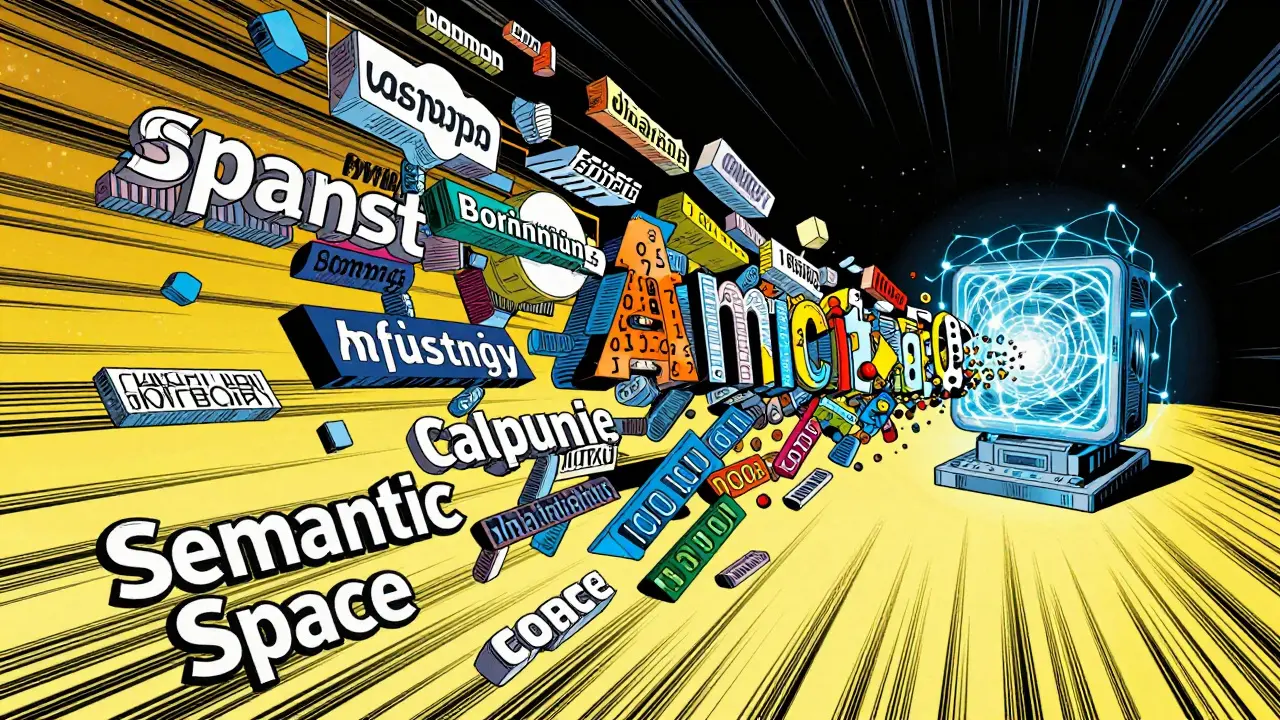
Before picking a model, it's important to understand what's actually happening under the hood. Embedding Models are neural networks that transform text chunks into dense numerical vectors, capturing the semantic meaning of the content. In a typical production pipeline, you'll be breaking your documents into chunks of 300-500 tokens. The model then assigns these chunks a position in a high-dimensional space. If two pieces of text are conceptually similar, they end up close to each other in that space.
The "dimension" count (like 768 or 3,072) tells you how many coordinates are used to describe a piece of text. While 3,072 dimensions allow for much more nuance-essential for legal or medical documents-they also make your vector database slower and more expensive to run. You have to decide if that extra 10% in retrieval accuracy is worth a 40ms spike in latency per query.
Open Source vs. Commercial Models
The first big fork in the road is whether to go with a managed API or a self-hosted model. Commercial options like OpenAI's embeddings are incredibly easy to start with. You send text via API, get a vector back, and you're done. This is great for getting a PoC (Proof of Concept) off the ground in a few days.
However, once you hit enterprise scale, the costs start to bite. A model like BGE-M3, developed by the Beijing Academy of AI, provides a powerhouse alternative. It's free to use and often beats commercial models on the MTEB (Massive Text Embedding Benchmark) leaderboard. The trade-off is that you now own the infrastructure. You'll need to manage GPUs and handle scaling, but you gain total control over your data privacy and licensing costs.
Why Generic Models Fail in the Enterprise
Here is a hard truth: a model trained on the general internet doesn't know your company's internal jargon. If your company uses the term "Project Bluebird" to refer to a specific Q3 accounting strategy, a generic model will just see a bird. This gap leads to a 25-35% increase in hallucination rates because the retrieval step fails to find the right documents.
To fix this, you need domain-specific fine-tuning. This doesn't mean training a model from scratch. Instead, you take a strong base model and perform "contrastive learning" using your own data. By showing the model which documents in your system are actually related, you can push retrieval accuracy above 85%. According to industry standards, if you aren't adapting your embeddings to your specific domain, you're essentially leaving a third of your potential accuracy on the table.
Optimizing for Production Performance
Once you've picked a model, the next battle is latency. In a real-time enterprise app, users won't wait three seconds for a response. To keep things snappy, you need to focus on a few technical optimizations:
- Quantization: Using tools like OpenVINO or ONNX can significantly speed up embedding generation. Some teams have seen a 1.9x increase in speed just by optimizing the runtime.
- Vector Database Choice: Your model is only as good as where it's stored. Whether you use Pinecone, Qdrant, or Weaviate, ensure the database supports the specific dimensionality of your model to avoid the dreaded "dimension mismatch" error that plagues many early deployments.
- Caching: Since document embeddings don't change unless the text does, cache your embeddings. Only the user's query needs to be embedded in real-time.

The Hidden Risk: Embedding Security
Most engineers treat their vector databases as safe zones, but there is a growing threat called "Embedded Threats." Researchers have shown that a single "poisoned" embedding-a piece of text carefully crafted to have a specific numerical value-can manipulate a RAG system. Because the system trusts the mathematical proximity of the vector, it can be tricked into retrieving malicious instructions or leaking data with an 80% success rate in some tests.
To mitigate this, enterprise systems should implement an embedding validation layer. Don't just trust the vector; use a reranking step (a second, more precise model) to verify that the retrieved document actually answers the query before passing it to the LLM. This adds a small amount of latency but prevents your RAG pipeline from becoming a security backdoor.
Putting it All Together: A Selection Checklist
If you're currently staring at a list of 20 different models on Hugging Face, use this decision tree to narrow it down:
- Do you have strict data residency requirements? If yes, go Open Source (BGE, E5) and self-host.
- Is your data primarily in one language or many? For multilingual needs, BGE-M3 is currently the gold standard.
- Is this for a low-latency chat interface? Look at Mistral Embed or E5-Small.
- Do you have a massive, multi-million document corpus? Prioritize NVIDIA NeMo Retriever or high-dimensional models paired with a distributed vector DB.
- Is the subject matter highly technical (Law, Med, Engineering)? Budget 20% of your time and money specifically for fine-tuning.
What is the difference between an embedding model and an LLM?
An embedding model is a specialized tool that turns text into a list of numbers (vectors) so a computer can find similar content. An LLM, like GPT-4, is a generative tool that uses those retrieved numbers to write a human-like response. The embedding model finds the needle in the haystack; the LLM explains what the needle is.
How often should I re-index my embeddings?
You only need to re-index when your underlying documents change or when you switch your embedding model. If you update your model to a newer version, you MUST re-embed every single document in your database, as vectors from different models are not compatible.
Can I use a small model for retrieval and a large one for reranking?
Yes, this is actually a best practice. This "two-stage retrieval" process uses a fast, lightweight model to grab the top 100 candidates and then a more expensive, accurate model to pick the top 5. This balances speed and accuracy perfectly.
What happens if I have a dimension mismatch?
A dimension mismatch occurs when your model produces a vector of, say, 1,536 dimensions, but your vector database is configured for 768. This will cause your system to crash or return completely random results. Always verify the output dimensions of your model before initializing your vector collection.
Is BGE-M3 really better than OpenAI embeddings?
In terms of raw benchmark scores on MTEB, BGE-M3 often leads. However, "better" depends on your setup. OpenAI is better for teams with no DevOps capacity; BGE-M3 is better for teams needing deep customization, multilingual support, and no per-token costs.



5 Comments
Rocky Wyatt
Most of you are just blindly following the hype and probably don't even understand the basics of vector space. It's honestly exhausting seeing people treat these tools like magic wands when they're actually just fancy math that requires real skill to implement. You can throw the most expensive NVIDIA hardware at a problem, but if your data strategy is garbage, you're just burning money. Most enterprise pipelines I see are absolute train wrecks because the architects are too lazy to actually look at their retrieval metrics. It's a sad state of affairs when "rapid prototyping" becomes the excuse for permanent technical debt. Just stop pretending this is easy.
Santhosh Santhosh
I feel like I can really relate to the struggle of trying to balance the technical requirements with the actual needs of the users who are often just trying to get their work done without the system crashing on them. In my experience, when we were looking at the trade-offs between latency and accuracy, we found that the human element-the way people actually phrase their queries in a high-stress environment-is something that often gets overlooked in the benchmark scores. It's quite a journey to move from a simple PoC to a full enterprise deployment, and I think it's important to remember that we are all just learning this together as the technology evolves so rapidly that it's almost hard to keep up with the weekly updates from Hugging Face.
Veera Mavalwala
Imagine thinking that a generic model could possibly grasp the labyrinthine complexities of specialized corporate jargon without a massive amount of fine-tuning, as if the AI is some omniscient deity rather than a glorified autocomplete engine. The sheer audacity of deploying a RAG system without a reranking layer is nothing short of professional negligence, and frankly, any engineer who thinks a 40ms latency spike is a deal-breaker is probably just prioritizing a superficial metric over actual, tangible precision. This whole discourse is often cluttered with mediocre interpretations of the MTEB leaderboard by people who couldn't tell a dense vector from a hole in the ground if their career depended on it. It is truly a carnival of errors when the industry accepts "hallucinations with confidence" as a baseline for failure instead of an absolute disqualifier for production use.
Ray Htoo
This is some absolute gold! Love how you broke down the two-stage retrieval process, it's like the secret sauce for keeping things snappy while staying accurate. I'm totally vibing with the idea of using a lightweight model to cast a wide net and then letting the heavy hitter refine the results. It's such a clever way to dodge that brutal latency wall without sacrificing the juicy details. Definitely makes the whole pipeline feel way more robust and less like a gamble.
Natasha Madison
The part about poisoned embeddings proves that these systems are just backdoors for foreign actors to slip into our infrastructure. These "open source" models from overseas are probably just trojans designed to leak every single piece of proprietary data back to a server in another country. It's all a huge setup to control the flow of information and keep us dependent on black-box math. Keep your data off the cloud and away from these so-called "global" standards.