You have a massive language model. It’s smart, it’s capable, but it’s slow and eats up all your GPU memory. You’ve heard about model compression and you know the two main players: pruning (cutting out weights) and quantization (shrinking number precision). But here is the catch most tutorials miss: doing them one after the other often hurts more than it helps. If you prune first, you break the structure needed for efficient quantization. If you quantize first, you lose the fine-grained data needed to decide what to prune.
The real magic happens when you combine them into a unified process. Recent breakthroughs, like the HWPQ (Hessian-free Weight Pruning-Quantization) framework released in early 2025, show that treating these as separate steps is outdated. By merging them, you can achieve speedups of nearly 5x over traditional methods while keeping your model accurate. This isn't just theory; it's about getting LLaMA or Mistral models running fast on hardware you already own.
Why Separate Steps Fail
Think of an LLM as a dense forest. Pruning is like cutting down specific trees to make paths. Quantization is like replacing wooden bridges with lighter plastic ones. If you cut the trees randomly (unstructured pruning), you might sever the connections between the bridges, making the path unstable. If you replace the bridges first, you don't know which trees are actually blocking traffic until you try to walk through.
Historically, engineers applied these techniques sequentially. They would use tools like SparseGPT to prune weights to zero, then run a tool like AutoGPTQ to lower the bit-depth of the remaining numbers. The problem? These operations fight each other. Pruning creates sparse matrices that standard quantization kernels aren't optimized for. Quantization introduces rounding errors that confuse pruning algorithms trying to identify "important" weights.
This friction leads to significant accuracy drops. Research from Apple Machine Learning indicates that while some methods hit 50-60% sparsity, performance often tanks at trivial sparsity ratios like 25-30%. Why? Because isolated methods ignore the interaction between weight magnitude and activation frequency. A weight might look small (good for pruning) but be multiplied by a huge activation value, making it critical to the output. Ignoring this context is why naive combinations fail.
The Unified Approach: How HWPQ Works
Enter HWPQ. Its core innovation is removing the computational bottleneck of previous combined methods: the Hessian matrix. Calculating second-order derivatives (the Hessian) across billions of parameters scales quadratically, O(n²), or worse, O(n³) for exact calculations. This makes it prohibitively expensive for large models.
HWPQ proposes a computationally efficient weight metric that eliminates these costly Hessian calculations. It reduces time complexity to linear O(n). How? By using a dynamic, Hessian-free approximation that estimates the impact of each weight on the final output without needing full curvature information. This allows the algorithm to simultaneously decide whether to prune a weight (set it to zero) or quantize it (reduce its precision) based on a unified importance score.
| Method | Complexity | Speedup vs Baseline | Key Feature |
|---|---|---|---|
| HWPQ | O(n) | 4.88x faster than AutoGPTQ | Hessian-free, unified pruning/quantization |
| SparseGPT | High (Iterative) | Baseline | Unstructured pruning only |
| Wanda | Low | Faster than SparseGPT | Pruning by weights and activations |
| AutoAWQ | Medium | 2.82x slower than HWPQ | Activation-aware quantization |
In tests on LLaMA2, HWPQ delivered average speedups of 5.97 times in quantization time and 12.29 times in pruning time compared to state-of-the-art baselines. In peak scenarios, it was over 20x faster. This isn't just about saving time during compression; it's about enabling frequent re-compression as models evolve.
Hardware Reality: Structured Sparsity Matters
You can prune 90% of your weights, but if your GPU can't read the resulting sparse matrix efficiently, you won't see any speedup. Standard GPUs are optimized for dense, regular computations. Randomly scattered zeros (unstructured sparsity) require specialized sparse matrix multiplication kernels that often add overhead rather than remove it.
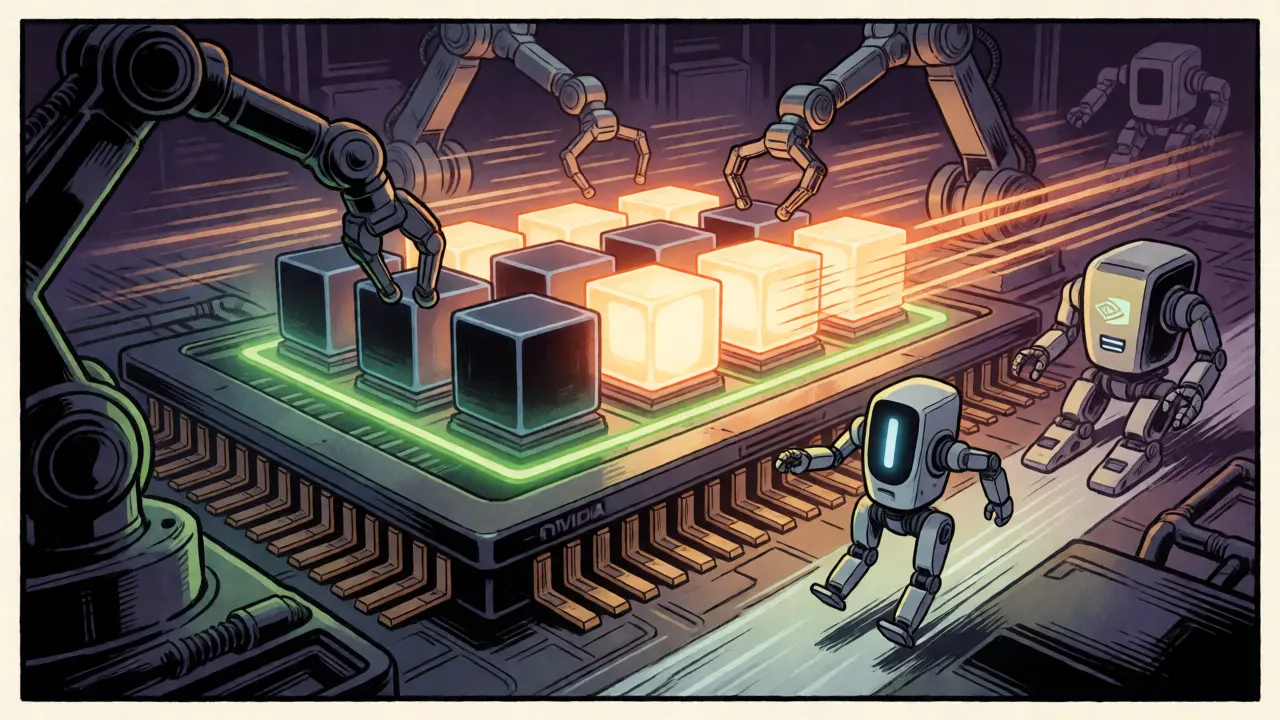
To get true acceleration, you need 2:4 structured sparsity. This pattern requires eliminating exactly two out of every four consecutive weights. Modern NVIDIA GPUs, specifically those with Tensor Cores, have native support for this pattern. When you enforce 2:4 sparsity, the hardware can skip the zeroed-out multiplications entirely, doubling inference throughput.
HWPQ integrates this directly into its pruning logic. Instead of letting weights go to zero randomly, it partitions each row into groups of four and identifies the two smallest weights in each group. This maintains O(n) time complexity while ensuring the resulting model fits perfectly into hardware accelerators. The result? A 1.50x speedup on Attention layers and 1.60x on MLP layers in LLaMA2-7B, with dequantization overhead reduced by over 80%.

Post-Training vs. Quantization-Aware Training
Once you've chosen your compression strategy, you need to decide how to apply it. There are two main paths: Post-Training Quantization (PTQ) and Quantization-Aware Training (QAT).
PTQ is the quick fix. You take a pre-trained FP16 model, feed it a small calibration dataset, and convert weights to INT8 or INT4. It's fast-often taking minutes instead of hours. TensorFlow Lite implementations show PTQ can yield 2-4x faster inference with only 1-2% accuracy drop. However, for aggressive compression (like binary quantization), PTQ can cause 5-20% accuracy loss because the model never learns to compensate for the rounding errors.
QAT simulates quantization noise during training. The model sees the low-precision values in the forward pass but calculates gradients in higher precision. This lets the weights adjust to minimize the error introduced by quantization. QAT preserves accuracy better but requires retraining, which is expensive. For most enterprise deployments where retraining costs millions, PTQ combined with smart pruning (like HWPQ) offers the best balance of cost and performance.
Advanced Synergy: Distillation and Mixed Precision
If you're pushing for maximum efficiency, look beyond simple pruning and quantization. Techniques like Quantization-Aware Distillation (QAD) take it a step further. Here, a smaller "student" model learns not just from the teacher's outputs, but also from the teacher's behavior under quantization constraints. This helps the student recover accuracy lost during compression.
NVIDIA's Model Optimizer framework supports five key techniques: PTQ, QAT, QAD, Pruning plus Knowledge Distillation, and Speculative Decoding. While speculative decoding speeds up generation by predicting multiple tokens, the first four make the model intrinsically cheaper and smaller. Combining pruning with knowledge distillation allows you to restore accuracy after aggressive sparsification. A short fine-tuning phase of approximately three hours can often recover the performance lost during pruning, especially when guided by a high-precision teacher model.
Another frontier is dequantization-free inference. Traditionally, compressed weights must be converted back to higher precision before calculation. This conversion adds latency. Newer frameworks aim to perform calculations directly on INT4 or FP8 formats using specialized hardware instructions. Reducing this overhead by 80% significantly impacts end-to-end latency, particularly for real-time applications like chatbots or code assistants.
Practical Implementation Guide
So, how do you actually implement this combo? Don't start with the most complex method. Follow this progression:
- Baseline Quantization: Start with AutoAWQ or AutoGPTQ. Get your model to 4-bit precision. Measure the accuracy drop. If it's acceptable, you might not need pruning.
- Add Structured Pruning: If you still need more speed, apply 2:4 structured pruning. Use a tool that respects the hardware layout. Do not use unstructured pruning unless you have custom sparse kernels.
- Try Unified Compression: If sequential application causes too much degradation, switch to a unified framework like HWPQ. This requires integrating the library into your pipeline but yields the best trade-off.
- Fine-Tune if Necessary: If accuracy drops below your threshold, run a brief QAT or distillation phase. Focus on the layers that showed the highest perplexity increase.
Keep in mind that different tasks react differently to compression. Pruned LLMs remain robust for in-context retrieval and summarization even at 50% sparsity. However, they struggle with knowledge-intensive tasks requiring precise factual recall. Always validate your compressed model against your specific use case, not just generic benchmarks like MMLU.
Troubleshooting Common Pitfalls
My model got smaller but didn't get faster. Check your sparsity pattern. Unstructured sparsity rarely speeds up inference on standard GPUs. Switch to 2:4 or block-sparse patterns supported by your hardware.
Accuracy tanked after quantization. You likely used PTQ on a sensitive layer. Identify outlier weights-those with extremely high magnitudes-and keep them in higher precision (mixed-precision quantization). Tools like AWQ help identify these outliers automatically.
Compression took forever. You probably used a Hessian-based method on a large model. Move to Hessian-free approximations like Wanda or HWPQ. The difference in compute time is orders of magnitude.
Is pruning better than quantization?
Neither is universally better; they serve different purposes. Quantization reduces memory bandwidth and storage needs by lowering bit precision. Pruning reduces the number of operations by removing weights. For maximum speedup, combining them is superior to using either alone, as they address different bottlenecks (memory vs. compute).
What is 2:4 sparsity?
2:4 sparsity is a structured pattern where exactly two out of every four consecutive weights are set to zero. Modern NVIDIA GPUs (Ampere architecture and newer) have hardware support for this pattern, allowing them to skip calculations for the zeroed weights, effectively doubling inference speed for those layers.
Does HWPQ require retraining?
No, HWPQ is designed for post-training compression. It uses a Hessian-free approach to estimate weight importance without needing gradient updates during the compression phase itself. However, a short fine-tuning or distillation phase afterward can help recover any minor accuracy losses.
How much accuracy do I lose with 4-bit quantization?
With modern methods like AWQ or GPTQ, accuracy loss for 4-bit quantization is typically less than 1-2% on standard benchmarks. However, for complex reasoning tasks, the drop can be higher. Combining it with pruning may increase this slightly, so always test on your specific domain data.
Can I use pruning and quantization together on CPU?
Yes, but the benefits differ. CPUs benefit greatly from reduced memory bandwidth via quantization. Structured pruning helps reduce cache misses. However, CPUs lack the dedicated sparse tensor cores found in GPUs, so unstructured pruning offers less speedup. Block-sparsity is preferred for CPU deployment.