Why Traditional OCR is No Longer Enough
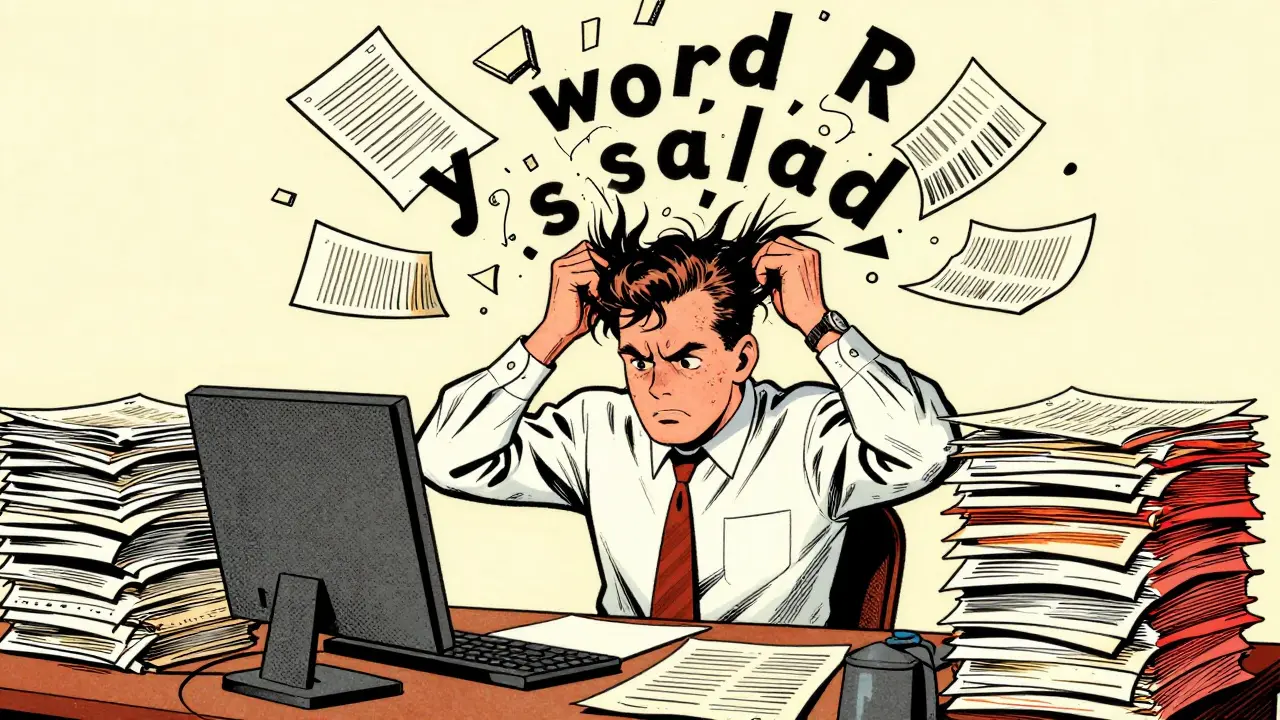
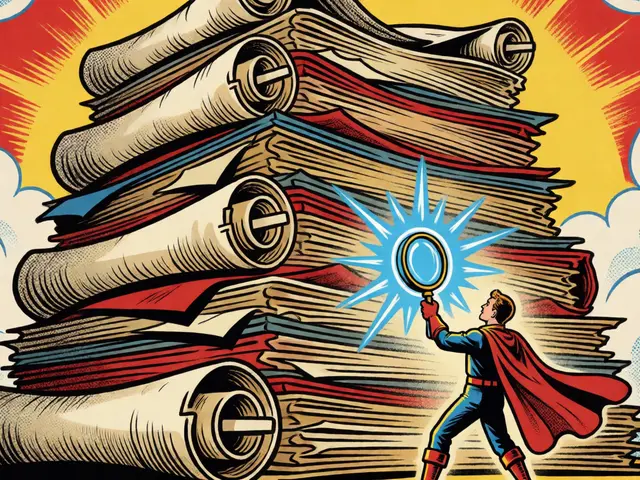
If you've used a standard scanner or a basic PDF converter, you know the frustration. Traditional Optical Character Recognition (OCR) treats a document like a big pile of letters. It finds the characters, guesses the words, and then throws away everything else. To a legacy system, a line separating two columns is just a random streak of pixels. A stamp on a contract is just noise. This "text-only" mindset fails miserably when things get complex. When you have a multi-column newsletter or a financial statement with nested tables, the traditional pipeline breaks. You end up with a "word salad" where text from the left column is mixed with the right. More importantly, traditional tools can't handle the spatial hierarchy-they don't know that a footnote belongs to a specific paragraph or that a value in a table belongs to a specific header. Vision-Language Models (VLMs) are neural networks that integrate visual encoders with language processors to interpret the semantic relationship between imagery and text. By using a unified learning approach, these models treat visual symbols-like a checkmark in a box or a trend line in a graph-as first-class data. They aren't just guessing letters; they are understanding the logic of the page.The New Era of Visual Reasoning and Table Extraction
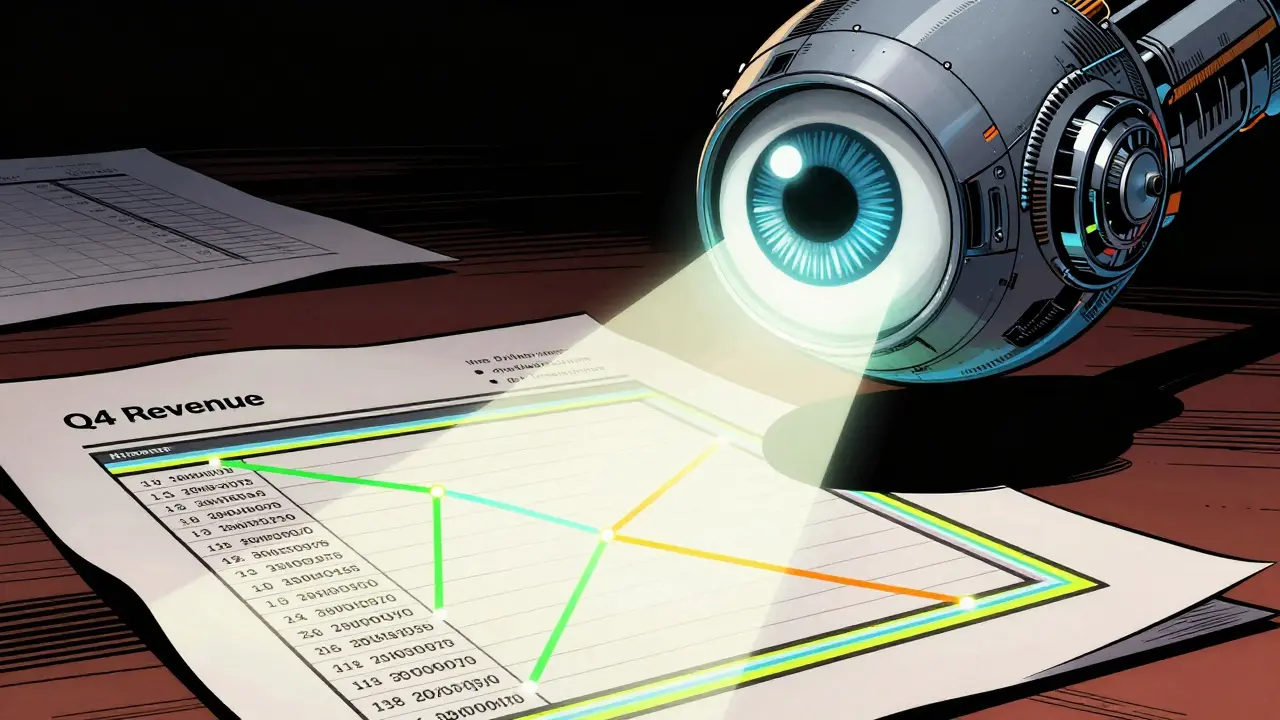
Extracting data from tables has always been a nightmare for AI. The old way was to use something like a Table Transformer to find the box, then run OCR inside that box. If the lines were faint or the table was borderless, the system guessed. Multimodal LLMs change the game by using visual reasoning. Instead of looking for lines, they look for alignment and patterns. They recognize that a number sitting under "Q4 Revenue" is linked to that header, even if there's no physical line connecting them. This ability to handle "borderless" or complex tables makes them indispensable for financial auditing and legal discovery. Beyond tables, these models tackle visual reasoning. This means they can answer questions about a document's content-a process known as Visual Question Answering (VQA) is the task of providing a natural language answer to a question based on the visual content of a document or image. If you ask, "Based on the trend in the bar chart on page 3, did sales grow in August?", a multimodal model doesn't just search for the word "August"; it looks at the visual height of the bar and reasons through the answer.| Feature | Traditional OCR Pipeline | Multimodal LLM Approach |
|---|---|---|
| Text Recognition | Character-based matching | Context-aware semantic decoding |
| Layout Handling | Linear (reads top-to-bottom) | Spatial (understands columns/grids) |
| Graphics/Charts | Ignored or treated as images | Converted to structured data or code |
| Handwriting | Very poor/Limited | High accuracy through VLM training |
| Error Correction | Manual human review | Automated logical verification |
The Heavy Hitters: Models Driving the Shift
Not all multimodal models are built the same. Depending on whether you need to process a million pages of archives or a few high-stakes contracts, you'll look at different architectures. GPT-4o and Phi-3 Vision are general-purpose powerhouses that can analyze a screenshot or a photo and give you a structured summary. They are great for a wide range of tasks but can be expensive for massive batch processing. For those needing more specialized, heavy-duty parsing, models like dots.mocr is a sophisticated multimodal OCR model that reconstructs document graphics into renderable code like SVG. Unlike most models that just give you a text description of a chart, dots.mocr can actually recover the graphics as reusable code. This is a massive leap because it turns a "dead" image into a "live" asset that you can edit or scale. Other notable mentions include Qwen3-VL, which is particularly impressive for its ability to handle ancient scripts and handwriting, and DeepSeek-OCR, which focuses on producing clean, structured Markdown output that developers can immediately plug into other applications. These models move us away from simple text dumps toward "intelligent document interpretation."Practical Applications: From Logistics to Finance
How does this actually look in the real world? It's not just about making PDFs searchable. It's about automating complex business logic.- Logistics and Shipping: Imagine a warehouse receiving thousands of different packing slips. Some have barcodes, some have handwritten notes about damaged goods, and some have complex tables of quantities. A multimodal LLM can read the barcode, interpret the handwriting, and verify the table totals in one pass.
- Financial Analytics: An analyst can upload a 50-page annual report. Instead of Ctrl+F for keywords, they can ask, "Compare the EBITDA from the chart on page 12 with the table on page 45." The model reasons across different visual formats to provide a single answer.
- Digital Archiving: Historians can process old, degraded scans. Models like Qwen3-VL can interpret handwriting and archaic layouts that would confuse any traditional software, turning centuries-old records into a searchable database.
- Web Scraping and UI Analysis: Because these models understand screenshots, they can be used to automate software testing. They "see" that a button is overlapping a text field and can report the visual bug, not just the code error.
Avoiding the Pitfalls: Quality Control and Hallucinations
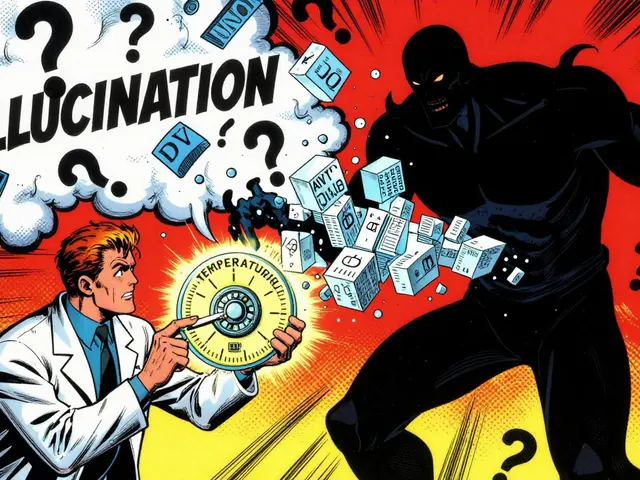
We can't talk about LLMs without talking about hallucinations. In document processing, a hallucination isn't just a weird story-it's a wrong number in a financial report, which can be catastrophic. To fix this, developers are using a "dual-layer" verification approach. First, the multimodal model extracts the data. Second, a separate logic-based check is performed. This often involves using a templated approach where the AI is asked to verify if the extracted data matches the visual evidence in the image. If the model says a value is "$500" but the image clearly shows "$5,000," the error detection mechanism flags it as False. Another pro tip: use structured outputs. Instead of asking a model to "describe the table," ask it to "output the table in HTML or Markdown format." This forces the model to adhere to a structural logic, making it much easier to spot when the formatting has gone sideways.The Future: Documents as Code
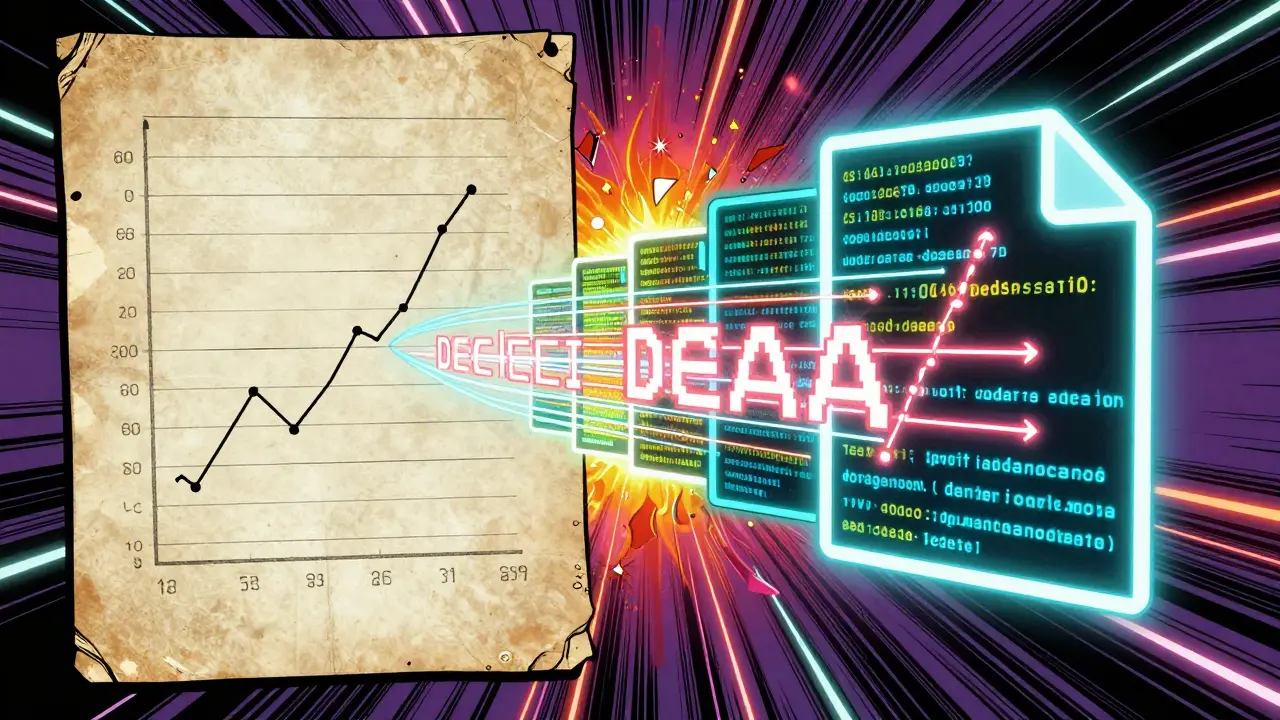
We are moving toward a world where documents are no longer static images. The shift toward converting graphics into SVG (Scalable Vector Graphics) means that the "visuals" in our documents are becoming data. When an AI can turn a chart into SVG code, it's not just describing the data-it's recreating the object. This allows for a level of precision in retrieval and pretraining that was previously impossible. We are effectively unlocking the latent information hidden in billions of PDF pages, turning the web's "dark data" into a structured knowledge graph.What is the main difference between traditional OCR and Multimodal LLMs?
Traditional OCR focuses on character recognition, essentially converting pixels into letters without understanding the layout. Multimodal LLMs understand the spatial relationship between elements, meaning they can recognize that a piece of text is a header, a footnote, or part of a specific table cell based on where it is located on the page.
Can Multimodal LLMs actually handle handwritten notes?
Yes, modern Vision-Language Models (VLMs) are trained on diverse datasets that include handwriting. While traditional OCR often struggles with cursive or overlapping text, models like Qwen3-VL are specifically designed to handle non-standard scripts and handwritten annotations with high accuracy.
How do these models prevent errors in data extraction?
They use a combination of structured output formats (like Markdown or HTML) and secondary verification layers. This involves "cross-checking" the extracted text against the original image using logical templates to ensure that the numbers and facts remain faithful to the source.
What is SVG reconstruction in the context of MLLMs?
SVG reconstruction is the process where a model (like dots.mocr) converts a raster image of a chart or diagram into Scalable Vector Graphics code. This makes the graphic editable and machine-readable, rather than just a static picture.
Which model should I use for batch processing thousands of documents?
For large-scale batch processing, specialized models like OlmOCR-2 or dots.ocr are often better choices than general-purpose models like GPT-4o, as they are optimized for spatial document understanding and higher throughput efficiency.


10 Comments
k arnold
Wow, a whole post just to tell us that AI can finally read a table without having a stroke. Truly revolutionary stuff here.
Zelda Breach
Imagine writing a technical guide and failing to maintain basic subject-verb agreement in the first paragraph. Multimodal LLMs is a category? It's an embarrassment to the English language, much like the'dark data' you're so obsessed with.
Alan Crierie
This is such a helpful overview of the current landscape 🌟 It's really exciting to see how inclusive these tools can be for people who struggle with traditional data entry 📚
Nicholas Zeitler
Exactly what we need!!! The jump from OCR to VLM is absolutely massive!!! Keep pushing these boundaries!!!
Tiffany Ho
this is so cool i bet it helps a lot of people save time
lucia burton
The integration of vision-language models into the document processing pipeline represents a paradigm shift in heuristic-based extraction where we can finally leverage zero-shot capabilities to mitigate the systemic failures of traditional deterministic OCR engines by implementing high-dimensional semantic embeddings that allow for the reconstruction of latent spatial hierarchies within complex unstructured data environments, effectively bridging the gap between raw pixel density and actionable business intelligence through a sophisticated orchestration of multimodal tokens and attention mechanisms that dynamically calibrate based on the visual saliency of the input document.
Denise Young
Oh sure, because we all know that the a-priori assumption of the 'dual-layer' verification is just a wonderful way to add another layer of latency to the inference cycle while we pretend that the stochastic nature of these models isn't just gambling with financial data in a very expensive way using high-level architectural jargon to mask the fact that we're basically just hoping the model doesn't make up a number that looks plausible enough to fool a tired auditor.
Sam Rittenhouse
It is honestly heart-wrenching to think about the thousands of historians who have spent their lives squinting at faded ink, and now we have the power to breathe life into those silent archives! The sheer emotional weight of recovering a lost voice from a degraded scan is simply overwhelming!
Peter Reynolds
makes sense i guess
michael Melanson
I agree that the shift toward SVG reconstruction is the most promising part of this transition as it allows for better version control and scalability of document assets.