Imagine telling your car’s computer to “optimize the bumper for better aerodynamics while keeping crash safety at top tier,” and watching it generate dozens of viable 3D models in minutes. Or picture a mechanic who doesn’t just read error codes but chats with an AI assistant that explains exactly why a battery is failing based on ten years of similar repair records. This isn’t science fiction anymore. It’s happening right now in the automotive industry.
We are witnessing a massive shift from traditional rule-based systems to Generative AI in automotive applications. This technology is no longer just about self-driving cars; it’s reshaping how vehicles are designed, built, diagnosed, and experienced by drivers. From concept sketches to end-of-life recycling, generative models are cutting development time by months and improving accuracy in ways older methods simply couldn't match.
Redefining Vehicle Design with Speed and Precision
Gone are the days when engineers had to build physical prototypes for every minor tweak. In the past, a design cycle might involve fewer than ten physical models before moving forward. Today, text-conditioned diffusion models and 3D reconstruction networks allow teams to explore hundreds of virtual variants instantly.
Here is how it works: An engineer inputs specific constraints-like material type, weight limits, or aerodynamic goals-into a system. The AI generates detailed 3D representations compatible with standard CAD workflows. These designs aren't just pretty pictures; they are immediately checked against simulation tools for crash performance and manufacturability. Companies like L&T Technology Services (LTTS) report that this approach lets global OEMs evaluate dozens or even hundreds of designs in the time it used to take to finalize one.
This speed matters because the timeline from first sketch to production start has compressed significantly. While traditional cycles spanned 36 to 60 months, integrating generative AI into product lifecycle management (PLM) systems can shave off critical weeks during the ideation phase. You get more options, faster feedback, and better cost optimization without the massive expense of physical prototyping.
Smarter Diagnostics: Beyond Simple Error Codes
If you’ve ever taken a car to a shop, you know the frustration of vague warning lights. Traditional diagnostic systems rely on predefined rules: if sensor X reads Y, then fault Z exists. But modern vehicles have millions of lines of code and complex interactions between components that simple rules miss.
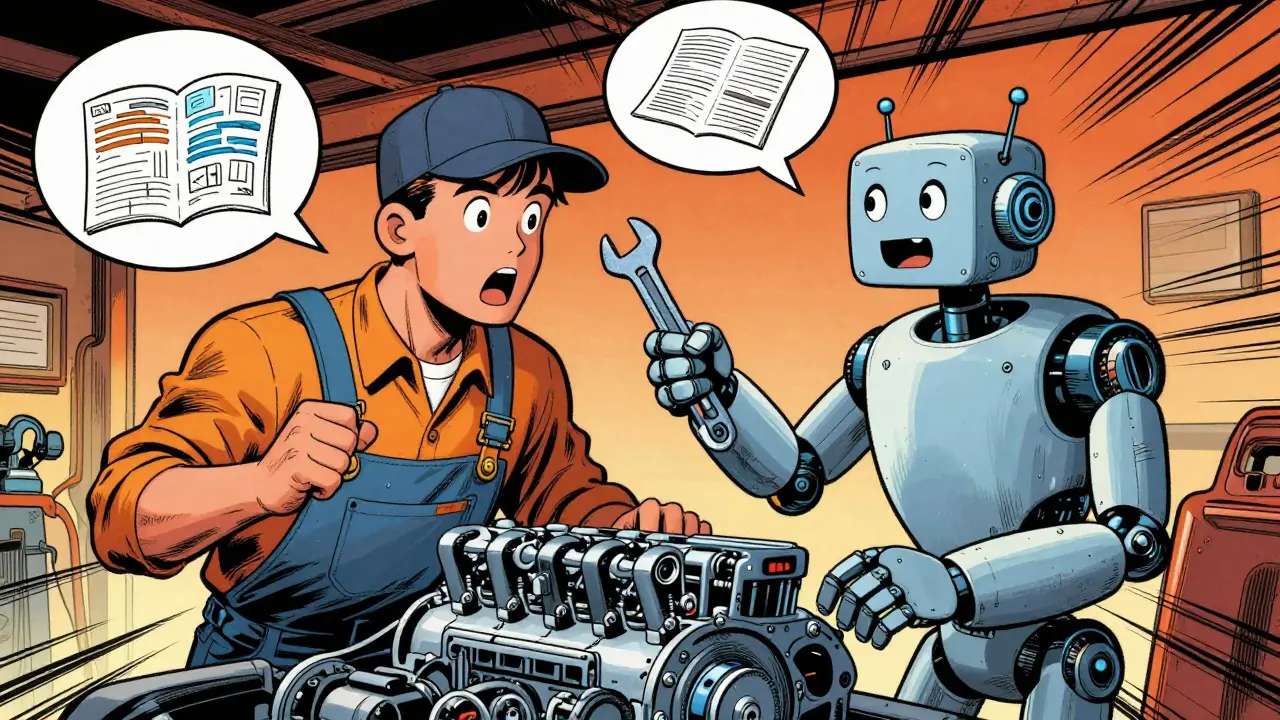
Retrieval-Augmented Generation (RAG) pipelines are changing this landscape. Instead of just flagging a problem, these systems act as intelligent assistants for technicians. Imagine a scenario where a computer vision agent detects smoke under the hood. It alerts a second AI agent, which scans through tens of thousands of pages of technical manuals and past service records to suggest the most likely cause and safe repair steps.
This multi-agent approach reduces diagnosis time from hours to minutes. For instance, IBM describes "copilots" that help service staff answer technical questions using natural language queries rather than keyword searches. However, there is a catch. As noted in recent arXiv surveys, these models can sometimes "hallucinate"-making up plausible-sounding but incorrect information. Therefore, current best practices treat AI recommendations as suggestions that require human verification, especially for safety-critical repairs.
The Rise of the Conversational Cockpit
Your car’s infotainment system is evolving from a button-pushing interface into a conversational partner. Early voice assistants were rigid; you had to say exact phrases like "navigate home." Now, thanks to large language models (LLMs), systems like Cerence’s CaLLM understand context, nuance, and intent.
You can ask, "Find a coffee shop near my route that has outdoor seating," and the AI understands not just the destination but your preference for ambiance. These systems run on embedded system-on-chips (SoCs) in the vehicle, connecting to cloud-based models when needed for heavy processing. NVIDIA emphasizes that these agents don’t just play music; they manage trip planning, adjust climate controls, and provide proactive safety suggestions based on driver behavior patterns.
This creates a hyper-personalized experience. Over time, the AI learns your preferences-your usual temperature, favorite radio stations, even your driving style-and adjusts accordingly. For fleets exceeding 100,000 vehicles, this level of personalization was previously impossible to scale manually.
Accelerating Software Development
A modern vehicle contains tens of millions of lines of code. Writing, testing, and validating all of it manually is a monumental task that spans 12 to 24-month platform cycles. Generative AI is stepping in to automate significant portions of this workload.
Tools integrated into development environments can generate C or AUTOSAR-compliant code snippets from natural language requirements. If you need a function to handle a specific diagnostic trouble code, the AI drafts the initial code. It also creates unit tests and scenario-based test cases, increasing coverage while reducing manual effort. KPIT highlights that this integration fits into existing V-model development processes, ensuring that while speed increases, compliance with standards like ISO 26262 remains intact.
However, this requires a new skill set. Engineering teams must blend domain expertise with familiarity in prompt engineering and data management. It’s not about replacing engineers; it’s about giving them superpowers to focus on high-level architecture rather than repetitive coding tasks.

Challenges and Realities of Implementation
Despite the hype, implementing generative AI in automotive isn’t plug-and-play. Several hurdles remain:
- Data Quality: Models are only as good as their training data. Many OEMs struggle with fragmented data across different departments and legacy systems.
- Computational Cost: Training and running large models requires significant GPU power, often necessitating partnerships with cloud providers like AWS or NVIDIA.
- Safety and Regulation: Unlike consumer apps, automotive errors can be fatal. Strict validation protocols are required to ensure AI outputs don’t compromise vehicle safety.
- Skill Gaps: There is a shortage of professionals who understand both automotive engineering and advanced AI techniques.
Experts recommend starting small. Begin with narrow pilots, such as an AI assistant for engineering documentation or warranty claim analysis. Once governance and security controls are validated, scale up to broader applications. This phased approach minimizes risk while demonstrating tangible value.
| Aspect | Traditional Methods | Generative AI Approach |
|---|---|---|
| Design Exploration | Few physical prototypes | Hundreds of virtual variants |
| Diagnostics | Rule-based error codes | Context-aware, conversational assistance |
| Software Coding | Manual writing and testing | AI-assisted code generation |
| In-Car Interaction | Rigid command recognition | Natural language understanding |
| Development Time | Months to years | Reduced by weeks to months |
Looking Ahead: What’s Next?
The trajectory is clear. By the early 2030s, we expect multimodal generative models that combine text, images, 3D geometry, and sensor data into unified pipelines. These systems could propose a design change, simulate its impact, and explain the rationale in natural language-all automatically.
We will also see more specialized foundation models trained specifically on automotive technical corpora, respecting proprietary data boundaries. The factory itself will become a giant compute platform, with AI optimizing layout, logistics, and robot programming in real-time.
For consumers, this means safer, more efficient, and more intuitive vehicles. For manufacturers, it’s a race to integrate these technologies responsibly. The key takeaway? Generative AI is not a replacement for human ingenuity; it’s a powerful amplifier. Those who learn to wield it effectively will lead the next generation of mobility.
Is generative AI safe for critical automotive functions?
Currently, generative AI is primarily used for support roles like design ideation, diagnostic assistance, and customer service. For safety-critical functions, outputs are treated as suggestions requiring human verification. Strict adherence to standards like ISO 26262 ensures that AI-enhanced processes maintain rigorous safety checks.
How does generative AI reduce vehicle development time?
It automates repetitive tasks like generating code snippets, creating test cases, and producing virtual design prototypes. This allows engineers to iterate faster, exploring hundreds of options digitally instead of building limited physical prototypes, thereby compressing the design-to-production timeline.
What is RAG in automotive diagnostics?
Retrieval-Augmented Generation (RAG) combines large language models with internal databases. In diagnostics, it retrieves relevant technical manuals and past repair records to provide accurate, context-specific answers to technicians, reducing the risk of hallucinations common in pure generative models.
Which companies are leading in automotive generative AI?
Key players include NVIDIA (compute platforms), IBM (enterprise governance and watsonx), AWS (cloud infrastructure), and specialized firms like Cerence (in-car voice AI). Service integrators like KPIT and LTTS help implement these solutions within OEM workflows.
Will AI replace automotive engineers?
No. AI acts as a copilot, handling routine coding, testing, and data analysis. Engineers focus on high-level architecture, creative problem-solving, and final validation. The demand for skilled engineers who can collaborate with AI tools is expected to grow.