Have you ever wondered how a chatbot knows exactly what to say next? It’s not magic, and it’s certainly not guessing. It is math. Specifically, it is a specific type of artificial neural network called the Transformer, which is a deep learning architecture introduced in 2017 that uses self-attention mechanisms to process sequential data in parallel rather than step-by-step. This architecture is the engine behind every major Large Language Model (LLM) you use today. Understanding how it works moves you from being a passive user to someone who truly grasps the mechanics of modern AI.
The Core Problem: Why We Needed Transformers
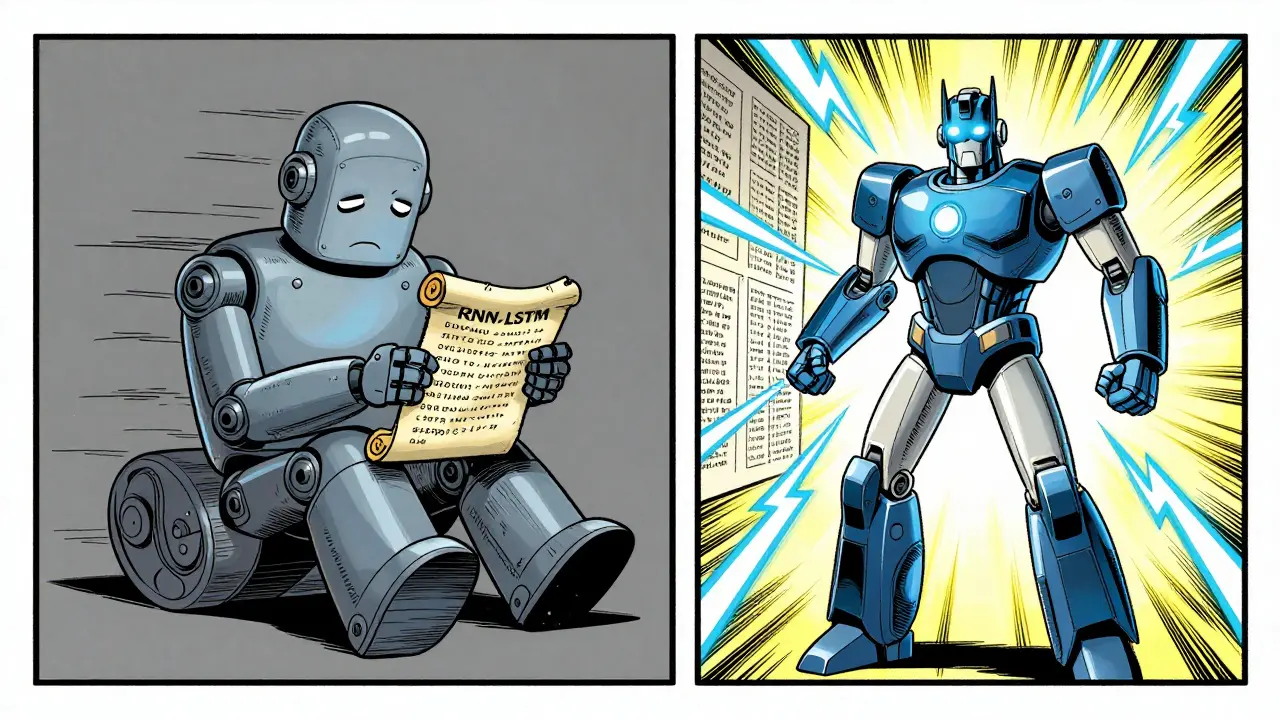
Before 2017, the dominant architectures for processing text were Recurrent Neural Networks (RNNs) and Long Short-Term Memory (LSTM) networks. These models processed text sequentially-word by word, like reading a sentence from left to right. While effective, this approach had two fatal flaws. First, it was slow because you could not process words in parallel. Second, it struggled with long-range dependencies. If a subject appeared at the start of a very long paragraph, the model often "forgot" it by the time it reached the verb at the end.
The Transformer solved this by abandoning sequential processing entirely. Instead of reading one word at a time, it looks at the entire input sequence simultaneously. This parallelization drastically reduced training time and allowed models to capture relationships between words regardless of their distance in the text. This shift marked the beginning of the modern era of natural language processing.
Anatomy of a Transformer Block
To understand the whole system, you need to look at its smallest building block: the Transformer layer (or block). Think of this as a factory assembly line where raw materials enter, get refined, and exit as a more valuable product. In our case, the "product" is a vector representation of meaning.
A standard Transformer block consists of three main components:
- Multi-Head Self-Attention: This mechanism allows the model to weigh the importance of different words relative to each other. For example, in the sentence "The bank was steep," the word "bank" needs context to determine if it refers to a financial institution or a river edge. Attention helps resolve this ambiguity.
- Feed-Forward Neural Network (FFN): Also known as an MLP (Multi-Layer Perceptron), this component processes each token independently after attention has aggregated information. It applies non-linear transformations to enrich the representation.
- Residual Connections and Layer Normalization: These are stability features. Residual connections add the input directly to the output of a sub-layer (y = x + F(x)), ensuring that gradients can flow backward during training without vanishing. Layer normalization keeps the values within a stable range, preventing the numbers from exploding or shrinking to zero.
In models like GPT-2, these blocks are stacked on top of each other. GPT-2 small, for instance, uses 12 such layers. As data passes through each layer, the representations become increasingly abstract, moving from simple syntax to complex semantic understanding.
Decoding the Self-Attention Mechanism
The heart of the Transformer is the self-attention mechanism. But how does it actually calculate "importance"? It uses three vectors for every token: Query (Q), Key (K), and Value (V).
Imagine you are searching for a book in a library. The Query is what you are looking for. The Key is the label on the book spine. The Value is the content of the book itself. The attention mechanism calculates the dot product between the Query and all Keys to see how well they match. A high score means a strong relationship.
Here is the mathematical flow:
- Projection: Each token embedding is multiplied by three learned weight matrices to produce Q, K, and V vectors.
- Scoring: The model computes the dot product of Q and K for every pair of tokens. This creates a matrix of scores showing how much each word should attend to every other word.
- Scaling: These scores are divided by the square root of the dimension of the key vectors. This prevents the dot products from becoming too large, which would push the softmax function into regions with tiny gradients.
- Softmax: The scaled scores are passed through a softmax function to convert them into probabilities that sum to 1.
- Weighted Sum: These probabilities are multiplied by the Value vectors. The result is a weighted sum of values, representing the attended information.
In Multi-Head Attention, this process happens multiple times in parallel with different weight matrices. Each "head" learns to focus on different aspects of the language-one might focus on grammar, another on semantics, and another on syntactic structure. The outputs of all heads are concatenated and linearly projected again.

Positional Encoding: Giving Order to Chaos
Since Transformers process all tokens simultaneously, they have no inherent sense of order. The word "cat" followed by "sat" is semantically different from "sat" followed by "cat," but the model sees them as a set of independent inputs. To fix this, we inject positional information.
This is done using Positional Encodings. These are vectors added to the token embeddings before they enter the first Transformer layer. There are two common methods:
- Sinusoidal Encodings: Used in the original 2017 paper. These use sine and cosine functions of different frequencies to create unique patterns for each position. The advantage is that the model can potentially generalize to sequence lengths it hasn't seen during training.
- Learned Positional Embeddings: Used in many modern LLMs like GPT. These are trainable parameters, just like the word embeddings. The model learns the best way to represent position during pretraining.
Without positional encoding, the Transformer would be permutation-invariant, meaning it would treat "I love you" and "you love I" as identical inputs. Positional encoding breaks this symmetry, allowing the model to understand sequence order.
Encoder vs. Decoder Architectures
While the original Transformer paper proposed an encoder-decoder structure (like Google Translate), most modern LLMs use only the decoder part. Here is why:
| Feature | Encoder (e.g., BERT) | Decoder (e.g., GPT) |
|---|---|---|
| Primary Goal | Understanding context (Bidirectional) | Generating text (Autoregressive) |
| Attention Scope | Sees past and future tokens | Sees only past tokens (Causal Masking) |
| Use Case | Classification, Question Answering | Text Generation, Chatbots |
| Mechanism | Masked Language Modeling | Next Token Prediction |
The critical difference lies in Causal Masking. In a decoder-only model, when predicting the next word, the model must not "peek" at future words. During training, the attention matrix is masked so that any token can only attend to tokens preceding it. This forces the model to learn generative capabilities, making it ideal for creating coherent, flowing text.
The Role of the Feed-Forward Network
After attention aggregates global context, the Feed-Forward Network (FFN) refines each token's representation locally. In GPT-2, the FFN expands the dimensionality of the hidden state by a factor of four (from 768 to 3,072 dimensions) before projecting it back down.
Why expand? High-dimensional space provides more room for complex, non-linear interactions. It allows the model to disentangle overlapping features. The expansion introduces non-linearity via activation functions (typically GeLU or ReLU), enabling the network to approximate any continuous function. Without this step, the Transformer would essentially be a linear model, severely limiting its expressive power.
Training Dynamics and Stability
Training a Transformer is computationally expensive and technically challenging. Two innovations made large-scale training possible:
Pre-Layer Normalization: The original Transformer used post-normalization (normalizing after the residual connection). However, this led to unstable gradients in deeper networks. Pre-LN normalizes the input before the sub-layer (y = x + Sublayer(LayerNorm(x))). This change dramatically improved training stability, allowing researchers to stack hundreds of layers without the gradients vanishing or exploding.
Learning Rate Warmup: Because Transformers are sensitive to initial updates, training starts with a very low learning rate that gradually increases over thousands of steps. This "warmup" phase allows the model to find a good direction in the loss landscape before taking larger steps.
Backpropagation adjusts billions of parameters based on the error between predicted and actual tokens. Over weeks of training on massive datasets, the weights encode statistical patterns of human language-from basic grammar rules to nuanced stylistic preferences.
Inference: How Text is Generated
Once trained, the model enters inference mode. This is an autoregressive process:
- Tokenization: Input text is split into tokens.
- Embedding: Tokens are converted to vectors with positional encodings.
- Forward Pass: Vectors pass through all Transformer layers.
- Unembedding: The final hidden state is projected onto the vocabulary size, producing logits (raw scores).
- Sampling: A probability distribution is created via softmax. The next token is selected based on this distribution. Strategies include greedy selection (highest probability) or temperature-scaled sampling (adding randomness for creativity).
- Iteration: The new token is appended to the input, and the process repeats until an end-of-sequence token is generated.
This loop continues until the model decides the response is complete. The speed of generation depends heavily on hardware acceleration, particularly GPUs optimized for matrix multiplication.
What is the difference between attention and memory in Transformers?
Unlike RNNs that maintain a hidden state as "memory," Transformers do not have persistent memory across sequences. Instead, they use attention to dynamically retrieve relevant information from the current input context. The "memory" is effectively stored in the weights learned during training, which encode general linguistic knowledge.
Why are Transformers better than LSTMs for long texts?
LSTMs process text sequentially, causing information to degrade over long distances due to the vanishing gradient problem. Transformers compute relationships between all tokens simultaneously, allowing direct access to any part of the sequence regardless of length. This makes them far more efficient at capturing long-range dependencies.
How does causal masking work in practice?
During training, a triangular mask is applied to the attention scores. Any position corresponding to a future token is set to negative infinity before the softmax operation. When exponentiated, these values become zero, ensuring the model assigns zero probability to attending to future information. This enforces the autoregressive property essential for generation tasks.
What is the computational complexity of self-attention?
The standard self-attention mechanism has a quadratic complexity O(n²) with respect to the sequence length n, because it computes pairwise interactions between all tokens. This becomes a bottleneck for very long contexts. Recent optimizations like FlashAttention and sparse attention aim to reduce this cost to near-linear time.
Can Transformers be used for non-text data?
Yes. The core principle of self-attention is modality-agnostic. Vision Transformers (ViTs) apply the same architecture to image patches, treating them as sequences. Audio transformers process spectrograms similarly. The flexibility of the attention mechanism makes it applicable to any data that can be represented as a sequence of embeddings.