
You’ve probably seen the headlines. Training a new Large Language Model is an artificial intelligence system capable of understanding and generating human-like text costs millions, sometimes hundreds of millions, of dollars. It sounds like a budget killer reserved for tech giants with bottomless pockets. But here’s the trap: most companies don’t fail because they can’t afford to train the model. They fail because they forget what happens *after* the training is done.
If you’re planning to scale AI in your organization, looking only at the initial development cost is like buying a house and only budgeting for the down payment. You still need electricity, repairs, insurance, and property taxes. In the world of LLMs, those ongoing bills are often higher than the upfront price tag. Understanding the Total Cost of Ownership (TCO) is a financial estimate that helps buyers and owners determine the direct and indirect costs of a product or system isn't just good accounting-it's the difference between a scalable AI strategy and a cash-burning disaster.
The Hidden Reality of AI Costs
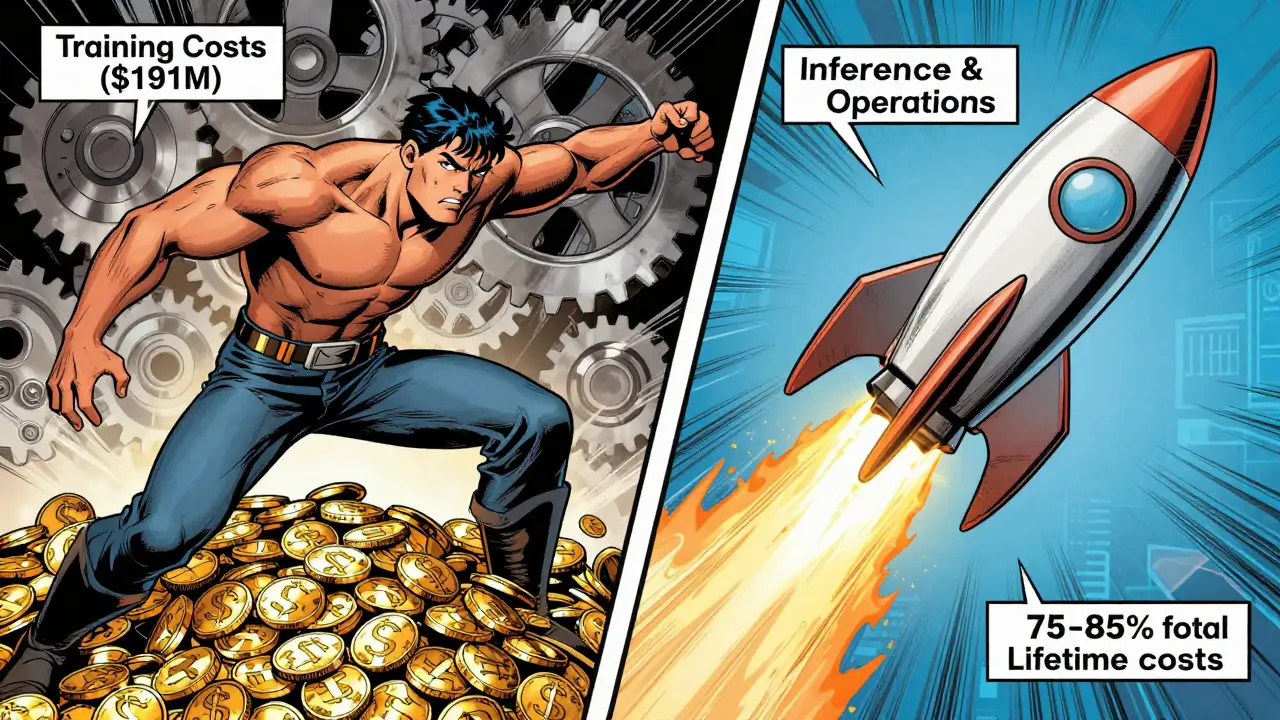
Let’s get straight to the uncomfortable truth. Industry analysis consistently shows that initial development and deployment represent only 15% to 25% of the total lifetime cost of an AI system. The remaining 75% to 85% comes from ongoing operations. This dramatic shift in cost distribution surprises many business leaders who approve budgets based on prototype success rather than production reality.
When you break down the comprehensive TCO formula for AI, it looks like this:
- Acquisition Cost: Initial infrastructure setup, hardware procurement, and initial training expenses.
- Operating Cost: Ongoing computational resources (inference), data management, model monitoring, and retraining.
- Maintenance Cost: Software updates, security patches, and integration fixes.
- Hidden Cost: Talent diversion, unbudgeted contingencies, and currency exchange risks.
- Disposal Cost: Data decommissioning and infrastructure retirement.
The biggest shocker? Data preparation. It typically consumes 60% to 80% of total project effort. You might spend weeks cleaning, labeling, and formatting data before your model even sees a single gradient update. If your TCO model doesn’t account for this massive labor sink, your timeline and budget will collapse under the weight of messy real-world data.
Training vs. Inference: Where the Money Goes
To understand scaling costs, you have to separate training from inference. Training is teaching the model; inference is using it. For most enterprises, inference becomes the dominant cost center once the model is live.
Look at how training costs have exploded. The original Transformer architecture in 2017 cost about $900 to train. By 2020, GPT-3 required an estimated $500,000 to $4.6 million. Today, training a frontier model like Google’s Gemini Ultra or OpenAI’s GPT-4 reportedly costs between $78 million and $191 million in compute alone. These numbers reflect the sheer resource intensity of contemporary large-scale model development, requiring thousands of GPUs operating in parallel for months.
But here’s the twist for most businesses: you likely won’t be training these models from scratch. You’ll be fine-tuning them or calling APIs. That changes the math entirely.
| Approach | Upfront Cost | Ongoing Cost Driver | Best For |
|---|---|---|---|
| Self-Hosted Proprietary | Very High ($M+) | Hardware depreciation, energy, engineering staff | High-volume, sensitive data, custom needs |
| Fine-Tuning Open Source | Medium ($10k-$100k) | Inference compute, maintenance | Specialized tasks, moderate volume |
| Pay-Per-Token API | Near Zero | Token consumption volume | Variable usage, rapid prototyping |
The Hardware Tax: GPUs Don’t Sleep
Whether you host yourself or use the cloud, hardware is your biggest line item. A single NVIDIA H100 GPU costs between $25,000 and $40,000. If you build a pod of 1,000 units for serious training workloads, you’re looking at $25 to $40 million in hardware acquisition alone. That’s capital expenditure (CapEx) that ties up cash flow immediately.
For those renting power, the burn rate is relentless. Cloud rental for GPU compute ranges from $1.50 per hour for older A100 GPUs to significantly more for newer architectures. Running 1,000 GPUs for one month at approximately $2,000 per GPU-month results in $2 million in monthly costs. Organizations utilizing 5,000 to 10,000 GPUs for several months routinely reach tens of millions of dollars in total compute expense.
This is where Scaling Laws are empirical relationships that predict model performance based on dataset size, model parameters, and compute budget become critical financial tools. Scaling laws allow you to predict how much better a model will get if you increase its size or data. Without them, you’re guessing. With them, you can calculate the marginal return on investment for every additional dollar spent on compute. If doubling the compute only improves accuracy by 1%, but doubles your bill, the scaling law tells you to stop spending.
Choosing Your Architecture: Build vs. Buy
Organizations implementing LLMs face two primary architectural approaches with distinct TCO implications. Your choice depends heavily on your usage volume and data sensitivity.
Option 1: Host Proprietary Models This involves obtaining a pre-trained model checkpoint (either open-source like LLaMA or via license) and conducting further training or fine-tuning using rented or owned cloud servers. This approach requires substantial capital investment, technical expertise, and ongoing operational management. You own the asset, but you also own the headache. You need DevOps engineers to manage clusters, MLOps specialists to monitor drift, and security teams to guard the data.
Option 2: Pay-Per-Token Access Utilize hosted models provided through APIs like OpenAI’s or Google’s services. Users pay based on token consumption for specific tasks including text generation, translation, and code writing. This offers significant cost advantages for specific use cases. You avoid upfront infrastructure investments, hardware procurement, and training data acquisition. Scalability advantages allow users to adjust LLM usage dynamically based on operational needs, paying exclusively for consumed tokens.
However, the pay-per-token model has a breaking point. For organizations with sustained, high-volume LLM usage requirements, cumulative token costs eventually exceed self-hosted infrastructure expenses. You need to run the numbers. If you’re processing billions of tokens a month, the API fees will eat your margin. If you’re processing millions, the API is likely cheaper than hiring the team to maintain a private cluster.
Fine-Tuning: The Sweet Spot?
Fine-tuning large pre-trained models presents a more cost-effective alternative to full-scale training from initialization. Fine-tuning a substantial model like LLaMA 2 (70 billion parameters) typically costs tens of thousands of dollars, substantially less than complete initial training from scratch. This makes it accessible for mid-sized enterprises.
The open-source ecosystem provides specialized tools and frameworks optimized for efficient distributed training, including DeepSpeed and Fully Sharded Data Parallel (FSDP). These tools manage large models across limited hardware through model sharding, enabling greater efficiency and reduced hardware requirements. By leveraging these techniques, you can squeeze performance out of fewer GPUs, directly lowering your TCO.

Practical Steps to Calculate Your LLM TCO
Don’t rely on gut feeling. Use a structured approach to map your costs over a three-to-five-year horizon. Here is how to do it right:
- Map the Lifecycle: List every phase from data collection to eventual decommissioning. Include the “hidden” phases like model monitoring and retraining.
- Budget for Data Prep: Allocate 60-80% of your project effort to data preparation. If your vendor says otherwise, ask for their definition of “clean data.”
- Calculate Inference Load: Estimate daily active users and queries per user. Multiply by average token length. Apply current API rates or internal compute costs. Project this growth year-over-year.
- Account for Talent: Include the salary costs of the engineers and data scientists working on the project. Don’t forget opportunity costs-the projects they *aren’t* working on while building your AI.
- Add Contingency: Add 15% to 25% contingency reserves for unexpected expenses. AI projects frequently encounter unforeseen costs, from buggy integrations to sudden spikes in traffic.
- Factor Currency Risk: If your vendors charge in USD but your revenue is in EUR or GBP, include hedging costs or exchange rate volatility in your model.
Avoiding Common TCO Pitfalls
Many companies fall into the trap of comparing license fees instead of total ownership costs. A cheap API might seem attractive until you realize you need a complex middleware layer to handle rate limits, caching, and fallbacks. That middleware costs money to build and maintain.
Another pitfall is ignoring change management. The best AI model in the world is useless if your employees don’t trust it or know how to use it. Training users, updating workflows, and managing resistance are real costs that belong in your TCO model. Companies benefit from commencing with focused pilot projects before scaling to enterprise-wide deployments. This allows TCO refinement based on actual operational experience rather than theoretical projections.
Finally, remember that technology depreciates. The GPU cluster you buy today will be obsolete in three years. Your TCO model should include a refresh cycle for hardware or a migration plan for cloud providers. Ignoring this leads to a sudden, massive capital expense when your systems slow to a crawl.
By treating Total Cost of Ownership as a living document rather than a one-time spreadsheet, you gain control over your AI strategy. You stop reacting to surprise bills and start making informed decisions about where to invest for maximum return.
What is the typical breakdown of costs in an LLM project?
Initial development and deployment typically represent only 15% to 25% of the total lifetime cost. The remaining 75% to 85% comes from ongoing operations, including inference compute, data management, monitoring, and maintenance. Data preparation alone often consumes 60% to 80% of total project effort.
How much does it cost to train a modern Large Language Model?
Costs vary wildly by size. The original Transformer cost ~$900. GPT-3 cost between $500k and $4.6 million. Recent frontier models like GPT-4 or Gemini Ultra have training compute costs estimated between $78 million and $191 million, requiring thousands of GPUs running for months.
When should I choose self-hosting over API access?
Choose self-hosting if you have sustained, high-volume usage where cumulative token costs exceed infrastructure expenses, or if data privacy/security requirements prohibit sending data to third-party clouds. Choose API access for variable usage, rapid prototyping, or lower overall volume.
What are the hidden costs of LLM implementation?
Hidden costs include talent diversion (opportunity cost of skilled personnel), unbudgeted contingencies, currency exchange risks for international vendors, data cleaning efforts, and the ongoing cost of model monitoring and retraining to prevent drift.
How do scaling laws help with TCO calculation?
Scaling laws predict model performance based on dataset size, parameters, and compute budget. They help you calculate the marginal return on investment for additional compute spend, allowing you to stop investing when the performance gains no longer justify the exponential cost increases.
Is fine-tuning cheaper than training from scratch?
Yes, significantly. Fine-tuning a large model like LLaMA 2 typically costs tens of thousands of dollars, whereas training from scratch can cost millions. Tools like DeepSpeed and FSDP further reduce costs by optimizing hardware usage through model sharding.