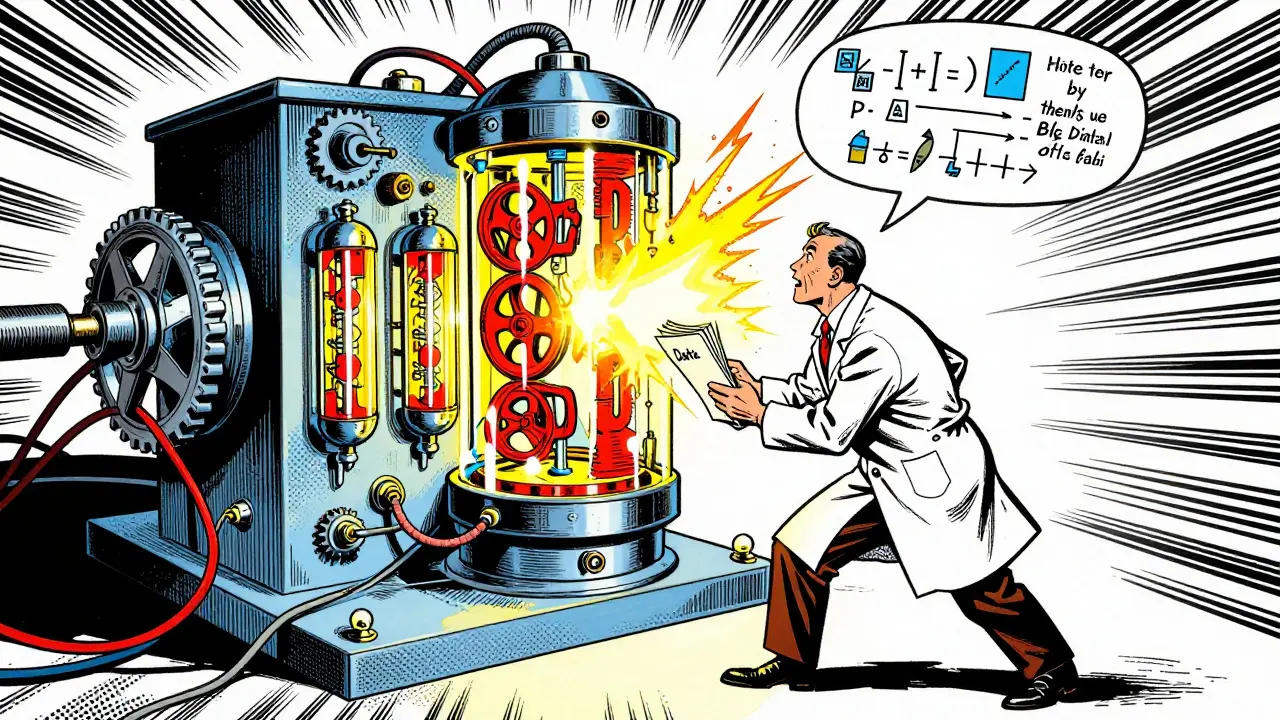
Have you ever wondered how a computer can write a poem, debug your code, or summarize a fifty-page legal contract in seconds? It feels like magic, but it’s actually math. At the heart of this revolution are Large Language Models, often called LLMs. These aren’t just chatbots; they are massive statistical engines trained on nearly everything humans have written. If you’re looking to understand what powers tools like ChatGPT, Gemini, or Claude, you need to look under the hood. This isn’t about black-box mystery-it’s about architecture, data, and probability.
The Foundation: Why Transformers Changed Everything
To understand where we are, we have to look back at 2017. Before that year, computers processed language sequentially, word by word, using models like Recurrent Neural Networks (RNNs). Imagine reading a book but only remembering the last sentence you read. That was the problem with RNNs-they struggled with long-range dependencies. If a character mentioned in chapter one reappeared in chapter ten, the model likely forgot who they were.
Then came the Transformer Architecture. Introduced in a paper titled "Attention Is All You Need" by researchers from Google Brain and the University of Toronto, this design discarded sequential processing entirely. Instead, it reads entire sentences-or even documents-at once. This parallel processing capability is why modern AI trains so much faster than its predecessors. The Transformer uses a mechanism called self-attention to weigh the importance of every word in relation to every other word in the input. It doesn’t just see words; it sees relationships.
Step-by-Step: How an LLM Processes Text
You might think the model reads text like you do. It doesn’t. It speaks in numbers. Here is the exact journey a piece of text takes inside a Large Language Model:
- Tokenization: First, the text is broken down into smaller chunks called tokens. A token isn’t always a whole word. For example, the word "unhappiness" might be split into ["un", "happy", "ness"]. Modern models use vocabularies ranging from 32,000 to 100,000 unique tokens. This allows them to handle rare words or typos without crashing.
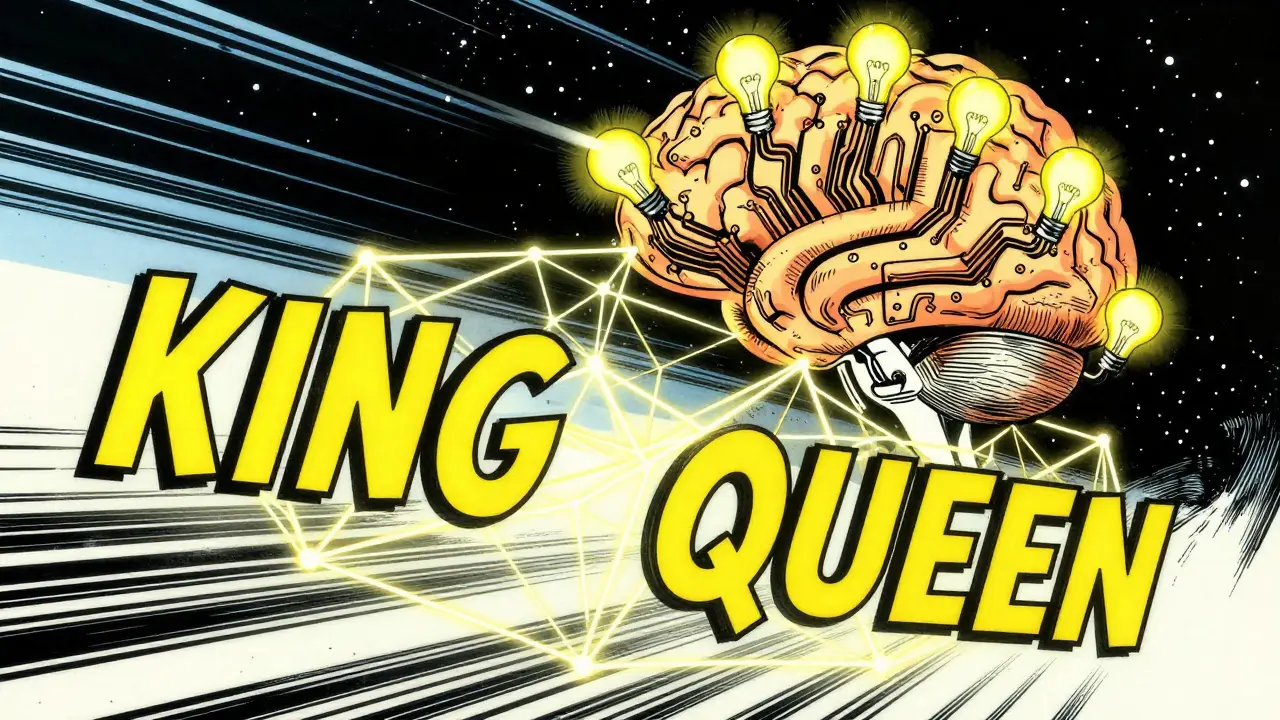
- Embedding: Each token is converted into a high-dimensional vector-a list of numbers. Think of these vectors as coordinates in a multi-dimensional space. Words with similar meanings, like "king" and "queen," end up close together in this mathematical space. Embedding dimensions typically range from 1,024 to 8,192 depending on the model’s size.
- Processing Layers: These vectors pass through multiple layers of the Transformer. State-of-the-art models usually have between 24 and 96 layers. In each layer, two main things happen: self-attention calculates which parts of the input matter most, and feedforward networks process that information non-linearly.
- Prediction: Finally, the model outputs probabilities for the next possible token. It doesn’t “know” the answer; it predicts the most statistically likely continuation based on its training.
The Power of Scale: Parameters and Data
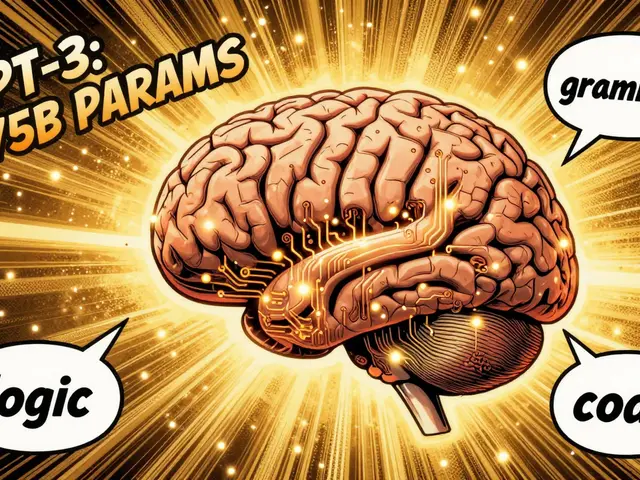
Why are these models called "Large"? Because of their parameter count. A parameter is essentially a weight or setting within the neural network that adjusts during training. GPT-3 had 175 billion parameters. PaLM 2 has 340 billion. Meta’s Llama 3, released in early 2025, boasts around 400 billion parameters. Some rumored models approach trillions.
There is a rough rule of thumb in AI research: optimal performance requires approximately 20 tokens of training data per parameter. So, a 100-billion-parameter model needs roughly 2 trillion tokens of text to learn effectively. This scaling law explains why bigger models generally perform better-they’ve seen more examples of how language works. However, size comes at a cost. Training a 100-billion-parameter model can require 1,000 NVIDIA A100 GPUs running for months, costing between $10 million and $20 million in computational resources alone.
| Model Family | Approx. Parameters | Key Innovation | Context Window |
|---|---|---|---|
| GPT-3 (OpenAI) | 175 Billion | Autoregressive Generation | 4,096 Tokens |
| Llama 3 (Meta) | 400 Billion | Open-Source Multilingual | 128,000 Tokens |
| Gemini 1.5 (Google) | Unknown (Massive) | Multimodal Integration | 1,000,000 Tokens |
| Claude 3 (Anthropic) | Unknown | Constitutional AI Safety | 200,000 Tokens |
Capabilities: What Can They Actually Do?
LLMs are categorized by how they are tuned. Generic models predict the next word based on raw data. Instruction-tuned models, like Flan-T5, are trained to follow specific commands. Dialog-tuned models, like ChatGPT, are optimized for conversation. This tuning changes their behavior significantly.
One major capability is zero-shot learning. You can ask an LLM to translate a text into Swahili or write a Python script, even if it hasn’t been explicitly trained on that specific task. It infers the pattern from general knowledge. Another key feature is reasoning via Chain-of-Thought. By prompting the model to "think step-by-step," accuracy on complex logic problems can improve by 15-25%. This mimics human cognitive processes, breaking down big problems into smaller, manageable steps.
However, capabilities have limits. LLMs struggle with precise mathematical reasoning because they predict tokens, not calculate equations. They also suffer from hallucinations-generating plausible-sounding but factually incorrect information. This happens because the model prioritizes linguistic coherence over factual truth. To mitigate this, developers use Retrieval-Augmented Generation (RAG), which connects the LLM to external databases so it can cite real sources rather than relying solely on memory.
The Future: Efficiency and Specialization
We are moving past the era of "bigger is always better." The industry is shifting toward efficiency. Small Language Models (SLMs) with 1-10 billion parameters are emerging. These specialized models deliver 80% of the capability of giant LLMs at 10% of the computational cost. They run on laptops, phones, and edge devices, making AI accessible without massive cloud infrastructure.
Additionally, multimodal integration is becoming standard. Models like Gemini don’t just process text; they analyze images, audio, and video simultaneously. This creates a richer understanding of context. By 2026, we expect to see hybrid architectures that combine neural networks with symbolic reasoning systems. This aims to fix logical inconsistencies and reduce hallucinations, bringing us closer to truly reliable AI assistants.
What is the difference between an LLM and a regular AI?
Regular AI often refers to narrow systems designed for specific tasks, like playing chess or recognizing faces. Large Language Models are general-purpose systems trained on vast amounts of text to understand and generate human language across many different domains, from coding to creative writing.
Do LLMs actually "understand" language?
Not in the human sense. LLMs do not have consciousness or intent. They are sophisticated pattern-matching engines that predict the next likely word based on statistical probabilities derived from their training data. Their "understanding" is mathematical, not experiential.
Why do LLMs sometimes make up facts?
This is known as hallucination. Since LLMs prioritize generating fluent and coherent text, they may invent details that fit the grammatical structure and context but are factually wrong. They lack a built-in truth verification system unless connected to external data sources via techniques like RAG.
What is a token in the context of LLMs?
A token is the smallest unit of text a model processes. It can be a whole word, part of a word, or even punctuation. For example, "running" might be one token, while "unbelievable" might be split into "un", "believe", and "able". Most models charge users based on the number of tokens processed.
How does the Transformer architecture differ from older models?
Older models like RNNs processed text sequentially, one word at a time, which made them slow and prone to forgetting earlier context. Transformers use self-attention mechanisms to process all words in a sequence simultaneously, allowing them to capture long-range dependencies and train much faster.