
Imagine launching a chatbot that instantly answers customer questions. It feels like magic until someone asks it something toxic, illegal, or just plain weird. Suddenly, your friendly assistant starts spitting out hate speech or hallucinated legal advice. This isn't just an embarrassment; it's a security risk and a brand killer. The solution? Content moderation pipelines for user-generated inputs to Large Language Models (LLMs). These systems act as the bouncer at the club, checking every guest before they get inside.
In 2026, simply throwing a keyword filter at your API is no longer enough. Users are smarter, and so are the attacks. You need a system that understands context, nuance, and intent. But building one from scratch can feel overwhelming. Do you use specialized models? General-purpose LLMs with clever prompts? Or a mix of both? Let’s break down exactly how these pipelines work, why the old ways fail, and how you can build a robust defense without breaking the bank.
The Problem with Old-School Filtering
A few years ago, if you wanted to keep bad words out of your app, you used regular expressions (regex) or simple Natural Language Processing (NLP) classifiers. These tools worked fine for obvious cases. If someone typed "f***," the regex caught it. Easy.
But language is messy. Context matters. Consider the phrase "bullshit" in a scientific paper versus a casual text message. Or sarcasm: "Great job, genius." Is that praise or an insult? Traditional NLP systems struggle here. According to data from GetStream’s 2024 analysis, standard NLP filters hit 85-90% accuracy on clear-cut profanity but drop to a dismal 62-68% when context is involved. That means nearly half your nuanced interactions are either wrongly blocked or wrongly allowed through.
Furthermore, false positives are a nightmare. CloudRaft reported that conventional filtering techniques suffer from false positive rates between 35% and 45%. Imagine blocking a legitimate medical query because it contained a sensitive term. Your users get frustrated, and your trust scores plummet. We need something smarter.
Enter the Hybrid Approach
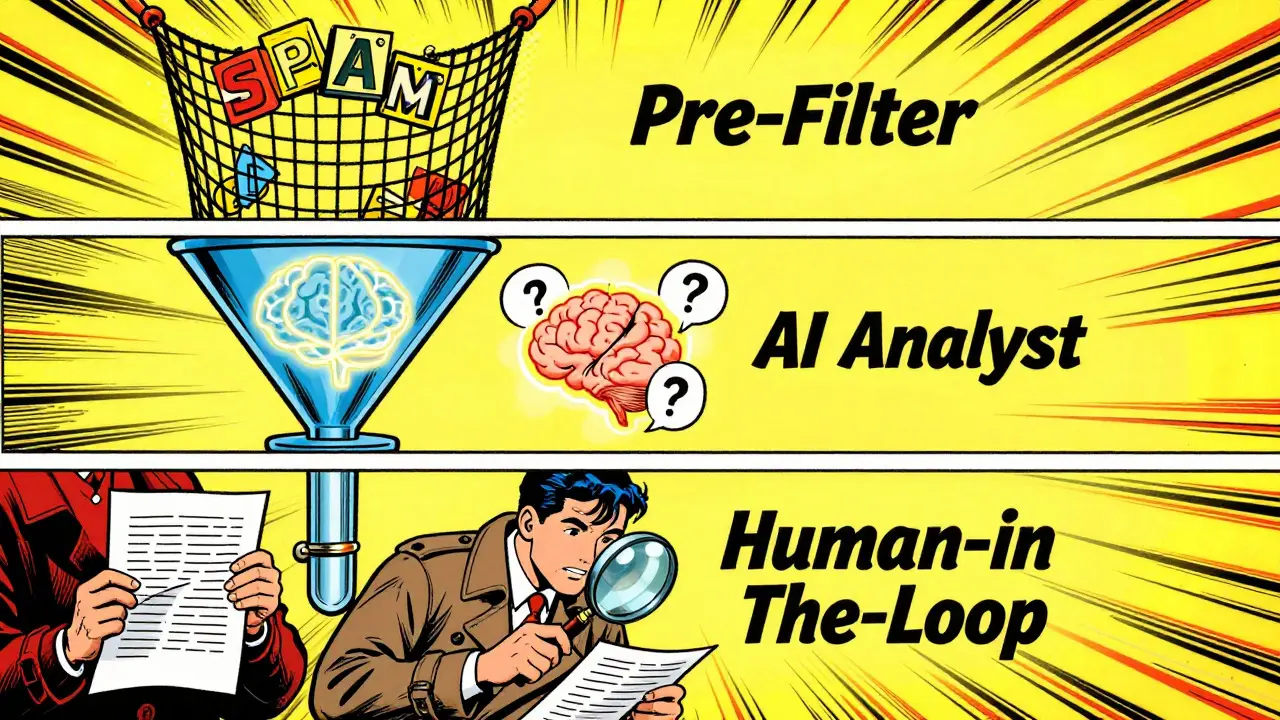
The current gold standard for moderating user inputs to LLMs is the hybrid moderation pipeline. A multi-stage architecture that combines fast, cheap deterministic filters with slower, more accurate AI-based analysis. Think of it like a funnel.
- Stage 1: The Pre-Filter (NLP/Regex): This layer catches the low-hanging fruit. Profanity lists, known spam patterns, and PII (Personally Identifiable Information) leaks. This stage is incredibly fast-processing content in 15-25 milliseconds-and costs almost nothing. AWS data shows this layer can handle about 78% of all incoming traffic.
- Stage 2: The AI Analyst (LLM/Specialized Model): The remaining 22% of ambiguous content gets escalated here. This is where we use Large Language Models to understand intent. Did the user mean harm? Was it sarcasm? This stage takes longer (300-500ms) and costs more, but it’s necessary for accuracy.
- Stage 3: Human-in-the-Loop (HITL): For the most critical decisions, or when the AI is unsure, a human moderator steps in. This also feeds back into the system to improve future AI performance.
This tiered approach reduces overall costs by up to 63% while maintaining high accuracy levels around 93%. You aren’t running expensive LLM inference on every single "hello" or "thanks." You’re saving compute power for the tricky stuff.
The Power of Policy-as-Prompt
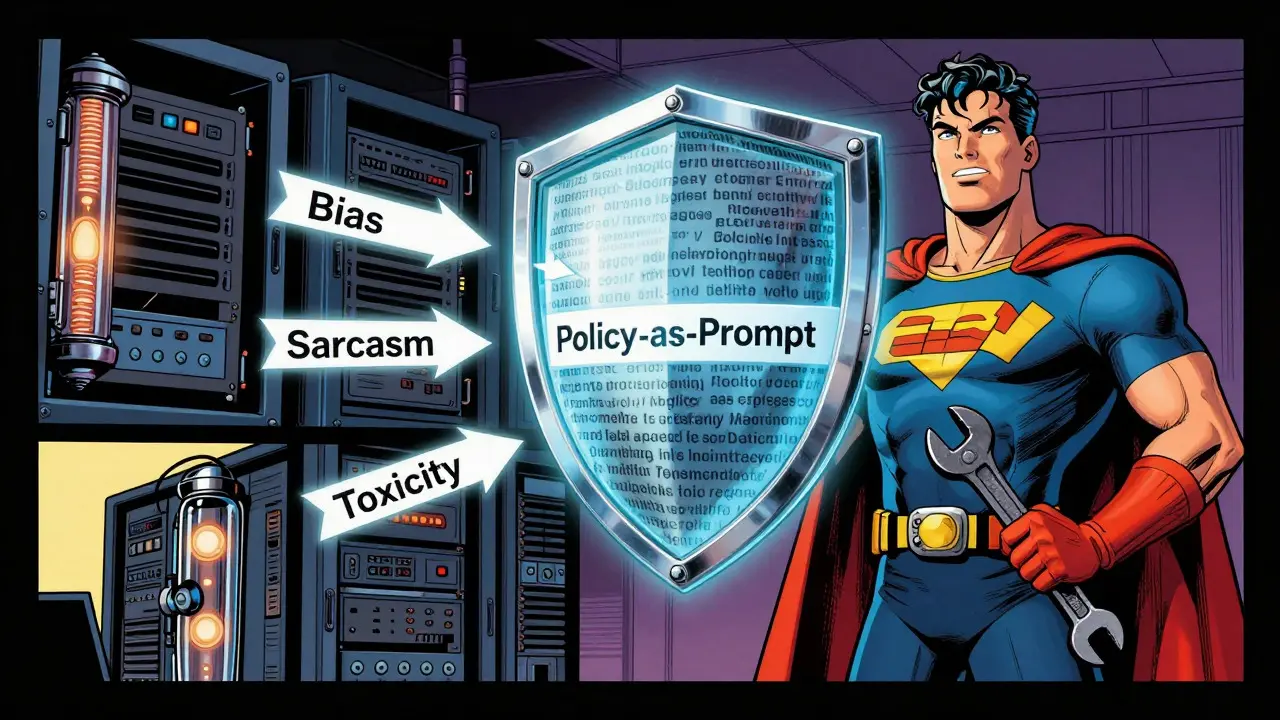
One of the biggest shifts in 2024 and 2025 was the rise of the policy-as-prompt paradigm. A method where content moderation rules are encoded directly into natural language instructions within the LLM's system prompt, rather than relying on rigid code or retrained models. Instead of training a separate model to detect "violence," you write a prompt that says:
"You are a content moderator. Review the following user input. Flag it if it contains graphic violence, hate speech based on protected characteristics, or actionable misinformation. Output JSON with 'flagged' boolean and 'reason' string."
Why is this huge? Speed and flexibility. In the past, updating a moderation policy meant collecting new data, labeling it, retraining a model, and deploying it-a process that took 2-3 months. With policy-as-prompt, Google researchers demonstrated that teams could update their moderation guidelines in under 15 minutes. When a new meme format becomes a vector for harassment, you tweak the prompt, not the codebase.
Meta’s research on LLAMA3 showed that general-purpose models with carefully crafted system prompts achieved 92.7% accuracy in classification tasks. This is comparable to specialized models like LLAMA Guard, which hit 94.1%, but with less operational overhead. You don’t need to maintain two different model infrastructures.
Choosing Your Tools: Specialized vs. General
You have options when it comes to the AI engine behind Stage 2. Here is how they compare:
| Approach | Accuracy | Latency | Cost | Flexibility |
|---|---|---|---|---|
| Traditional NLP | 62-90% | 15-25ms | Near Zero | Low (Code changes required) |
| Specialized Model (e.g., LLAMA Guard) | ~94% | 200-400ms | Medium | Medium (Retraining needed) |
| General LLM + Prompt | 88-93% | 300-500ms | High ($0.002/1k tokens) | Very High (Prompt tweaks) |
If you need absolute precision and have the budget for dedicated infrastructure, specialized models are great. But for most startups and mid-sized enterprises, the general LLM with policy-as-prompt offers the best balance. You can swap out the underlying model (from GPT-4 to Claude to LLAMA) with minimal friction.
Handling Edge Cases and Bias
No system is perfect. One major pitfall is bias. The arXiv paper on LLM moderation highlighted that certain demographic references trigger false positives at rates 3.7 times higher than neutral content. If your model was trained mostly on Western English data, it might flag cultural idioms or dialects as offensive.
To mitigate this, you need to augment your "golden datasets." This means curating examples of benign content that previously got flagged incorrectly and feeding them back into your prompt or fine-tuning set. Also, consider multilingual challenges. Performance drops by 15-22% for low-resource languages. If your app serves global users, implement language detection early in the pipeline and route non-English inputs to specific translation or localized moderation prompts.
Implementation Checklist
Ready to build? Here is a practical roadmap based on industry best practices from 2025-2026:
- Define Your Policy First: Before writing code, clearly define what constitutes a violation. Vague policies lead to vague prompts. Be specific: "No threats of physical harm" is better than "Be nice."
- Start with a Pre-Filter: Implement a lightweight NLP library (like spaCy or a custom regex list) to catch obvious spam and PII. This saves money.
- Select Your LLM Partner: Choose an API provider that offers robust safety features. Look for providers that support structured outputs (JSON mode) so your pipeline can parse decisions programmatically.
- Implement Logging: Log every decision made by the AI, especially edge cases. You will need this data for auditing and improving your prompts.
- Add Human Review Queue: Set up a dashboard for moderators to review AI-flagged content. Aim for a review rate of 10-15% initially to calibrate your system.
- Monitor Costs: LLM APIs charge per token. Monitor your usage closely. If costs spike, adjust your pre-filter to catch more noise before it hits the LLM.
Future-Proofing Your Pipeline
The landscape is moving fast. By 2026, Gartner predicts that 75% of major platforms will use hybrid systems. Regulatory pressures like the EU AI Act are forcing companies to adopt "appropriate technical solutions" for high-risk AI systems. Having a documented, auditable moderation pipeline isn't just good practice; it's becoming a legal requirement.
We are also seeing a shift toward platform-independent moderation layers. Imagine a universal "moderation API" that any service can plug into, similar to how payment processors work today. Until then, building your own flexible, hybrid pipeline gives you control over your brand's voice and safety standards.
Don't wait for a crisis to fix your filters. Start small, measure often, and remember: the goal isn't perfection. It's progress. Every blocked toxic comment makes your community safer.
What is the cost of using LLMs for content moderation?
The cost varies by provider, but a common estimate is around $0.002 per 1,000 tokens processed via API. However, using a hybrid approach where only 22% of traffic hits the LLM can reduce total costs by up to 63% compared to running all inputs through the AI.
How does 'policy-as-prompt' differ from traditional machine learning?
Traditional ML requires collecting data, labeling it, and retraining a model, which can take months. Policy-as-prompt allows you to update moderation rules by changing the natural language instructions in the system prompt, enabling updates in minutes without retraining.
Why do I need a hybrid moderation pipeline?
A hybrid pipeline balances speed, cost, and accuracy. Fast, cheap NLP filters handle obvious violations, while slower, more expensive LLMs handle complex, contextual cases. This prevents wasting resources on simple inputs while ensuring nuanced content is reviewed properly.
Can LLMs replace human moderators entirely?
Not yet. While LLMs achieve high accuracy (88-94%), they still make errors, especially with sarcasm, cultural nuances, and rare edge cases. A human-in-the-loop system is recommended for final decisions on contested content and for continuous feedback to improve the AI.
How do I handle multilingual content in my pipeline?
Performance drops by 15-22% for low-resource languages. Best practice involves adding a language detection step early in the pipeline. Route major languages to optimized prompts and consider translating low-resource language inputs to English for analysis, though this adds latency.
What is the typical latency of an LLM-based moderation check?
LLM-based moderation typically takes 300-500 milliseconds per request. This is significantly slower than traditional NLP filters (15-25ms), which is why hybrid architectures are preferred to keep average response times low for end-users.