
Standard benchmarks like MMLU or ARC-e are useless if your goal is to build an internal HR chatbot. They test whether a model knows the capital of Peru or can solve logic puzzles. They do not test whether the model can navigate your company’s specific policy on remote work without hallucinating.
This gap between academic evaluation and business reality is where most enterprise AI projects stumble. You pick a model that scores 90% on general knowledge, deploy it, and watch it fail at basic tasks because it doesn't understand your proprietary data structure or tone requirements. To fix this, you need to stop relying on public leaderboards and start building custom benchmarks tailored to your specific use cases.
Why General Benchmarks Fail in Business Contexts
The core problem is specificity. Public datasets focus on abstract reasoning or general trivia. Enterprise applications require specialized domain knowledge. When you ask a model to "locate the conference room for the Q3 planning meeting" or "draft a response to a customer complaint based on our refund policy," general benchmarks offer no insight into how well the model will perform.
Existing frameworks often assume static inputs and controlled environments. In the real world, enterprise contexts evolve daily. New regulations drop, product lines change, and organizational structures shift. A static dataset becomes outdated quickly. Furthermore, traditional metrics like BLEU or ROUGE scores measure surface-level text similarity. They award high marks to robotic, manual-like outputs while penalizing natural paraphrasing. If your goal is user satisfaction, these metrics are misleading.
| Metric Type | Focus Area | Enterprise Relevance |
|---|---|---|
| General Knowledge (e.g., MMLU) | Facts, Logic, Trivia | Low - Misses domain context |
| Surface Metrics (BLEU/ROUGE) | Text Overlap | Low - Ignores tone and nuance |
| Custom Enterprise Benchmark | Task Success, Compliance, Tone | High - Measures actual business value |
Defining Your Evaluation Dimensions
You cannot evaluate everything at once. You must break down your enterprise needs into measurable dimensions. Research from organizations like Moveworks identifies five essential themes: generation, reasoning, relevance, extraction, and classification.
- Generation: Can the model produce coherent, brand-aligned text? This includes checking for tone adherence and readability.
- Reasoning: Does the model follow multi-step instructions correctly? For example, calculating a discount based on tiered pricing rules.
- Relevance: Does the output directly address the user's intent without adding fluff?
- Extraction: Can the model pull specific entities (dates, names, amounts) from unstructured text accurately?
- Classification: Does it categorize inputs correctly, such as tagging support tickets by urgency?
Beyond these functional areas, you must include non-functional constraints. These include regulatory compliance, safety checks, and latency requirements. A model might be accurate but too slow for a real-time customer service bot. Another might be fast but prone to leaking sensitive PII (Personally Identifiable Information). Your benchmark must capture these trade-offs.
Building the Dataset: From Chaos to Structure
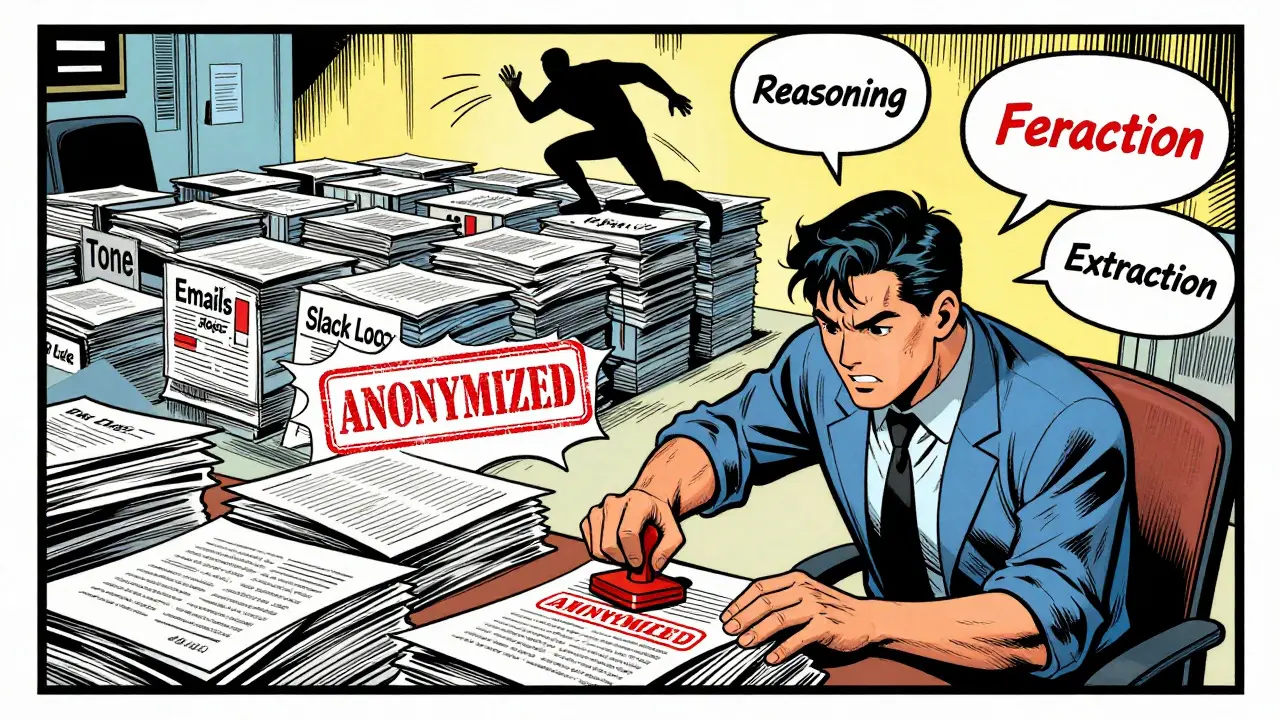
The foundation of any custom benchmark is high-quality data. You need to convert raw enterprise data into standardized instruction-input-output trios. Start by anonymizing real-world interactions. Pull email support tickets, Slack conversations, internal policy documents, and past customer queries.
Aim for diversity. A small set of 50 examples is not enough to detect edge cases. Industry best practices suggest creating between 200 and 1,000 custom examples for initial validation, scaling up to 1,000+ for robust production testing. These examples should cover:
- Happy Paths: Standard requests that the model should handle easily.
- Edge Cases: Ambiguous queries, typos, or incomplete information.
- Adversarial Inputs: Attempts to jailbreak the model or extract sensitive data (red teaming).
- Long-Context Scenarios: Queries requiring the model to process entire documents or long conversation histories.
For each input, define the ideal output. This is not just about correctness; it is about alignment with business goals. If your brand voice is professional yet empathetic, the gold-standard answer should reflect that. Involve domain experts-HR managers, legal counsel, or senior engineers-to score these outputs. Their judgment defines what "good" looks like in your organization.
Implementing LLM-as-a-Judge
Manual review scales poorly. Reading thousands of model outputs is tedious and expensive. This is where LLM-as-a-Judge comes in. You use a powerful, reliable large language model to evaluate the outputs of other models.
Instead of asking a human to read every response, you prompt a judge model with a rubric. For example: "Evaluate the following response for accuracy against the provided policy document. Check if the tone is professional. Score from 1 to 5." This approach allows you to assess nuanced criteria like helpfulness and brand voice at scale.
To ensure fairness, standardize your prompts. Use fixed parameters across all model evaluations to prevent spurious differences arising from implementation variations rather than fundamental capabilities. Tools like Galileo or open-source frameworks can help automate this process, integrating continuous benchmarking that re-evaluates models whenever you update your data or switch providers.
Technical Architecture and Integration
Your benchmarking framework must integrate seamlessly with your deployment pipeline. It should not be a one-time check but a continuous monitoring system. As your enterprise data changes, your benchmark must evolve.
Consider the role of Retrieval-Augmented Generation (RAG). Most enterprise apps rely on RAG to ground answers in verified internal data. Your benchmark must test the entire chain: retrieval accuracy plus generation quality. Did the model retrieve the right document? Did it synthesize the information correctly? Did it cite sources properly?
Evaluate flexibility metrics too. How well does the model adapt to new requirements via fine-tuning or prompt engineering? Test its compatibility with different context window sizes, especially for complex multi-step workflows. Assess tool-use capabilities, such as API chaining for booking meetings or updating CRM records. These technical dimensions determine whether the model can function as an autonomous agent within your ecosystem.

Measuring Business Impact
Ultimately, benchmarks must tie back to ROI. Technical accuracy means little if it doesn't drive business outcomes. Define success metrics early. Is it reduced ticket resolution time? Higher customer satisfaction scores? Lower operational costs through automation?
Compare models based on these holistic criteria. A smaller, fine-tuned model might outperform a massive general-purpose model on your specific tasks while costing significantly less in inference fees. Studies have shown that enterprise-specific tuning can enable smaller models to match the performance of larger counterparts on niche tasks. This optimization reduces computational overhead and accelerates response times.
Regularly audit your benchmark for drift. Usage patterns change. Users find new ways to break the system. Incorporate feedback loops where end-user ratings feed back into your test cases. This iterative approach ensures your evaluation remains relevant and rigorous.
Common Pitfalls to Avoid
Many teams make the mistake of treating benchmarking as a static project. They build a dataset once and never update it. This leads to overfitting, where the model performs well on tests but fails in production. Keep your dataset fresh. Rotate out old examples and add new ones reflecting current business realities.
Avoid relying solely on automated metrics. While LLM-as-a-Judge is efficient, it is not infallible. Periodically inject human review to catch subtle failures the judge model might miss. Also, beware of bias in your training data. If your historical data contains biased responses, your benchmark might inadvertently reward those biases. Conduct regular fairness audits.
Finally, don't ignore security. Ensure your benchmarking process handles sensitive data securely. Anonymize PII before using it in tests. Implement strict access controls. A breach during the evaluation phase can undermine trust in your entire AI initiative.
How many examples do I need for a custom enterprise benchmark?
Start with 200 to 1,000 diverse examples covering happy paths, edge cases, and adversarial inputs. For robust production testing, aim for 1,000+ examples to ensure comprehensive coverage of user scenarios and usage patterns.
What is LLM-as-a-Judge and why use it?
LLM-as-a-Judge uses a powerful language model to evaluate the outputs of other models based on predefined rubrics. It enables scalable assessment of nuanced criteria like tone, helpfulness, and brand compliance without the bottleneck of manual human review.
Can I use public benchmarks for enterprise applications?
Public benchmarks provide a baseline for general capabilities but lack enterprise specificity. They fail to test domain knowledge, proprietary data handling, and business-specific constraints. Use them for initial screening, but rely on custom benchmarks for final selection and monitoring.
How often should I update my custom benchmark?
Update your benchmark continuously. As business contexts, regulations, and user behaviors evolve, your test cases must reflect these changes. Regular updates prevent model drift and ensure ongoing alignment with organizational goals.
Does fine-tuning improve performance on custom benchmarks?
Yes. Fine-tuning on enterprise-specific data allows smaller models to achieve performance parity with larger general-purpose models on niche tasks. This optimization reduces computational costs while maintaining high accuracy on business-critical operations.