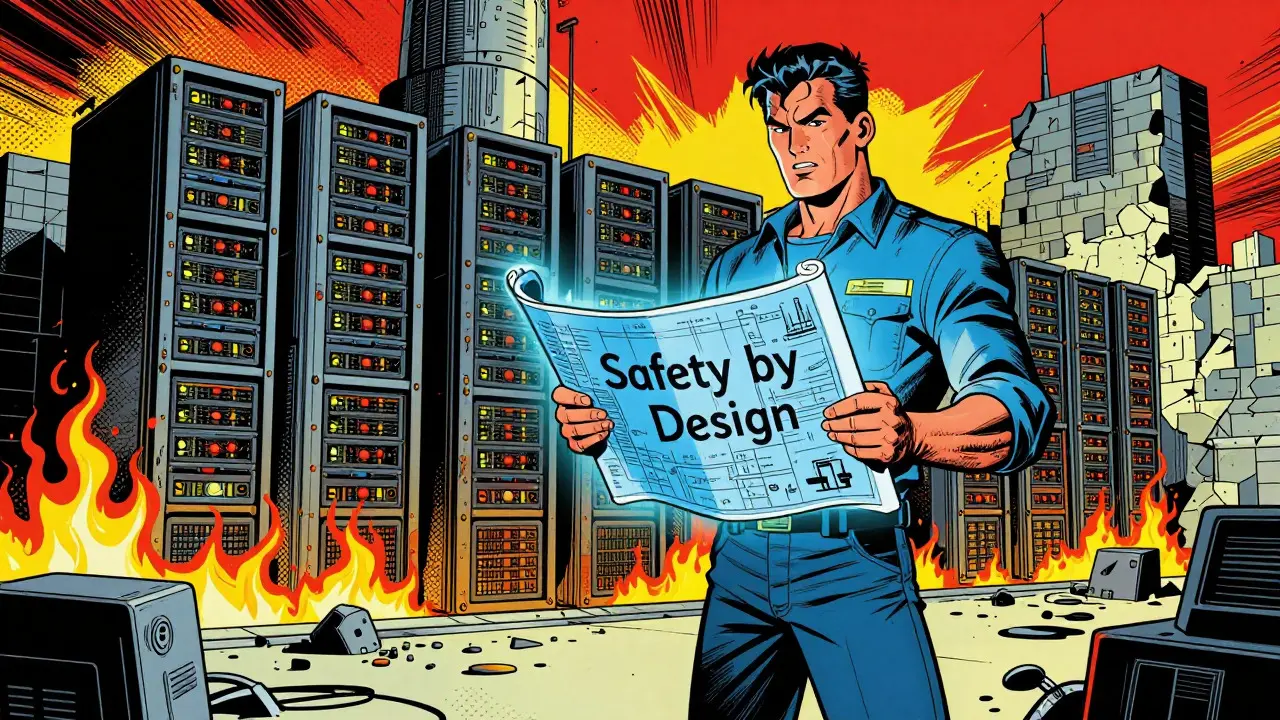
For years, the tech industry operated on a simple, dangerous mantra: build it fast, fix it later. We shipped features, saw what broke, and patched the holes as users complained. That approach worked for minor bugs. It is failing us completely when it comes to Safety by Design in generative AI.
We are no longer just talking about annoying spam or slight inaccuracies. We are facing a crisis where bad actors use large language models (LLMs) to create realistic deepfakes, scale harassment, and generate horrific content like child sexual abuse material (CSAM) at unprecedented speed. Reactive filters-the digital equivalent of a bouncer checking IDs at the door-are being bypassed daily. The only way to keep up is to change how we build these systems from the ground up.
This article breaks down what Safety by Design actually means, who is driving it, and how companies are embedding protections directly into the architecture of their AI products. If you are building, buying, or regulating AI, this is the new baseline for responsible technology.
What Is Safety by Design?
The core idea is simple but radical: if your technology can be misused to harm vulnerable people, especially children, you cannot wait until launch to address those risks. You must bake safety into every decision point, from data selection to model fine-tuning.
Think of it like building a house. Traditional safety is like installing a lock on the front door after the house is built. Safety by Design is like designing the walls to be fireproof and the windows to shatter-proof during the construction phase. It changes the physical properties of the system so that misuse is inherently difficult, not just discouraged.
This framework emerged because the cost of inaction-legal exposure, reputational ruin, and human suffering-far outweighs the upfront investment in safe engineering. It is not a single product you buy; it is a set of principles and standards that guide how AI is created.
The Three Stages of Implementation
Safety by Design isn't a one-time checklist. It covers the entire lifecycle of an AI model. Here is how it works in practice across three critical stages:
- Development: This is where the foundation is laid. Companies must scrub training datasets to remove CSAM and other harmful content. They implement "model biases" against exploitation content, meaning the model is trained to resist generating such outputs even when prompted. Crucially, teams conduct red teaming sessions specifically focused on child safety scenarios. If developers don't stress-test their models for abuse capabilities, bad actors will do it for them.
- Deployment: Once the model goes live, real-time protection kicks in. Systems monitor input prompts for suspicious patterns and scan outputs for harmful content before it reaches the user. Technical measures like watermarking and provenance tracking help authenticate content. User agreements explicitly require compliance with child safety standards.
- Maintenance: Threats evolve, so safety mechanisms must too. This stage involves ongoing vigilance, updating filters as new attack vectors emerge, and continuously re-evaluating the model's behavior against current safety benchmarks.
The key difference here is integration. Instead of relying on external filters that can be circumvented, safety becomes part of the model's "personality" and architecture.
Key Players and Standardization
You won't find Safety by Design in a vacuum. It is the result of intense collaboration between nonprofits, tech giants, and global standardization bodies.
Thorn, the organization behind the framework, has acted as the convener. They brought together major players like Google, OpenAI, Meta, and Stability AI to refine these principles. But they didn't stop there. To give these guidelines teeth, they partnered with two massive institutions:
- NIST (National Institute of Standards and Technology): Thorn worked closely with NIST to ensure their efforts align with comprehensive industry standards for reducing risks related to synthetic media. This gives the framework government-backed credibility.
- IEEE (Institute of Electrical and Electronics Engineers): Efforts are underway to establish an IEEE recommended practice based on Safety by Design principles. This ensures the global scientific community recognizes and adopts these standards.
This coalition matters. When the biggest AI labs and the world's leading technical standards bodies agree on a path forward, it signals that the window for voluntary, loose interpretations of safety is closing.

Why Reactive Filters Fail
Let’s look at why the old way doesn’t work anymore. Traditional content moderation is reactive. It detects harm after it has already been generated and seen. In the age of generative AI, this is like trying to bail out a sinking boat with a teaspoon while the hull is still leaking.
Bad actors are sophisticated. They use prompt injection, jailbreaking techniques, and subtle linguistic tricks to bypass keyword filters. A filter that blocks the word "abuse" might miss a coded phrase that means the same thing. By the time a human moderator reviews the flagged content, the damage is done.
Safety by Design addresses this by making the model itself resistant to misuse. Through techniques like reinforcement learning from human feedback (RLHF) focused on safety, the model learns to refuse harmful requests intrinsically. It reduces the operational burden of moderation because fewer harmful items slip through in the first place. It also provides stronger protection because architectural constraints are harder to hack than surface-level text filters.
Beyond Child Safety: Broader Implications
While the initial urgency around Safety by Design was driven by the need to combat CSAM, its principles apply to all high-stakes AI risks. McKinsey and other industry analysts note that implementing AI with both speed and safety requires "responsibility by design."
This includes addressing hallucinations, bias, and privacy leaks. For example, if a medical AI hallucinates a diagnosis, that is a safety failure. Embedding protections means creating guardrails that prevent the model from stating unverified medical facts with confidence. It means educating users that AI outputs are probabilistic, not absolute truths.
IBM research supports this broader view. Organizations using secure-by-design protocols report significant improvements in governance, risk, and compliance (GRC). Nearly 72% see better outcomes when security is embedded into the product lifecycle from day one. This concept extends to Machine Learning Security Operations (MLSecOps), which adapts traditional DevSecOps practices for the unique vulnerabilities of autonomous AI agents.

Challenges in Adoption
Implementing Safety by Design is not easy. It requires a cultural shift within tech companies. Leadership must embrace safety as a core commitment, not a compliance checkbox delegated solely to legal or security teams.
There are technical hurdles too. Scrubbing massive training datasets for nuanced harmful content is computationally expensive. Red teaming requires specialized expertise in psychology and sociology, not just code. And there is the tension between openness and control. Some argue that over-restricting models stifles creativity or innovation. However, the counter-argument is strong: public trust is the currency of AI adoption. Without trust, the technology stalls regardless of its capability.
As of early 2026, adoption is growing but uneven. While major players have signed on, smaller startups may struggle with the resources needed for rigorous safety testing. This creates a potential gap where less-resourced tools could become vectors for harm if they ignore these emerging standards.
Comparison: Traditional vs. Safety by Design
| Feature | Traditional Reactive Moderation | Safety by Design |
|---|---|---|
| Timing | Post-deployment (after harm occurs) | Pre-deployment (during development) |
| Method | External filters, keyword blocking, human review | Architectural constraints, dataset cleaning, model biasing |
| Efficacy Against Jailbreaks | Low (easily bypassed) | High (intrinsic resistance) |
| Operational Cost | High (constant monitoring required) | Lower long-term (fewer incidents to manage) |
| Primary Focus | Detection and removal | Prevention and resilience |
Next Steps for Organizations
If you are leading an AI initiative, here is how to start integrating these principles:
- Audit Your Data: Ensure your training sets are sourced responsibly and screened for harmful content using purpose-built detection tools.
- Expand Red Teaming: Don't just test for functionality. Hire experts to try and break your model's safety guards, focusing on edge cases involving vulnerable populations.
- Align with Standards: Review the latest NIST and IEEE guidelines. Use them as a benchmark for your internal policies.
- Train Your Team: Safety is everyone's job. Developers, designers, and product managers need to understand the ethical implications of their choices.
- Be Transparent: Communicate clearly with users about how safety is implemented. Transparency builds trust and helps users understand AI limitations.
The era of "move fast and break things" is over for generative AI. Now, we must move thoughtfully and protect things. Safety by Design is not just a regulatory hurdle; it is the foundation of sustainable, trustworthy AI.
Who developed the Safety by Design framework?
The framework was developed by Thorn, a technology nonprofit, in collaboration with major AI companies like Google, OpenAI, Meta, and Stability AI, as well as standardization bodies NIST and IEEE.
How does Safety by Design differ from traditional content moderation?
Traditional moderation is reactive, detecting and removing harmful content after it is generated. Safety by Design is proactive, embedding safety mechanisms into the model's architecture and training process to prevent harm before it occurs.
What role does NIST play in this framework?
NIST works with Thorn to integrate Safety by Design principles into comprehensive industry standards, providing government-backed credibility and guidance for reducing risks associated with generative AI and synthetic media.
Is Safety by Design only focused on child safety?
While the initial impetus was combating child sexual abuse material (CSAM), the principles apply broadly to other AI risks including hallucinations, bias, privacy violations, and misinformation, promoting overall responsible AI development.
What are the main challenges in implementing Safety by Design?
Challenges include the high computational cost of scrubbing large datasets, the need for specialized red-teaming expertise, cultural shifts within organizations to prioritize safety over speed, and resource constraints for smaller companies.
How does Safety by Design affect the cost of developing AI?
While upfront costs for data cleaning and safety testing increase, the long-term operational costs often decrease due to reduced need for extensive post-deployment moderation and lower risk of legal and reputational damage.




11 Comments
Savara Gunn
I've been quietly following the shift in how tech companies talk about safety, and this article really hits the nail on the head regarding the 'build it fast' mentality. It feels like we are finally moving past the hype cycle into something more grounded. The comparison to building a house with fireproof walls instead of just locking the door is so intuitive. I think many people overlook how much work goes into scrubbing datasets before training even starts. It's not glamorous work, but it seems essential for trust.
Tamara Miller
Oh, please. Another corporate PR piece disguised as an engineering breakthrough. They want you to believe that if they just "bake" safety in, everything will be fine. It never is. These companies have had decades to fix their algorithms and all they did was optimize for addiction. Now they expect us to trust them with child safety? Absolutely laughable. They profit from our data and now they want a medal for trying not to poison the well? Typical.
Anthony Miller
You're missing the point entirely. This isn't about PR. It's about liability. If your model generates CSAM, you go to jail. That's why NIST and IEEE are involved. It's not charity. It's survival. Wake up.
Tamara Miller
Jail? Please. They'll pay a fine that amounts to rounding error in their quarterly earnings. And then they'll hire another consultant to write a blog post about how committed they are to change. We've seen this movie before. It ends with us being poorer and more monitored. Stop letting them off the hook with buzzwords like "Safety by Design."
michelle veluz
It's a trap! They say "safety" but they mean "control." Who decides what is safe? The same elites who want to rewrite history? Once they embed these biases into the architecture, there is no going back. You can't even argue with the machine because it's "designed" to disagree with you. It's digital fascism wrapped in a pretty bow. WAKE UP PEOPLE!!!
john randall
The table comparing traditional moderation vs Safety by Design is actually quite clear. The operational cost argument makes sense too. Constantly hiring humans to review flagged content is expensive and traumatic for the reviewers. If the model itself refuses to generate harmful content, it saves money and reduces burnout. Seems like a win-win if implemented correctly.
Jacob Baby Official
Don't get too excited about "intrinsic resistance." Bad actors are already jailbreaking models with simple prompt injections. I've seen it happen with my own eyes. You think a few RLHF tweaks are going to stop a determined hacker? No. They'll just find a new way around it. The whole premise is flawed because it assumes the model is a static entity rather than a probabilistic engine waiting to be exploited. It's theater.
john randall
Maybe it's not perfect, but it's better than nothing. The article mentions that reactive filters are bypassed daily. So even if Safety by Design isn't bulletproof, raising the barrier to entry helps. Plus, watermarking and provenance tracking add another layer. It's about defense in depth, not a silver bullet.
Jeff Falcon
I think the biggest hurdle here is the cultural shift mentioned in the challenges section. Engineers are trained to move fast and break things. Asking them to slow down and consider ethical implications at every step of the pipeline is a massive mindset change. It requires leadership to genuinely care, not just check a box for compliance. If the CTO doesn't prioritize it, the junior devs won't either. It's top-down or it fails. Also, the computational cost of scrubbing datasets is no joke for smaller startups. This might create a two-tier system where only the giants can afford to be "safe."
Alyson Karson
YES! Finally someone said it! The startup gap is real and its scary. Big tech has the resources to do red teaming properly but small teams are left guessing. We need open source tools for dataset cleaning so everyone can play fair. Lets make AI safe for ALL of us not just the rich ones!!
Vishnu Vardhan Reddy M S
Oh sure, let's just trust the "open source community" to save us. Because clearly, the last time we relied on volunteer efforts for security, everything was peachy. Good luck with that.