
Imagine asking a colleague to organize a complex spreadsheet for a project they've never seen before. You have two choices: you can just tell them exactly what you want and hope they get it right, or you can show them three examples of how you've done it in the past. In the world of Artificial Intelligence, this is exactly how we interact with Large Language Models (LLMs). We call these two approaches zero-shot and few-shot learning.
For a long time, if you wanted a machine to recognize a specific pattern, you had to feed it thousands of labeled examples. This process, known as traditional supervised learning, was slow and expensive. LLMs changed the game by allowing us to trigger complex behaviors using nothing more than a well-written prompt. Whether you are building a healthcare diagnostic tool or a customer service bot, knowing when to provide examples and when to rely on the model's raw intuition can be the difference between a hallucination and a perfect answer.
The Basics of Zero-Shot Learning
Zero-Shot Learning is the ability of an AI to complete a task without having seen any specific examples of that task during the current session. It relies entirely on the model's pre-training-the massive amount of data it digested during its initial creation-and its ability to follow instructions.
Think of this as the "just do it" approach. You give the model a command, and it uses its internal knowledge to generalize a solution. For instance, if you ask an LLM to translate a sentence from English to French, it doesn't need you to show it five English-French pairs first; it already knows the relationship between the two languages.
The power of zero-shot is most evident in general tasks. Some models are incredibly precise here. In specialized testing, Flan-T5 demonstrated a precision of 0.94 and a specificity of 0.95 in certain zero-shot evaluations. This means that for many standard tasks, the model is already "smart enough" to handle the request without a cheat sheet.
Scaling Up with Few-Shot Learning
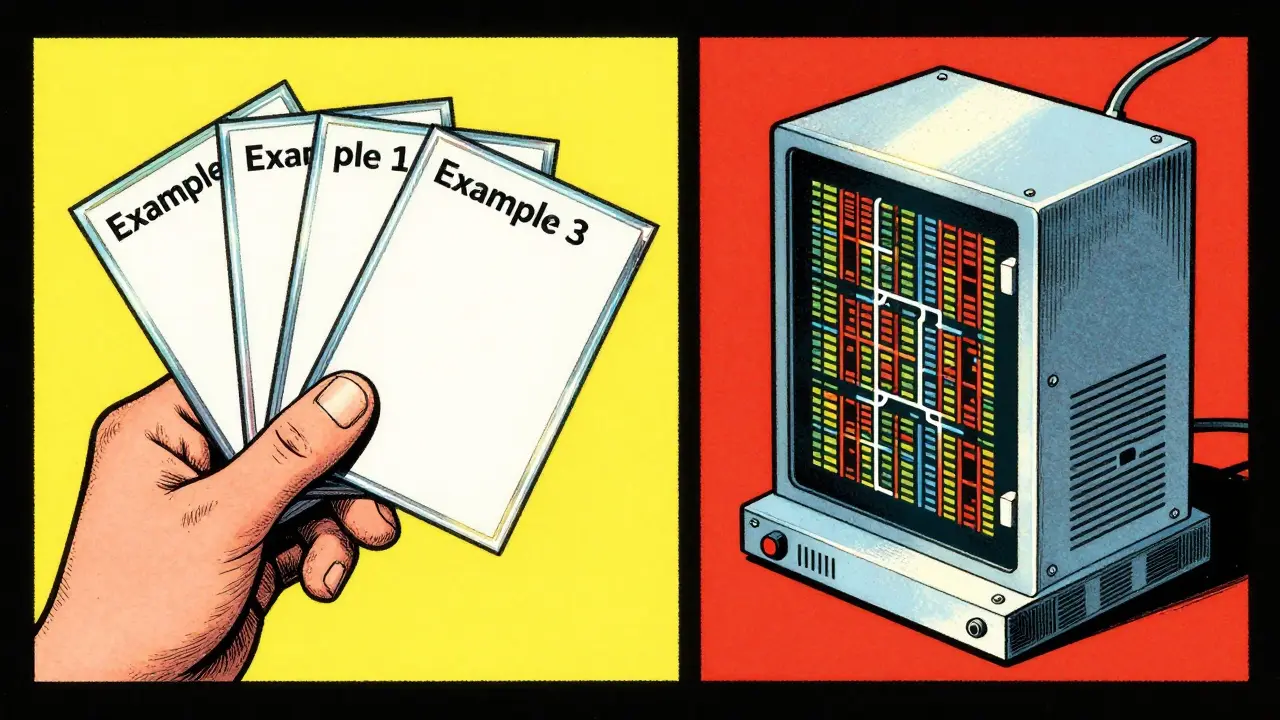
Sometimes, a simple instruction isn't enough. This is where Few-Shot Learning comes in. Instead of just a command, you provide the model with a few high-quality examples (typically between 2 and 10) to show it the exact format, tone, or logic you expect. This is often referred to as "in-context learning."
Few-shot learning is a lifesaver when you need the model to adhere to a very specific brand voice or a complex data format. If you want an AI to extract medical data into a very specific JSON schema, showing it three perfect examples of that extraction is far more effective than writing a five-paragraph instruction manual on how to format the code.
The impact here is concrete. In healthcare settings, organizations have used few-shot prompting to cut the development time of diagnostic tools by 40%. By providing just a handful of rare disease cases as examples, they saw early diagnosis rates climb by 30%. The examples act as a bridge, guiding the model toward the narrow, specialized knowledge required for the task.
Zero-Shot vs Few-Shot: Which One Should You Pick?
Choosing between these two isn't about which one is "better" in a vacuum, but which one fits your specific constraints. You have to balance speed, accuracy, and the availability of data.
| Feature | Zero-Shot Learning | Few-Shot Learning |
|---|---|---|
| Setup Speed | Instant (No examples needed) | Slower (Requires curation of examples) |
| Data Requirement | None | Small set (2-10 examples) |
| Best Use Case | General tasks, rapid prototyping | Domain-specific, high-precision tasks |
| Consistency | Variable | High (follows provided patterns) |
| Risk Tolerance | Moderate (requires human oversight) | Low (more predictable outputs) |
If you are in a rush and the task is broad-like summarizing a news article-go with zero-shot. But if you are dealing with regulatory requirements or a narrow industry niche, the small investment of time needed to find five great examples for few-shot prompting will pay off in significantly higher accuracy.
Real-World Performance and Limitations
It is a mistake to assume that LLMs can do everything perfectly without training. While they approach the performance of state-of-the-art models in question-answering, they often struggle with highly technical classification and relation extraction. For example, in the biomedical field, general-purpose models often perform worse than PubMedBERT, which was specifically trained on medical literature.
However, the gap is closing. Research has shown that some instruction-tuned models can achieve a 78.5% accuracy rate in identifying factors affecting drug clinical exposure without any fine-tuning. This is a huge win for researchers who don't have the thousands of labeled samples traditionally required for neural networks.
We also see this in the rise of open-source models. Tools like Llama-3-8B-Instruct and Mistral-7B-Instruct allow companies to deploy these capabilities on local networks. This eliminates the risk of sending sensitive data to a cloud provider while still leveraging the few-shot ability to handle tasks like claim matching or binary classification.
A Practical Framework for Implementation
When you're sitting down to build a prompt, follow this simple decision tree to decide your approach:
- Can the model do it? Try a zero-shot prompt first. If the response is correct and the format is right, stop there.
- Is it almost there but slightly off? If the model understands the task but fails on the formatting or tone, move to few-shot. Pick 3-5 diverse examples that cover the edge cases the model is missing.
- Is the data variety too high? If the model fails because the input data is too varied, increase your few-shot examples to 10, ensuring each example represents a different "type" of input.
- Is the error rate still too high for a critical task? If few-shot isn't hitting the 95%+ accuracy mark and the task is high-risk (like medical or legal work), you may need to move beyond prompting and into fine-tuning or a RAG (Retrieval-Augmented Generation) pipeline.
One pro tip: when doing few-shot prompting, the order of your examples matters. Models sometimes suffer from "recency bias," where they weigh the last example more heavily than the first. To fight this, shuffle your examples or ensure the most representative one is at the end.
What is the main difference between zero-shot and few-shot learning?
Zero-shot learning is when the model performs a task based only on instructions, without any prior examples. Few-shot learning is when you provide the model with a small number of examples (usually 2-10) to guide its behavior and output format.
Do I always need examples to get a good result?
No. For general tasks like summarization, translation, or brainstorming, zero-shot is often sufficient. Examples are primarily needed when you have a very specific output format, a niche domain, or a need for high consistency.
How many examples are typically enough for few-shot learning?
Most practitioners find that 2 to 10 examples are sufficient. Adding too many examples can sometimes confuse the model or exceed the context window, while too few might not capture the necessary variation in the data.
Can few-shot learning replace traditional model training?
In many cases, yes, especially for rapid prototyping or tasks where labeled data is scarce. However, for extremely specialized tasks (like deep medical relation extraction), a dedicated model like PubMedBERT still often outperforms few-shot LLMs.
Is zero-shot learning risky for enterprise use?
It can be if the task is critical. Zero-shot has a higher chance of inconsistency. For enterprise deployment, zero-shot is best used with a "human-in-the-loop" system where a person reviews the output before it is finalized.
Next Steps and Troubleshooting
If you've tried few-shot prompting and the model is still struggling, check your examples. Are they too similar? If all your examples follow the same pattern, the model might overfit to that specific pattern and fail when it sees something slightly different. Try to pick examples that represent the full spectrum of what the model will encounter in the real world.
For those in highly regulated industries, consider deploying open-source models on your own hardware. This allows you to experiment with few-shot prompting without risking data leakage to third-party API providers. If the accuracy still isn't where it needs to be, the logical next step is exploring Parameter-Efficient Fine-Tuning (PEFT), which allows you to update the model's weights on a specific dataset without the massive cost of a full training run.




8 Comments
Jane San Miguel
The distinction between in-context learning and traditional fine-tuning is handled with a certain lack of nuance here, though the general premise remains acceptable for a lay audience. One must realize that the efficacy of few-shot prompting is intrinsically tied to the quality of the curated exemplars, a point that is touched upon but not sufficiently emphasized as a rigorous requirement for professional deployment.
Jeroen Post
all this talk about patterns and examples is just a veil for the fact that they are building digital prisons for our thoughts and training the machine to mimic human consciousness so they can eventually replace the need for actual thought entirely its just a loop of mirrors man
Dave Sumner Smith
You're blindly trusting these "open source" models like Llama and Mistral but you forget that the base weights are still proprietary secrets controlled by a handful of corporations who decide what the model is allowed to "know" and what it should ignore to keep us in line while you're busy worrying about JSON schemas the real architecture of control is being baked into the tokens themselves
Honey Jonson
love the way u broke this down!! makes it so much easier to grasp for people who aint tech wizards
Paul Timms
The advice regarding the order of examples to avoid recency bias is a very practical addition to the guide.
Kasey Drymalla
totally a scam the 40 percent drop in time is fake news probably just some marketing fluff to get us to buy more gpu credits while they steal our data anyway
Bob Buthune
I spent my entire weekend trying to implement this exact logic for a project that eventually failed because my boss didn't understand the concept of hallucinations and he just kept blaming the tool while I felt the weight of the world on my shoulders 😩 it's just so draining to explain that a model can't just "know" everything without a bit of guidance and then I have to deal with the emotional fallout of a crashed deadline 📉💔 honestly the struggle of balancing the context window while trying to maintain a semblance of sanity in a corporate environment is just a nightmare that never ends 🌪️
Cait Sporleder
The conceptual dichotomy presented between zero-shot and few-shot paradigms is quite illuminating, particularly the assertion that a mere handful of high-fidelity examples can act as a cognitive bridge for the model. It is profoundly fascinating to consider how the strategic curation of a minuscule dataset can catalyze such a dramatic increase in diagnostic accuracy within the biomedical sphere, transforming a generalized linguistic engine into a precision instrument of scientific inquiry. One cannot help but marvel at the alchemy of prompt engineering, where the subtle juxtaposition of examples orchestrates a sophisticated emergence of pattern recognition that mimics the intuition of a seasoned practitioner. The mention of recency bias further adds a layer of psychological complexity to the interaction, suggesting that these silicon entities exhibit behavioral quirks strikingly similar to the cognitive limitations of the human mind. Such an intricate dance between human guidance and machine inference paints a vivid picture of the future of intellectual labor, where the art lies not in the execution of the task, but in the masterful orchestration of the instructions provided. This synergy is truly a kaleidoscopic display of modern computational capability, weaving together the threads of massive pre-training and surgical in-context guidance to achieve outcomes that were previously deemed impossible without exhaustive supervised learning. It is an exquisite evolution of the symbiotic relationship between man and machine, elevating the act of prompting to a veritable craft of linguistic precision.