You’ve probably been there. You open a file to fix a tiny bug, but the logic is so tangled that you spend two hours just trying to figure out what the code actually does. Or worse, you change one line in Module A, and suddenly three unrelated features in Module B break because they were secretly dependent on each other. This isn’t just bad luck; it’s a measurable failure of software maintainability. While many teams rely on old-school metrics like cyclomatic complexity, modern engineering demands a more nuanced approach. We need to measure how hard code is to read (cognitive load) and how tightly connected modules are (coupling). If you’re serious about reducing technical debt, you need to understand these two pillars.
The Flaw in Traditional Complexity Metrics
For decades, developers relied on McCabe’s Cyclomatic Complexity, introduced in the 1970s. It counts the number of independent paths through a program. The logic was sound for its time: more paths mean more unit tests required. But here’s the problem-it doesn’t care if those paths are easy or hard to follow. A method with ten flat `if` statements has the same cyclomatic score as one with deeply nested loops and conditions. Yet, we all know the nested version is a nightmare to debug. Cyclomatic complexity measures testability, not readability. It treats a simple switch statement and a complex nested structure as equally "complex," which feels wrong when you’re staring at the screen at 2 AM.
This gap led SonarSource to introduce Cognitive Complexity around 2017-2018. Unlike McCabe’s metric, this one is designed specifically to approximate human mental effort. It doesn’t just count branches; it penalizes them based on how difficult they are to track mentally. In early internal validations, 77% of surveyed developers agreed that this metric reflected their actual perception of code difficulty. That’s a huge signal. It means the math aligns with the gut feeling engineers have when they look at messy code.
How Cognitive Complexity Actually Works
So, how do you calculate it? It’s not magic; it’s a set of rules that mimic how our brains process logic. The algorithm starts every function at zero and adds points for specific structures. Here is the breakdown:
- +1 point for each control flow break (like `if`, `else`, `while`, `for`).
- +1 additional point for each level of nesting. This is key. Nested code forces your brain to hold context in memory while evaluating inner conditions. Deeper nesting equals higher cognitive cost.
- +1 point for sequences of logical operators in complex boolean expressions (e.g., `A && B || C`).
- Recursion penalties apply where applicable.
Notice the difference from cyclomatic complexity? A `switch` statement usually gets a fixed cost of 1 in Cognitive Complexity, regardless of how many cases it has, because reading a switch is straightforward. But an `if-else-if` chain? Each step adds up. And crucially, nesting hurts. A method with a Cognitive Complexity score above 15 (or 25 for C-family languages) is generally considered a red flag. SonarQube and SonarCloud use these thresholds by default. When you see a score of 30+, you’re looking at code that requires significant mental bandwidth to understand.
| Feature | Cyclomatic Complexity | Cognitive Complexity |
|---|---|---|
| Primary Goal | Testability (path coverage) | Understandability (mental effort) |
| Nesting Impact | Low impact (counts paths only) | High impact (+1 per nesting level) |
| Switch Statements | Counts each case label | Fixed cost (usually +1 total) |
| Logical Operators | Ignored | Adds points for complex sequences |
| Typical Threshold | 10 | 15 (Java/JS), 25 (C++) |
Coupling: The Hidden Risk Multiplier
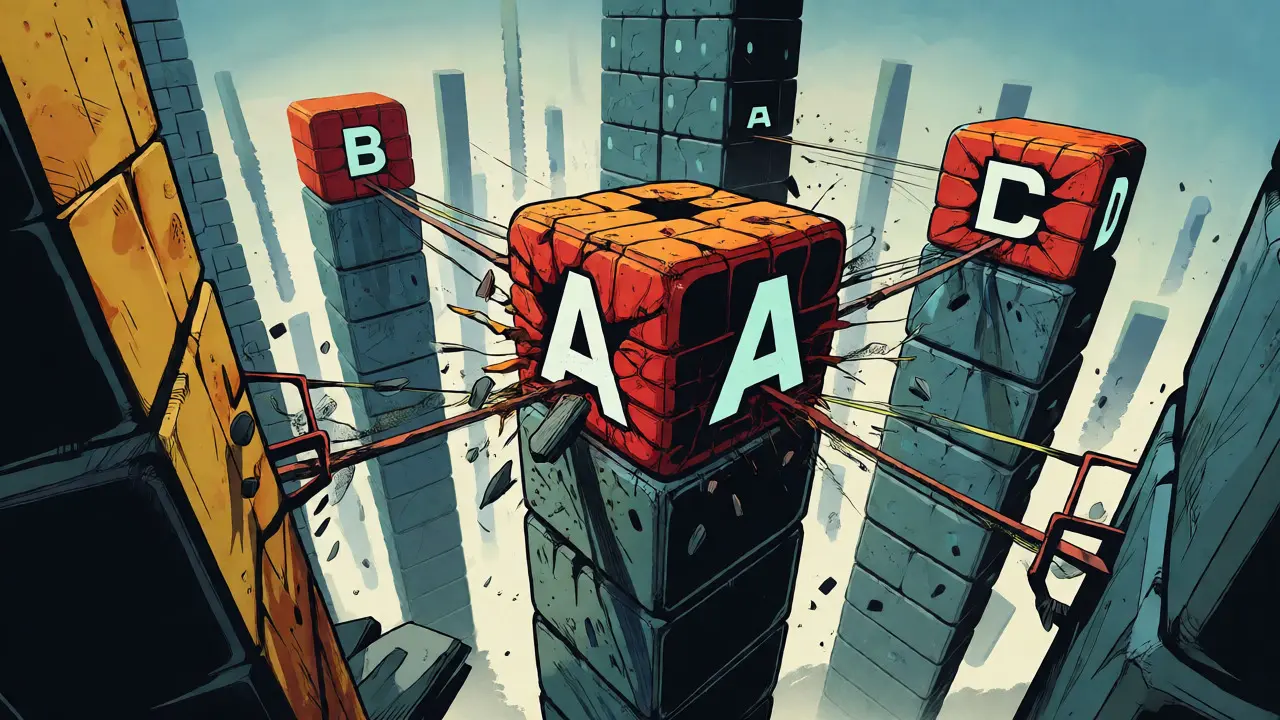
Understanding a single function is half the battle. The other half is understanding how that function interacts with the rest of the system. This is where coupling metrics come in. Coupling measures the degree of interdependence between software modules. High coupling means that changing one part of the system ripples through others, increasing the risk of bugs and the cost of maintenance.
The most common way to measure this is through Fan-In and Fan-Out. Fan-In is the number of other modules that call a given component. High Fan-In means many things depend on you; if you break, everyone breaks. Fan-Out is the number of modules that a component calls. High Fan-Out means you depend on many others; if they change, you might break.
To get a holistic view, engineers often use the Information Flow Index (IF). The formula is simple but brutal: IF(A) = [FAN-IN(A) × FAN-OUT(A)]². Because it squares the product, this metric grows quadratically. A module with moderate dependencies can quickly become a critical hot spot. For example, if a function has a Fan-In of 4 and a Fan-Out of 5, its IF score is $(4 \times 5)^2 = 400$. That’s a massive number compared to a module with low coupling. These high-IF components are prime candidates for refactoring because they sit at the intersection of incoming requests and outgoing dependencies.
Combining the Two for Real Insights
Why bother measuring both? Because they tell different stories. Cognitive Complexity tells you if a function is hard to read. Coupling tells you if a function is dangerous to change.
Imagine a utility function with a Cognitive Complexity of 5 (very readable) but a Fan-In of 50 (used everywhere). It’s safe to change only if you have rigorous tests, but it’s not inherently confusing. Now imagine a business logic function with a Cognitive Complexity of 25 (hard to read) and a Fan-Out of 10 (calls many services). This is a ticking time bomb. It’s hard to understand, and changes propagate widely. These are your "maintenance hot spots."
Research supports this combined approach. A 2023 study in the *Journal of Systems and Software* found that while Cognitive Complexity alone didn’t significantly outperform traditional metrics in predicting defects, combining it with structural metrics provided a clearer picture of risk. Practitioners report that using both allows them to prioritize refactoring efforts more effectively. Instead of fixing everything, you focus on code that is both internally complex and externally critical.

Practical Implementation Strategies
Don’t just add these metrics to a dashboard and ignore them. Integrate them into your workflow. Start small. Enable SonarQube Community Edition (it’s free) or similar tools in your CI/CD pipeline. Set strict thresholds for new code. Allow legacy code to remain messy for now, but enforce a rule: no new pull request can merge if it introduces a function with Cognitive Complexity > 15.
Here is a checklist for implementation:
- Set Function-Level Rules: Don’t use project-level quality gates for Cognitive Complexity. They aggregate data and hide individual offenders. Enforce rules per method.
- Monitor Fan-Out Trends: Use a rule of thumb. Optimal Fan-Out is often cited as "seven, plus or minus two" (based on Miller’s Law). If a module directly calls more than 9 submodules, flag it for design review.
- Visualize Call Graphs: Static analysis tools can generate call graphs. Look for nodes with high centrality (high Fan-In/Fan-Out). These are your architectural bottlenecks.
- Iterate on Thresholds: Default thresholds (15/25) are starting points. If your team consistently passes 15 but struggles with 20, adjust the gate. Make it realistic.
Remember, metrics are guides, not laws. A Cognitive Complexity of 16 isn’t evil; it’s a prompt to ask, "Can we simplify this?" A high Information Flow Index isn’t a failure; it’s a warning to proceed with caution during refactoring.
Frequently Asked Questions
Is Cognitive Complexity better than Cyclomatic Complexity?
It depends on your goal. If you want to estimate the number of unit tests needed, stick with Cyclomatic Complexity. If you want to improve code readability and reduce the mental burden on developers, Cognitive Complexity is superior because it penalizes nesting and complex control flows that humans find difficult to track.
What is a good threshold for Cognitive Complexity?
The industry standard defaults are 15 for most languages (like Java, JavaScript, Python) and 25 for C-family languages (C++, C#). However, these should be treated as guidelines. Teams often start with higher limits for legacy code and gradually lower them as they refactor.
How does high coupling affect maintainability?
High coupling increases the blast radius of changes. If a module has high Fan-In, breaking it affects many consumers. If it has high Fan-Out, it is fragile because it depends on many external factors. Both scenarios make the system harder to modify safely, requiring more regression testing and coordination.
Can I automate the enforcement of these metrics?
Yes. Tools like SonarQube, SonarLint, and various linters support Cognitive Complexity checks. You can configure your CI/CD pipeline to fail builds if new code exceeds defined thresholds for complexity or coupling metrics, ensuring that technical debt doesn't accumulate silently.
What is the Information Flow Index?
The Information Flow Index (IF) is a coupling metric calculated as $[FanIn \times FanOut]^2$. It highlights modules that are central to the system's architecture. High IF values indicate components that are both heavily used and highly dependent on others, making them critical points for stability and performance monitoring.